33
ACCESSORIES
ROLLER STOCK CONVEYORS
1. Your machine may be equipped with one of the fol-
lowing roller stock conveyors for moving long stock
into cutting position (or as an unloading adjunct).
The following conveyors are available:
• Stock conveyor ve (5) feet (1524.0 mm) long by
14 inches (355.6 mm) wide with a weight capacity
of 750 pounds (340.2 kg) per roller.
• Stock conveyor ten (10) feet (3048.0 mm) long by
14 inches (355.6 mm) wide with a weight capacity
of 750 pounds (340.2 kg) per roller.
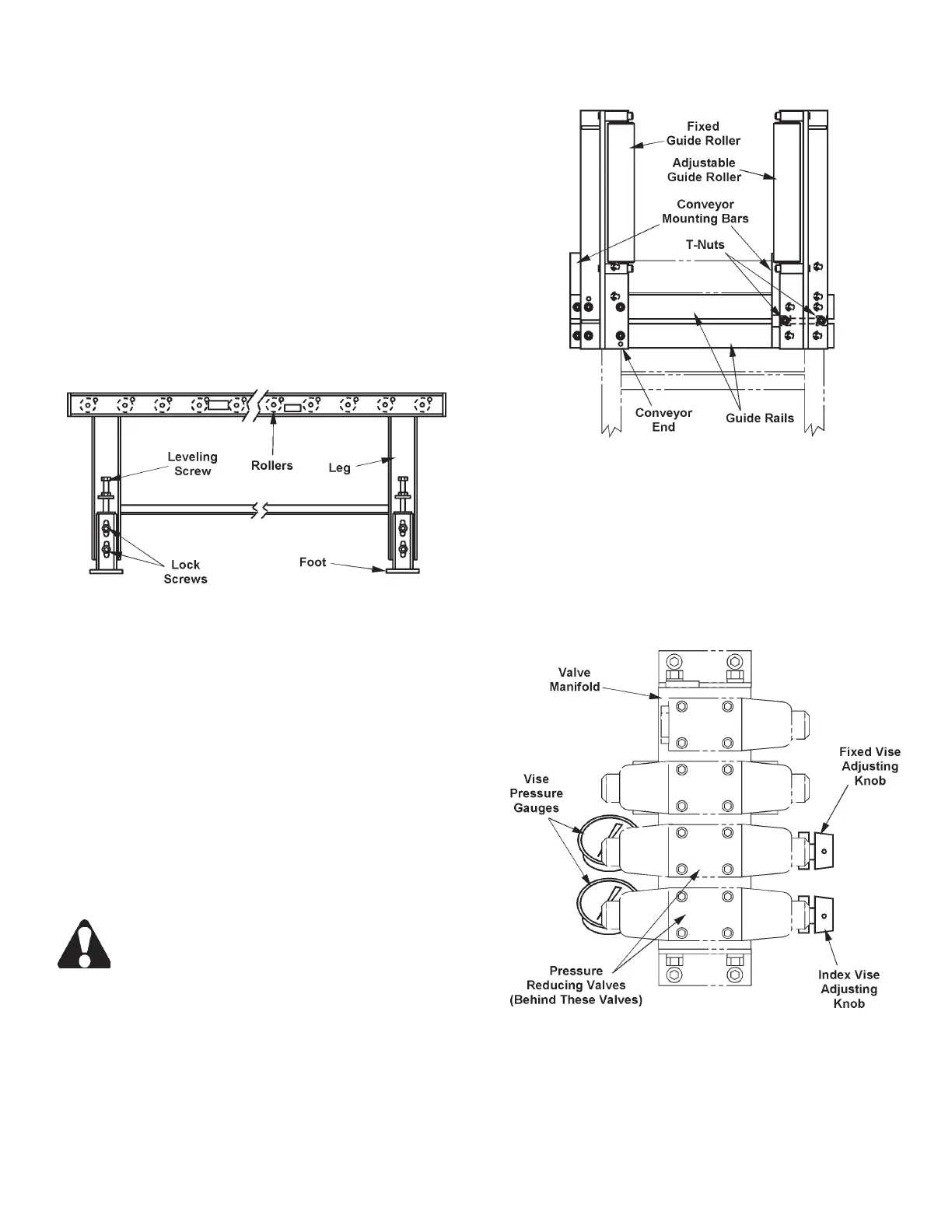
Roller Stock Conveyor.
2. To install a roller stock conveyor: (a) Position the
assembled conveyor(s) behind or in front of the
machine base; (b) Adjust the conveyor to the ma-
chine with the leveling screws on the conveyor legs.
The top of the front conveyor roller should be inline
to 0.010-inch (0.25 mm) above the vise bed wear
plate.
3. The remaining rollers must be parallel to, and in the
same plane with the vise beds to within 0.010-inch
(0.25 mm) per 24 inches (609.6 mm) of travel.
4. Depress the roller shafts for ease of installation or
removal of rollers.
The conveyor DOES NOT attach to the machine
base.Anchortheconveyortotheoorafter
all leveling and adjustments are made.
VERTICAL GUIDE ROLLERS (Conveyors)
1. Vertical guide rollers are effectively used to help
maintain correct positioning of long stock on the
conveyor.
2. These can be installed between the interface plate
and conveyor or between conveyors (if more than
one is supplied).
Vertical Guide Roller for Conveyors.
VARIABLE VISE PRESSURE
1. The Variable Vise Pressure control valve is used to
adjust vise clamping force against materials which
cannot tolerate full vise clamping pressure (examples
are thin-walled tubing, pipe,light structurals, etc.).
This control can be used with or without the optional
Nesting Fixture.
Variable Vise Pressure.
2. The controls for variable vise pressure are located
in the valve manifold. Clamping pressure is set by
loosening the locknut and turn the adjustment knob
until the desired pressure is shown by the indicator
gauge. The lower the number, the lighter the pres-
sure and vice versa.



 To Next Page