MAINTENANCE
24
7/71, 12/56
Inspect the safety shutdown system switches and the instrument
panel relay contacts for evidence of arcing and pitting. Clean where
necessary.
Check the mechanical action of the components.
Check the security of electrical terminals on the switches and relays
i.e. nuts or screws loose, which may cause local hot spot oxidation.
Inspect the components and wiring for signs of overheating i.e.
discolouration, charring of cables, deformation of parts, acrid smells
and blistered paint.
BATTERY
Keep the battery terminals and cable clamps clean and lightly
coated with petroleum jelly to prevent corrosion.
The retaining clamp should be kept tight enough to prevent the
battery from moving.
PRESSURE SYSTEM
At 500 hour intervals it is necessary to inspect the external surfaces
of the system (from the airend through to the discharge valve(s))
including hoses, tubes, tube fittings and the separator tank, for visible
signs of impact damage, excessive corrosion, abrasion, tightness and
chafing. Any suspect parts should be replaced before the machine is
put back into service.
TYRES/TYRE PRESSURE
See the GENERAL INFORMATION section of this manual.
RUNNING GEAR/WHEELS
Check the wheel nut torque 20 miles (30 kilometres) after refitting
the wheels. Refer to the TORQUE SETTING TABLE later in this
section.
Lifting jacks should only be used under the axle.
The bolts securing the running gear to the chassis should be
checked periodically for tightness (refer to the
SERVICE/MAINTENANCE CHART for frequency) and re−tightened
where necessary. Refer to the TORQUE SETTING TABLE later in this
section.
BRAKES
Check and adjust the brake linkage at 500 miles (850Km) then
every 3000 miles (5000Km) or 3 months (whichever is the sooner) to
compensate for any stretch of the adjustable cables. Check and adjust
the wheel brakes to compensate for wear.
ADJUSTING THE OVERRUN BRAKING SYSTEM
1: Preparation
Jack up the machine
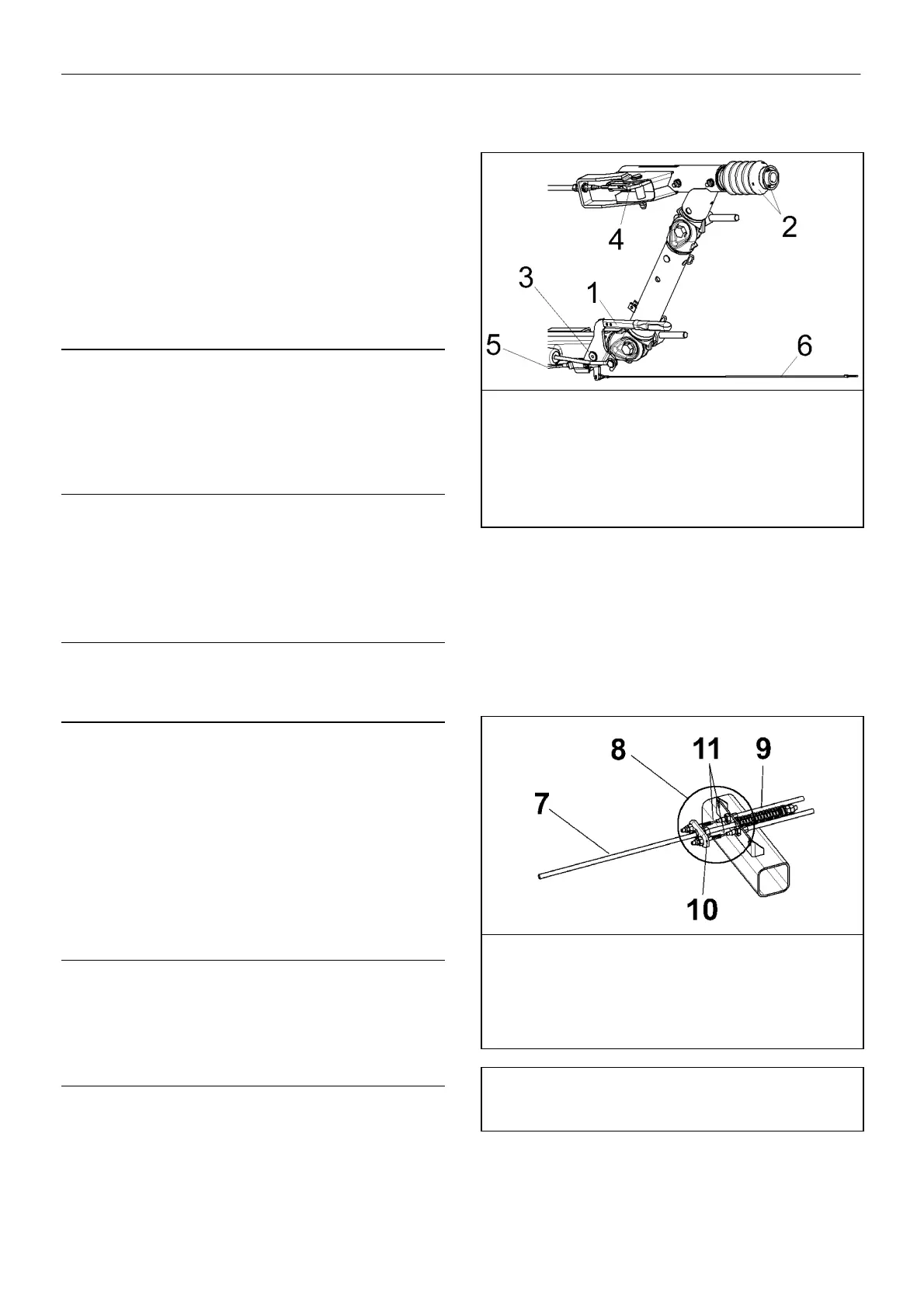
Disengage the handbrake lever [1].
Fully extend the draw bar [2] on the overrun braking system.
1 Handbrake lever
2 Draw bar and bellows
3 Handbrake lever pivot
4 Transmission lever
5 Brake cable
6 Breakaway Cable
Requirements:
During the adjustment procedure always start with the wheel brakes.
Always rotate the wheel in the direction of forward movement.
Ensure that an M10 safety screw is fitted to the handbrake pivot.
The brake actuators must not be pre−tensioned − if necessary loosen
the brake linkage [7] on the brake equalisation assembly [8].
Check that brake actuators and cables [11] operate smoothly.
7 Brake linkage
8 Equalisation assembly
9 Compression spring
10 Equaliser plate
11 Cable
CAUTION
The compression spring [9] must only be lightly pre−tensioned and
when operating must never touch the axle tube.
Never adjust the brakes at the brake linkage [7].



 To Next Page