MAINTENANCE
25
7/71, 12/56
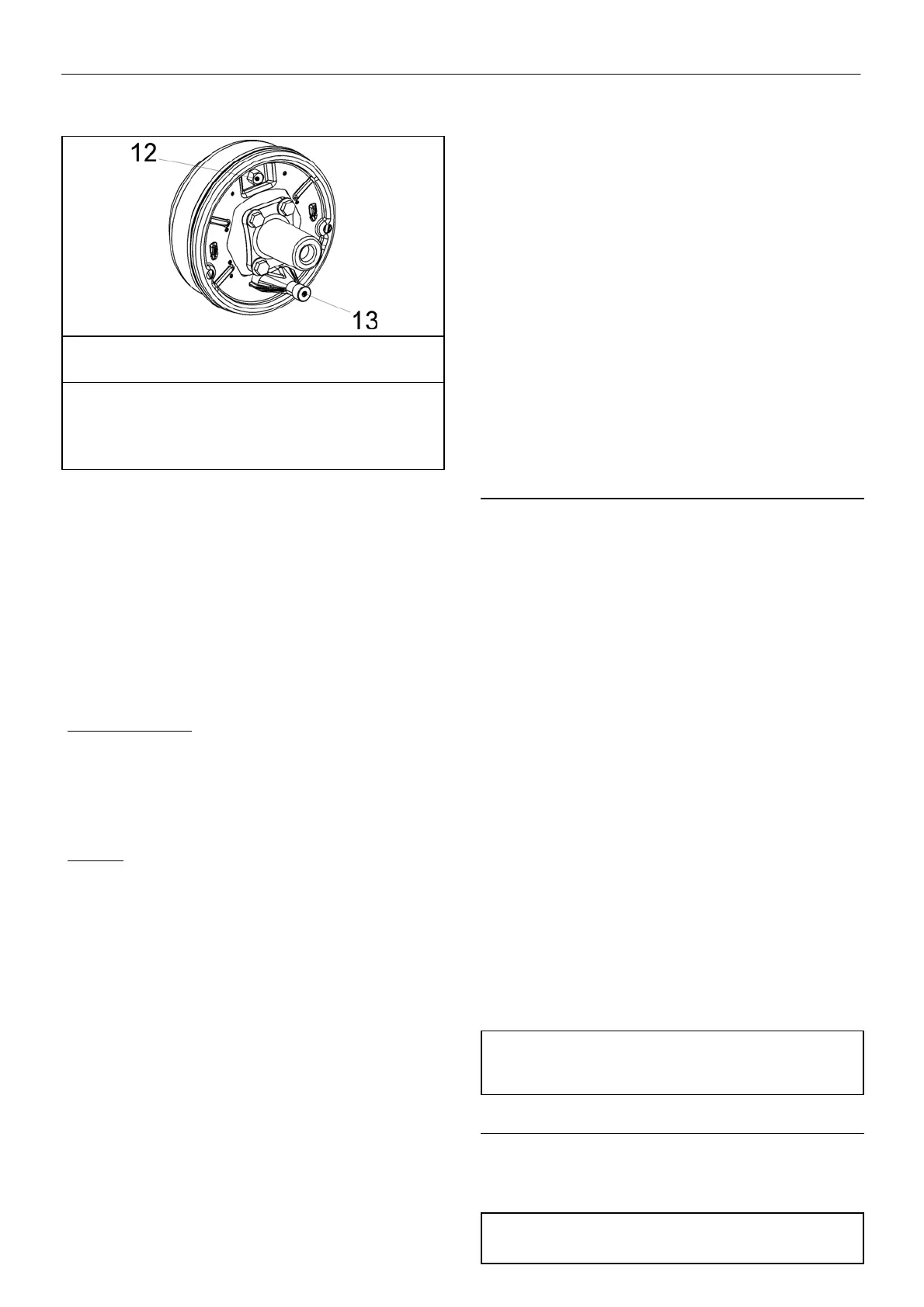
2. Brake Shoe Adjustment
12 Adjusting screw
13 Cable entry
Width across flats of adjusting screw [12]
Brake size Key width
160x35 / 200x50 SW 17
250x40 SW 19
300x60 SW 22
Tighten adjusting screw [12] clockwise until the wheel locks.
Loosen adjusting screw [12] anti−clockwise (approx. ½ turn) until the
wheel can be moved freely.
Slight dragging noises that do not impede the free movement of the
wheel are permissible.
This adjustment procedure must be carried out as described on both
wheel brakes.
When the brake has been adjusted accurately the actuating distance
is approximately 5−8mm on the cable [11]
3: Compensator assembly adjustment
Variable Height models
Fit an M10 safety screw to the handbrake pivot.
Disconnect the handbrake cable [5] at one end.
Pre−adjust brake linkage [7] lengthways (a little play is permissible) and
re−insert the cable [5], adjusting it to give a small amount of play.
Remove the M10 safety screw from the handbrake pivot.
All Models
Engage the handbrake lever [1] and check that the position of the
equaliser plate [10] is at right angles to the pulling direction. If
necessary correct the position of the equaliser plate [10] on the cables
[11].
The compression spring [9] must only be slightly pre−tensioned and
when engaged must not touch the axle tube.
4: Brake linkage adjustment
Adjust the brake linkage [7] lengthways without pre−tension and
without play in the transmission lever [4].
Readjustment
Engage the handbrake lever [1] forcefully a number of times to set the
brake.
Check the alignment of the equalisation assembly [8], this should be at
right angles to the pulling direction
Check the play in the brake linkage [7]
If necessary adjust the brake linkage [7] again without play and without
pre−tensioning
There must still be a little play in cable [5] (Variable Height Only)
Check the position of the hand brake lever [1]. The start of resistance
should be approximately 10−15mm above the horizontal position.
Check that the wheels move freely when the handbrake is disengaged.
Final test
Check the fastenings on the transmission system (cables, brake
equalisation system and linkage).
Check the handbrake cable [5] for a small amount of play and adjust if
necessary (Variable height only)
Check the compression spring [9] for pre−tensioning.
Test run
If necessary carry out 2−3 test brake actions.
Test brake action
Check the play in brake linkage [7] and if necessary adjust the length
of brake linkage [7] until there is no play.
Apply the handbrake while rolling the machine forward, travel of the
handbrake lever up to 2/3 of maximum is allowed.
RE−ADJUSTING THE OVERRUN BRAKING SYSTEM
Re−adjustment of the wheel brakes will compensate for brake lining
wear. Follow the procedure described in 2: Brake Shoe Adjustment.
Check the play in the brake linkage [7] and re−adjust if necessary.
Important
Check the brake actuators and cables [11]. The brake actuators must
not be pre−tensioned.
Excessive operation of the handbrake lever, which may have been
caused by worn brake linings, must not be corrected by re−adjusting
(shortening) the brake linkage [7]
Re−adjustment
The handbrake lever [1] should be engaged forcefully several times to
set the braking system.
Check the setting of the brake equalisation assembly [8], which should
be at right angles to the pulling direction.
Check the play in the brake linkage [7] again, ensuring that there is no
play in the brake linkage and that it is adjusted without pre−tension
Check the position of the hand brake lever [1], cable [5] (with little play)
and the compression spring [9] (only slight pre−tension). The start of
resistance of the handbrake lever should be approximately 10−15mm
above the horizontal position.
Final test
Check the fastenings on the transmission system (cables, brake
equalisation system and linkage)
Apply the handbrake while rolling the machine forward, travel of the
handbrake lever up to 2/3 of maximum is allowed.
Check the handbrake cable [5] for a small amount of play and adjust if
necessary (Variable height only)
Check the compression spring [9] for slight pre−tensioning.
CAUTION: Check the wheel nut torque 20 miles (30 kilometres) after
refitting the wheels (Refer to the TORQUE SETTING TABLE later in
this section).
LUBRICATION
The engine is initially supplied with engine oil sufficient for a nominal
period of operation (for more information, consult the Engine section of
this manual).
CAUTION: Always check the oil levels before a new machine is put into
service.



 To Next Page