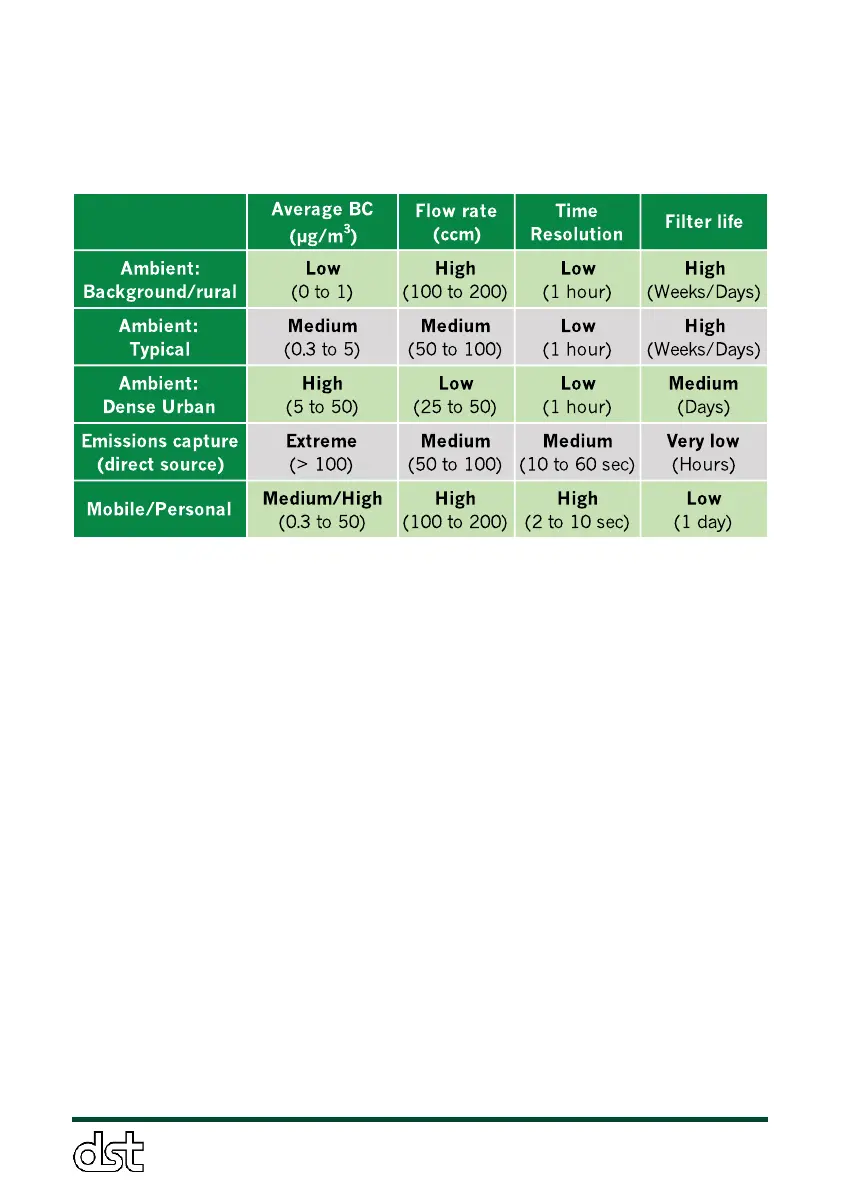
Table 8 provides typical BC concentrations and operational settings for
some common sampling scenarios. Note that the guidance provided is
approximate and intended to serve as an illustrative guide: Some
applications may not be well described/served by the parameters listed.
Table 8. General settings for several monitoring applications
Ambient monitoring: When deploying the ObservAir as a static network
node over long periods (weeks or months), the flow rate should be set as
low as possible to maximize filter life and reduce the maintenance effort,
especially when network sites are remote or numerous. Ambient
monitoring applications typically require data with low temporal resolution
– hourly measurements are often sufficient – and this helps reduce the
flow rate requirements. Referring to Table 7, it can be seen that the
minimum flow rate setting of 25 ccm provides suitable hourly
measurements for nearly all BC concentrations. However, it should be
noted that this achieves a nominal BC measurement resolution that is
~10% of the average concentration, which may not be sufficient for all
applications (e.g., regulatory monitoring). If greater resolution is desired,
flow rate should be increased to the values listed in Table 8. Similarly,
special consideration should be given when conducting long-term
monitoring in rural or remote areas with BC concentrations < 0.5 µg/m
3
.
In these scenarios when filter loading is low, it is generally advisable to
operate the sensor at a high flow rate setting (100 to 200 ccm) to maintain
BC measurement integrity.
Emissions source characterization: The ObservAir can be configured to
characterize emissions from stationary exhaust stacks, vehicle tailpipes
and other pollution sources. When sampling emissions directly, do not



 To Next Page