- 88 -
5.0 MAINTENANCE
5.1 GENERAL
As with all mechanical equipment, a program of
regular inspection, cleaning and preventive
maintenance by trained personnel will contribute
greatly to the long satisfactory service life of this
product.
5.2 PERIODIC INSPECTION
Read essential temperatures and pressures
periodically to see that they indicate normal
operation. It is a good idea to record these
readings on a log sheet. If any abnormal
operation is observed, try to remedy it. See
Trouble Shooting Guide Section.
5.3 MONTHLY INSPECTION
Check cooling tower water treatment system,
Wipe down external surfaces of unit. Shut unit
down, open main disconnect, inspect control
panel, checking for loose wires, burned contacts,
signs of overheated wires, etc. Restart unit and
check performance of controls. Check sight
glasses for proper refrigerant charge.
5.4 PHE MAINTENANCE
5.4.1 GENERAL
The efficient performance of the
evaporator and condenser heat transfer
surfaces is essential for efficient
performance of your packaged water
cooling machine. If these surfaces
accumulate a film of dirt, scale or slime,
their performance efficiency will degrade
substantially. The refrigerant side of heat
transfer surfaces does not foul since
refrigerant is a good solvent and it is in a
closed, filtered cycle. Water side surfaces
can foul from the water system. A
program of water treatment can slow the
rate of fouling on heat transfer surfaces,
but not eliminate it.
5.4.1.1 Freezing Protection For BPHE
a.) Use a filter <1mm, 16 mesh (see
previous chapter on BPHE
maintenance)
b.) Use an anti-freeze when the
evaporation temperature is close to
liquid-side freezing
c.) Use a freeze protection thermostat
and flow switch to guarantee a
constant water flow before, during
and after compressor operation.
d.) Avoid "pump-down" function
e.) When starting up a system, wait a
moment before starting the
condenser (or have reduced flow
through it)
5.4.2 EVAPORATOR CLEANING
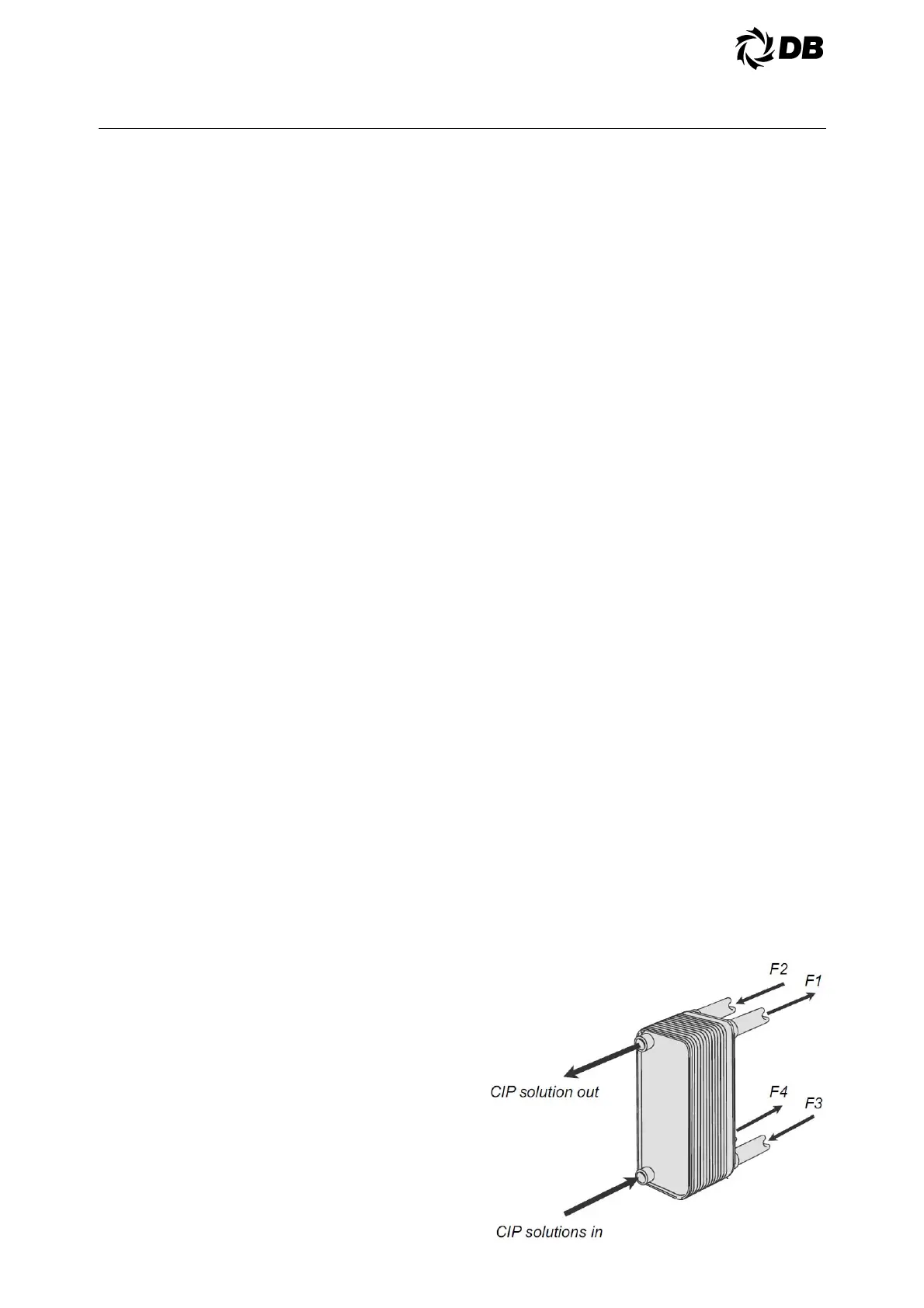
5.4.2.1. Cleaning BPHE
Normally very high degree of
turbulence in BPHE there is a self-
cleaning effect in the channels.
However, in some applications the
fouling tendency can be very high.
In such cases, it is always possible to
clean the exchanger by circulating a
cleaning liquid (CIP-Cleaning In Place).
Use a tank with weak acid or, if the
exchanger is frequently cleaned, 5%
oxalic acid.
Pump the cleaning through the
exchanger.
For optimum cleaning, the cleaning
solution flow rate should be a minimum
of 1.5times the normal flow rate,
preferably in a back-flush mode.
After use, do not forget to rinse the heat
exchanger carefully with clean water.
A solution of 1-2% sodium hydroxide
(NaOH) or sodium bicarbonate
(NaHCO₂) before the last rinse ensure
that all acid is neutralized. Clean at
regular intervals.



 To Next Page