20111028#4.2 EBS Ink-Jet Systeme
EN
9
EN
Control of Electromagnetic Inter-
ference
1. Properties of high-frequency
devices.
Your Ink-Jet printer contains a high-
frequency transmitter and receiver. When
it is in the ON state, the printer receives
and transmits high-frequency (HF) signals.
The controller of the Ink-Jet printer system
controls energy emitted during printer
operation on an on-going basis.
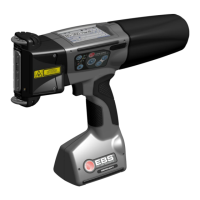
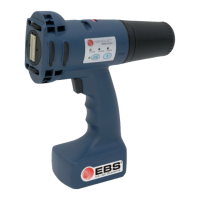
The HANDJET
®
EBS 250 printer
complies with all the requirements of
the regulations concerning the impact
of the HF energy on humans in your
country.
2. Printer accessories.
If you do not use original EBS parts or
printer accessories, including batter-
ies or electronic components, the
statutory requirements may not be
met and the HF electromagnetic
emission limits may be exceeded.
Medical Equipment
Pacemaker
The pacemaker manufacturers rec-
ommend that the distance between a
transmitter and the pacemaker be at
least 15 cm so that any mutual inter-
ference between the two devices is
avoided.
Other Medical Equipment
If you use a piece of medical equip-
ment, please ask the equipment
manufacturer whether the equipment
is sufficiently shielded against elec-
tromagnetic radiation. In certain cir-
cumstances your doctor may help you
gain the information you require.
Operation in Explosion Hazard
Areas
If you work in an explosion hazard
area, switch your Ink-Jet printer off,
do not replace the batteries or do not
remove them from the printer and
follow all instructions and precautions.
Sparking generated by batteries may
cause an explosion and/or fire in this
hazardous area and result in personal
injuries or even death.
The regions where a potential explo-
sion hazard exists are usually marked
appropriately. The examples of such
regions are: solvent storage areas,
fuel storage areas and petrol stations,
below-decks onboard ships, storage
areas for explosive gases, air mix-
tures, chemicals and metal or flour
powders.
Operation in Areas of Blasting
In order to avoid interference during
blasting (shot firing) the printer should
be switched off in blasting areas or in
places where the use of radio devices
is prohibited.
Follow the operating instructions and
information signs.
Conformity Marking
The HANDJET
®
EBS 250 printer has
followed the conformity assessment
procedure which resulted in the issue
of Declaration of Conformity. This
forms the basis for the statement that
the HANDJET
®
EBS 250 printer and
the manufacturer’s accessories, to
which this Declaration relates, meet
the general requirements and other
relevant provisions of the Directive if
the printer and the accessories are
installed and used in compliance with
the manufacturer's instructions:
1999/5/EC
and that they meet the following
norms that are harmonised with the
above Directives
EN 60950-1:2006,
EN 61000-6-2:2001,
EN 61000-6-4:2001,
EN 50371:2002,


 To Next Page