RGF 300
11/53
1.3 PRINCIPLE OF OPERATION
The
rgf300
series appliances are voltage regulators that use the phase cutting principle totally controlled over
three phases.
The regulators, also referred to as speed controls, have been designed to change the average voltage on the
following types of equipment, according to a control signal:
•
asynchronous three phase motors connected to
fans, pumps, agitators, mixers
;
•
electrical resistor devices with sectioned
single / three phase
.
Regulation occurs as a result of cutting of the input sinusoid. Regulation does not generate any torque knock
or pulsation and is particularly quiet. Any voltage loss is contained within a maximum limit of
1%
.
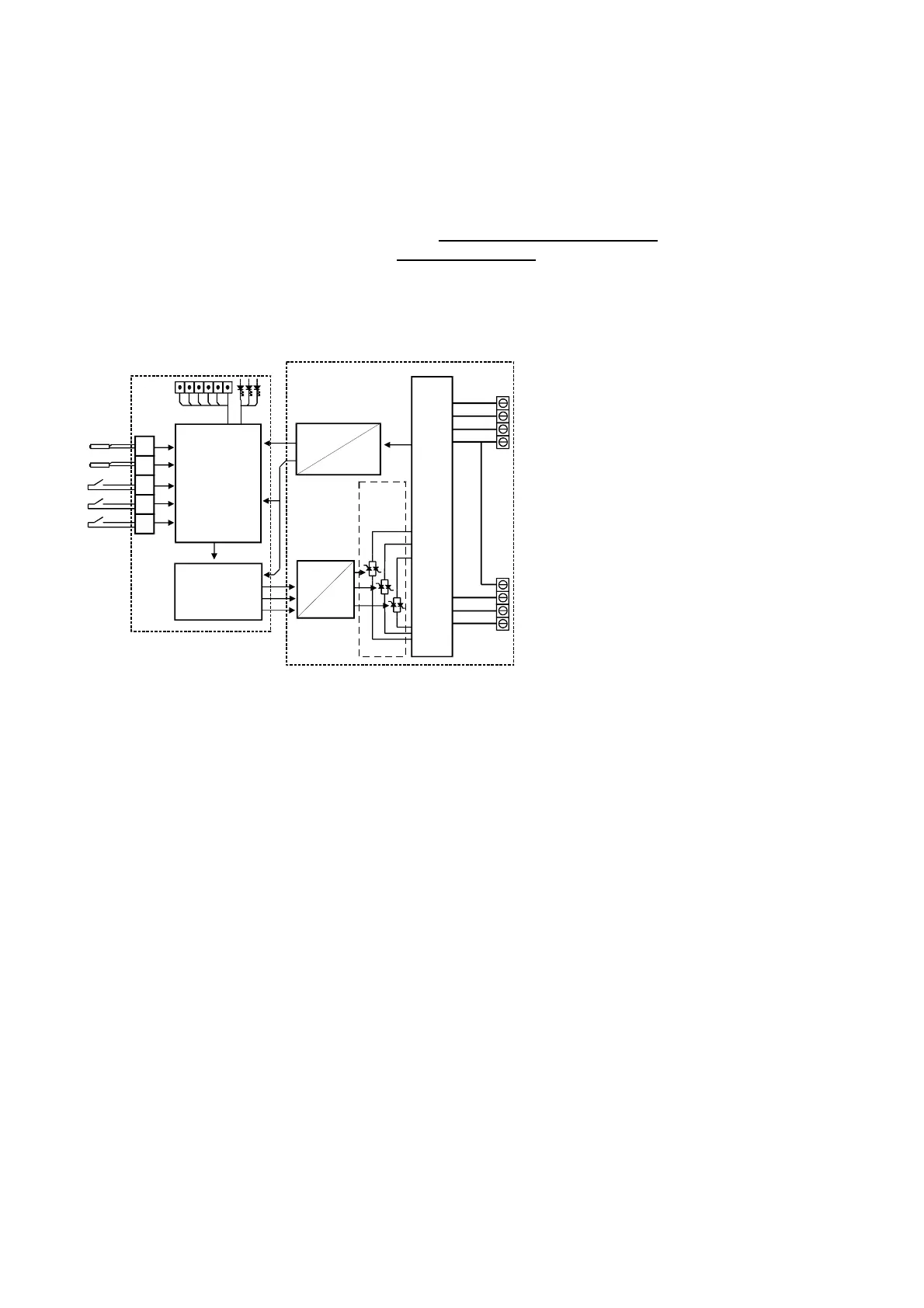
Fig. 6
shows a block diagram of regulator
rgf300
.
A - Power circuit
B - Mains filter and EMC
protective devices
C - Power supply and synchronism
signals
D - Insulators for the control
signals of the power devices
E - Regulation and control circuit
F – Modulator for control of the
power devices
fig. 6
The speed regulators are sized to withstand a starting current equal to more than twice the rated current;
therefore, when choosing a regulator, it is essential to take into consideration both the motor starting current
and the type of motor.
It is actually well-known that, while the starting current in axial fans is equal to 2 or 3 times the rated current,
the same current in centrifugal fans can have values around 7 or 8 times the rated current.
As far as the choice of motor is concerned, it is advisable to choose motors suited to the type of regulation.
As a general rule, the best suited are:
•
motors with high slipping resistive motors
•
defluxed motors
•
tropicalised motors
•
CLASS H motors
as these allow better performance to be obtained with speed changes, they are quieter and start with lower
current.
When choosing a motor, it is always advisable to contact your own supplier and order a motor which is
suitable for speed control by voltage change. Subsequently, practical trials should be carried out on the
motors or prototype machines in order to check their correct operation.
After choosing the motor, the speed regulator must be ordered according to
•
the
rated voltage
,
•
maximum power
required (load-Amperes) bearing in mind the
starting current
.
CONTROL CIRCUIT
POWER CIRCUIT
T
S
R
PE
PE
W
V
U
E
F
C
D
B
A


 To Next Page