105U-G Wireless Gateway User Manual
Page 11 © August 2003
♦ Low battery voltage. The 105G has an internal battery charger to trickle charge a back-
up battery. If the battery voltage is low, this status is set.
♦ Battery voltage - the actual value of the connected battery voltage.
1.3
The Wireless Network
The 105G can communicate with up to 490 other addresses - this could be 490 other 105U
modules, or in the case of 105K modules, it could be many thousands of modules (as many
105K modules can share the same address). 105G modules may take up more than one
address under some circumstances.
Any 105G or 105U module can act as a radio repeater for other modules - that is, radio
messages can be passed onto other modules. Up to five repeater addresses can be configured
for messages transmitted to a 105G module.
Each module can have a unit address between 1 – 95, but the 105G also recognises repeater
addresses in conjunction with the unit address as the module “identifier”. Hence module #2 is
recognised as different to #2 via #57 - #57 being a repeater.
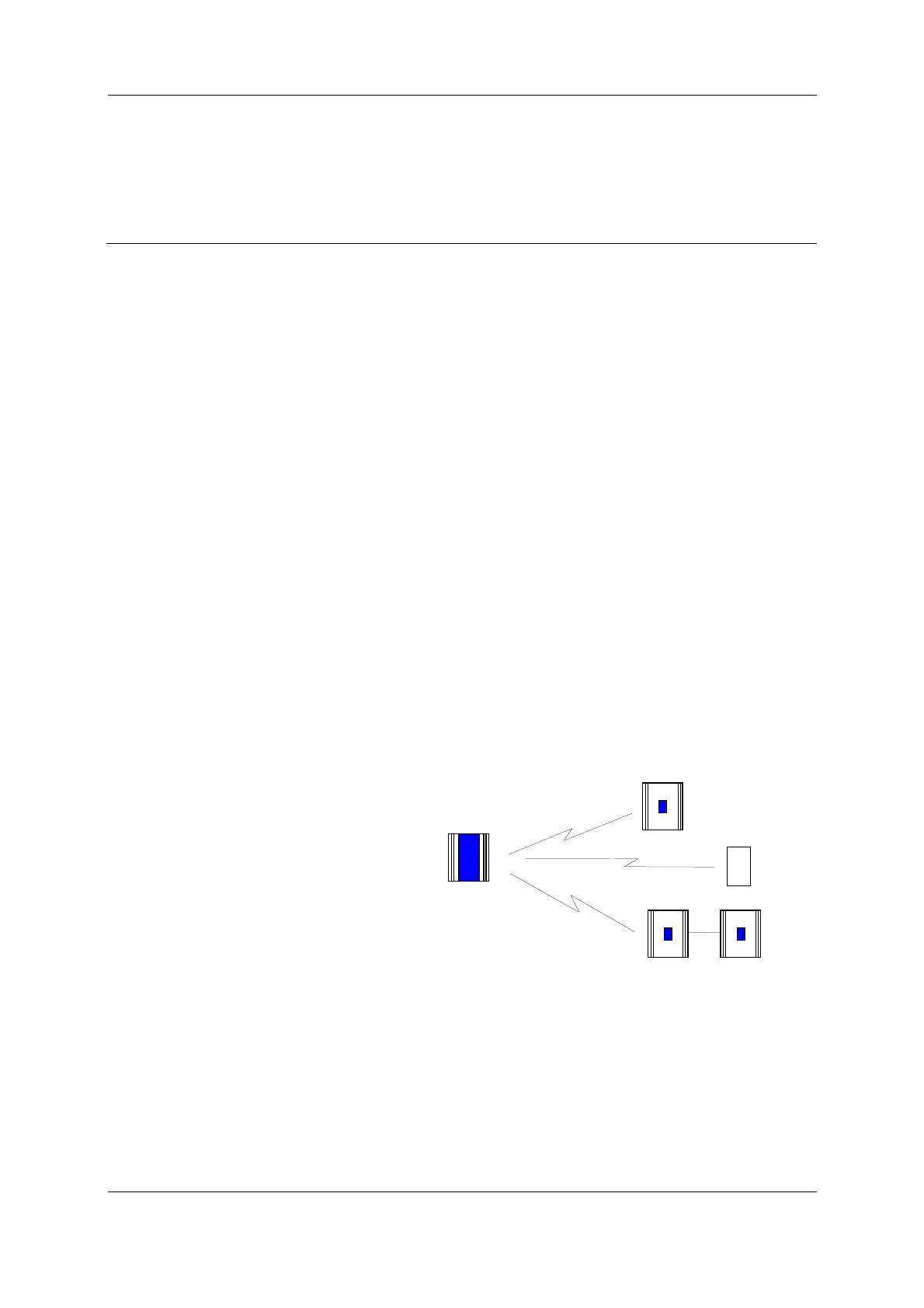
1.3.1 105U to 105G Network
In the wireless I/O system, the 105G acts as a normal 105U module (this covers 105U I/O,
105S I/O, 505U and 105U-C modules).
105U modules transmit messages to the 105G address and the 105G acknowledges these
messages like a normal 105U module. When a 105G transmits messages to change remote
outputs, it will "re-try" if it does not receive an acknowledgement, like a normal 105U
module.
Remote 105U modules can connect to 105S modules in the normal way. The 105G host can
access I/O on 105S modules by using the intermediate 105U as a repeater. 105S modules
cannot connect directly to a 105G module.
105U modules can transmit input
messages directly to outputs on other
105U module, as well as the 105G. The
same input can be transmitted to
different addresses by entering two
"mapping" configurations at the remote
module.
Normal 105U Messages
I/O registers in a 105G can be
configured (mapped) to outputs at
remote 105U modules, or I/O registers
in 105G modules. The 105G will transmit an I/O message when a “change-of-state” occurs
for that I/O register . Registers have a configurable “sensitivity” value - this determines how
much the register value has to change to trigger a change message. A change-of-state occurs
when the register value has changed by more than the sensitivity value since the last
transmission.
The 105G also transmits periodic update messages if there has been no change - if an I/O
register is mapped to a remote output or another 105G, then that register can be configured
with an update time.
105U-G
105U-3
105U-1
105S-2
505U


 To Next Page