9
9 POWERING UP
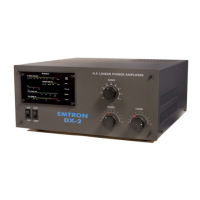
Before switching the power on, check all the necessary connections: Earth, Antenna, Transceiver, PTT, ALC (if used). Make sure the 2
switches on the front panel are in the positions: OFF, STBY.
Switch now the mains power ON (The power switch to ON position). The "soft start" system will take about 5 seconds to fully turn the
power on. After 5 seconds, the display will indicate the plate voltage, typically 2450 V. The FAULT light will turn on briefly, then off.
Wait for the DX-2 to warm up, until the READY light turns on.
This takes about 2 - 3 minutes. This is a minimum required. If you are not in a hurry, give it another minute or two before transmitting.
WARNING!
WHEN YOU SWITCH THE POWER ON, YOU MUST HEAR AIR FLOW NOISE.
IF THERE IS NO AIR FLOW NOISE, SWITCH THE POWER OFF IMMEDIATELY
AND CONTACT YOUR SUPPLIER
10 OPERATION
10.1 TUNNING PROCEDURE -
10.1.1 General
For each band and operating frequency, the transceiver settings must match the position of the BAND switch on the front panel of the
DX-2, while the PLATE and LOAD knobs must be adjusted for optimum operation which gives – in conjunction with the input drive
level, the maximum output power that can be obtained for that input power. When the tuning is correct, this will also result in a
minimum plate current, minimum plate dissipation and good linearity.
10.1.2 Preliminary tuning
• Turn the BAND switch to the same band setting as the transceiver. (Also, make sure the right antenna is used).
• Put LOAD and PLATE knobs in the initial positions given in Table 1.
• DX-2 must be powered ON and "Ready", with the OPR/STBY switch in OPR position.
• Start with the transmitter at minimum power, in a "carrier" mode e.g. RTTY or CW - key down.
• Key the transceiver ON and gradually apply power to the DX-2. When 0.5 to l W of drive is reached, the EBS is activated and
the plate current jumps from zero to about 0.3 - 0.4A
• Increase the drive until there is some output power indicated. If the current plate Ip reaches about l A and there is still no
output indication, turn PTT off and check the connections, the band and the initial settings.
• As soon as there is any power indication, tune PLATE for maximum output (and minimum plate current).
• Apply more drive and adjust PLATE again for maximum output. Keep PTT ON for short time only (about 10 seconds). Go
gradually, in several steps. When about 700 - 1000W output is reached, adjust LOAD for maximum output. If there is no red
Ig2 indication, it is likely that LOAD needs to be turned clockwise, towards higher numbers on the dial.
• Apply more drive and adjust both knobs again. When screen current appears (red Ig2 indication), increase loading by turning
anti-clockwise the loading capacitor. (LOAD towards lower numbers on dial) until Ig2 drops almost to zero. Then adjust
PLATE for maximum output power and maximum Ig2. At this point, Ig2 is the most sensitive indicator of resonance on
the working frequency. If Ig2 goes too high (e.g. starts blinking), increase the loading again, then tune PLATE.
• Repeat the above steps, while gradually increasing the input drive power, until the overdrive indicator just starts turning on.
Now the DX-2 is tuned for operation at full power on that particular operating frequency.
NOTES:
1. The maximum power is obtained from a DX-2 when:
onset of the overdrive indication
PLATE is tuned for maximum output power, maximum screen current Ig2 and minimum plate current, Ip
Ig2 indicator shows 2 or 3 red LEDs.
2. The above conditions will also give the best linearity.
3. During the preliminary tuning, switch PTT on and off several times, to allow time for tube cooling. The tube dissipation (at a given
drive level) is minimum when tuning is optimum. In short, be brief, with tuning "bursts".
4. Preliminary tuning, as described above, is only necessary when operating for the first time in a certain band. When the final settings
for PLATE and LOAD have been found for the particular working conditions - especially the antenna used, note your settings on
Table 1. The new settings will normally differ to some extent from the ones indicated, depending on the "purity" of your antenna load.
Note that the settings (especially LOAD) will be different at lower output power – See “Tuning for less than full power”.


 To Next Page