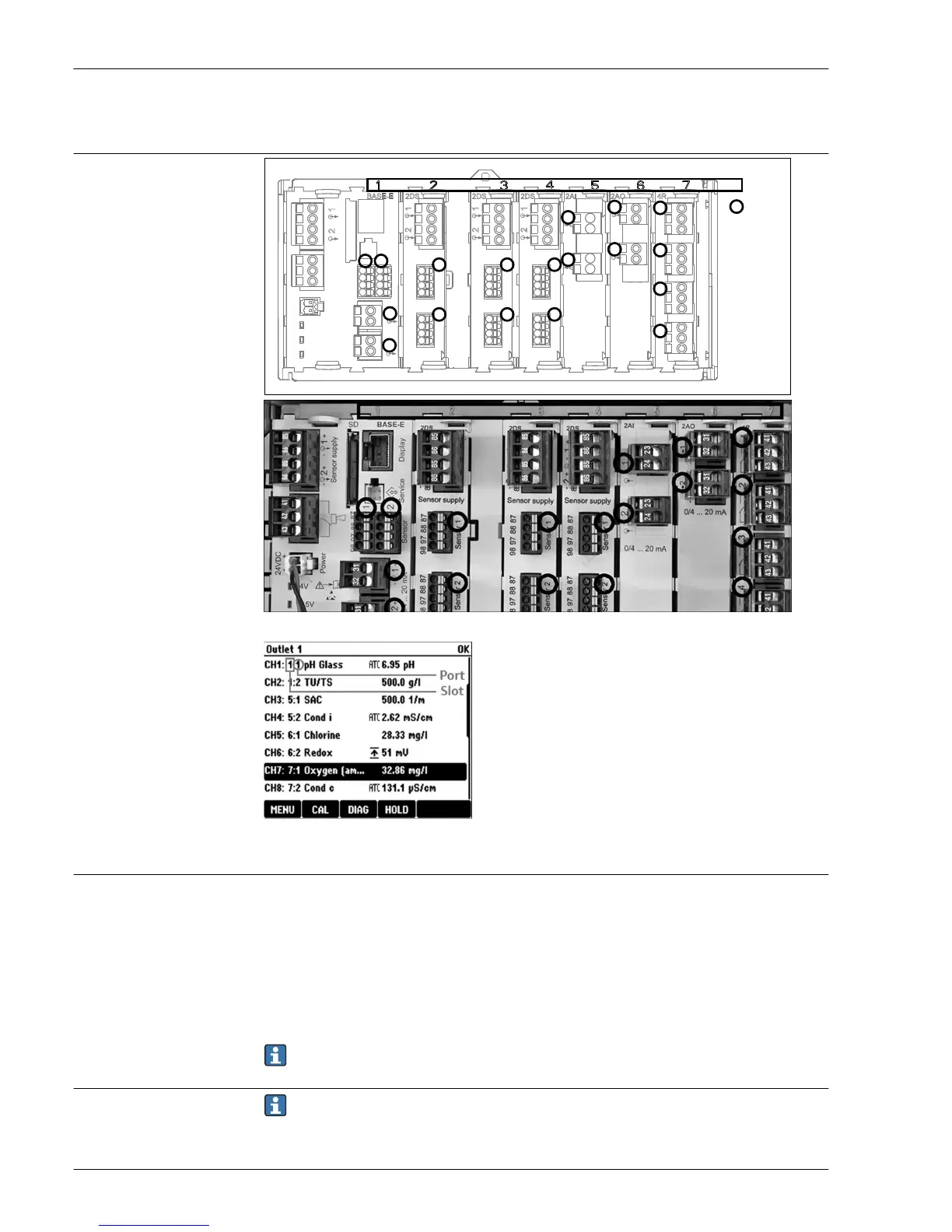
3 Slot and port assignment of the hardware modules
4 Slot and port assignment on the
display
• Inputs are assigned to measuring channels in the
ascending order of the slots and ports.
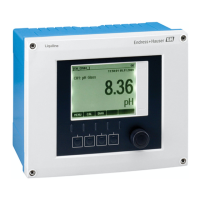
Adjacent example:
"CH1: 1:1 pH glass" means:
Channel 1 (CH1) is slot 1 (basic module) : Port 1 (input
1), pH glass sensor
• Outputs and relays are named according to their
function, e.g. "current output", and are displayed with the
slot and port numbers in ascending order
Order of the modules
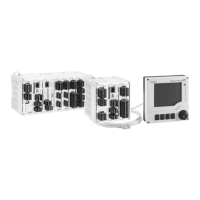
Depending on the version ordered, the device is supplied with a number of electronic modules, which
are assigned in a specific sequence in ascending order to slots 0 to 7. If you do not have a particular
module, the next moves up automatically:
• The basic module (which is always present) always occupies slots 0 and 1
• Fieldbus module 485 or Ethernet module ETH (only one of the two modules can be used)
• Memosens input module 2DS (DS = digital sensor)
• Extension module for digital inputs and outputs DIO (DIO = digital input and output)
• Current input module 2AI (AI = analog input)
• Current output module 4AO or 2AO (AO = analog output)
• Relay modules AOR, 4R or 2R (AOR = analog output + relay, R = relay)
Modules with 4 ports are connected before modules of the same type with 2 ports.
Basic rule for hardware
upgrades
Please note the following if upgrading the device:
• The sum of all current inputs and outputs may not exceed 8!
• A maximum of two "DIO" modules may be used.




 To Next Page