23Installation instructions
EN
• Do not connect Modbus until all installation
and commissioning work is done.
7. Install over voltage protection to the unit.
8. Open the unit’s maintenance hatch and make sure
that:
• The unit is clean from the inside
• There are no unwanted objects inside
• The lters are in place and
• The condensate drain works.
9. Close the hatch carefully.
10. Connect the unit to an appropriate electric supply.
NOTE: The valve and actuator must be in the
same position when connected. When the
valve is in open position, the actuator is turned
counter-clockwise before connecting, and
when the valve is closed, the actuator is turned
clockwise before connecting. Figure 2 on page
23 shows the valve and markings on valve
spindle in valve open (cooling/heating on max)
position.
Draining condensate water
All Enervent ventilation units must be drained. When
air cools down (condenses), condense water forms.
For example in winter time when humid inside air
meets cold heat recovery wheel, or when warm outside
air meets the cooling coil in the ventilation unit (if
applicable).
CAUTION
CAUTION: The condense water drain must not
be directly connected to a sewer pipe.
• The condensate water should be led in a falling, at
least Ø15 mm pipe, through a water trap to a oor
drain or such.
• The pipe must at all times lie lower than the
condensate water drip pan / condensate water
connection of the ventilation unit.
• There must not be any longer horizontal sections
on the pipe.
• The condensation drain pipe must be insulated if
mounted in spaces where freezing can occur.
• Only one water lock is allowed for each condensate
water drain.
• If the unit is equipped with more than one
condense water drains, each one must have a
water lock of its own.
• There is underpressure in the ventilation unit. We
recommend a height dierence of (A) 75 mm,
or at least the underpressure divided with 10 in
millimeters (i.e. 500 Pa under pressure -> 50 mm),
between the unit drain and the water lock drain.
Figure 2. Valve and actuator open counter-clockwise and
close clockwise. The gure shows the valve and actuator
in the fully open position. Also, shown is the allowed direc-
tion of the liquid ow.
NOTE: Do not install the actuator so that the
manual control faces downwards.
4. Connect the water.
• Do not connect to a point where the water
circulation ends for example during hot water
production.
5. Check the duct coil and its connections for leaks
immediately after the system has been lled with
water.
• The water heating coil needs a steady ow
of suciently warm water without large
temperature uctuations.
• Adjust the water ow in the heating coil
according to the technical features table at the
end of this manual.
• If the water is taken for instance from a ground
source heat pump, the heating coil needs its
own circulation pump.
• If the installation is done in wintertime it is
recommended not to let water in the coil until
the ventilation is running. This is in order to
prevent cold air from entering the ventilation
system and possibly freezing the coil.
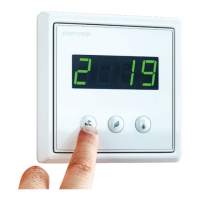
6. Connect the external cables such as the cable
between the unit and the control panel, supply
sensor, actuator and pump.


 To Next Page
 Loading...