30
• If the unit is not to be used for a longer period
of time, it can be shut down if you cover both
the outside air intake and the exhaust air
outtake.
• In this way you stop moisture from condensing
on for example the fans’ electric motors.
• Before the heating season in the Autumn
and before there is cooling need (if unit is
equipped with cooling) the functionality of
the condensation drain(s) must be checked by
pouring water into the drain and checking that
the water is drained away.
Fans
When electricity is connected to the ventilation unit
the relay controlling the dampers activates and heat
recovery turn on full power. After a while the extract
fan starts up and after a small delay, also the supply
fan. After that the ventilation unit runs according to the
dened settings.
The fans are operating at specic speed, based on the
prevailing mode. During commissioning of ventilation
unit, a specic fan speed is assigned to each mode.
Supply and extract fans have each their own fan speeds.
Modes that aect the operating speed of the fans are:
• Mode 1, 2, 3 or 4
• CO (accessory) or %RH boosting
• Away
• Manual boosting
• Overpressure
• Alarm modes A and AB
Supply and extract fan speed is assigned to each of
these modes, not including alarm modes.
CO (accessory) and humidity
boosting of fans
The ventilation unit fan speed is controlled by data
received from humidity and/or CO2 (accessory) sensors.
When CO2 boosting is selected, the external analog
input (AI1) is automatically congured as a CO2 sensor
input.
CO and/or humidity content of a space is meant to be
kept below the limit set in the control panel. Humidity
control commands the fans based on data from
internal and possible external humidity transmitters
of the ventilation unit. One built-in humidity sensor is
included in the standard unit delivery.
USING THE EQUIPMENT
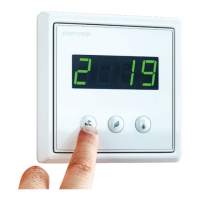
Introduce the end user to proper use of the ventilation
unit and the control panel.
NOTE: If you run into problems while using
the ventilation unit, please consult the
Troubleshooting guide at the end of this
manual.
General
CAUTION
CAUTION: Do not switch the ventilation unit
o. It must always be kept running at the power
specied by the ventilation designer.
• Ventilation must be sucient.
• If the ventilation is insucient, the humidity
indoors becomes too high and can result in the
formation of condensation on cold surfaces.
• Indoor humidity levels must be checked regularly.
• In winter an indoor relative humidity of
max. 40 - 45% is recommended (room
temperature of +20 - 22°C). At these levels
the humidity will be at a healthy level and the
risk of condensation is drastically diminished.
Humidity levels can be checked with a
hygrometer. When the humidity rises above
45%, ventilation needs to be increased, and
when the humidity goes lower than 40%,
ventilation can usually be lowered.
• Cleanliness of the lters must be checked regularly.
• During winter the extract air lter usually
become dirty sooner than the supply
air filter. As a result of this, the extract air ow
decreases, which leads to a higher indoor
humidity. This also leads to poor heat recovery.
NOTE: If you run into problems while using
the ventilation unit, please see the chapter
"MAINTENANCE" on page 32.
• Make sure monthly that the heat exchanger is
rotating correctly.
NOTE: For more information on checking and
cleaning the heat exchanger, please see chapter
"MAINTENANCE" on page 32.



 To Next Page
 Loading...