Operating Instructions
Transponder-Coded Safety Switch CET.-AS-…
8
(Translation of the original operating instructions) 2113689-04-07/19
6. Function
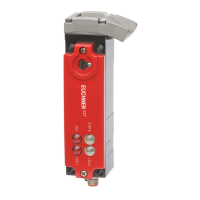
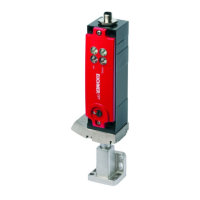
The device permits the locking of movable guards.
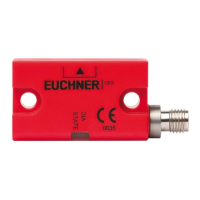
The system consists of the following components: coded actuator (transponder)
and switch.
Whether the device learns the complete actuator code (unicode) or not (multicode)
depends on the respective version.
Ì Devices with unicode evaluation: The actuator must be assigned to the
safety switch by a teach-in operation so that it is detected by the system. This
unambiguous assignment ensures a particularly high level of protection against
tampering. The system thus possesses a high coding level.
Ì Devices with multicode evaluation: Unlike systems with unique code detec-
tion, on multicode devices a specic code is not requested but instead it is only
checked whether the actuator is of a type that can be detected by the system
(multicode detection). There is no exact comparison of the actuator code with
the taught-in code in the safety switch (unique code detection). The system pos-
sesses a low coding level.
When the guard is closed, the actuator is moved towards the safety switch. When
the switch-on distance is reached, power is supplied to the actuator by the switch
and data are transferred.
If the guard is closed, guard locking is effective and the code is permissible, each
CET-AS transmits a switch-specic, unique safety code sequence with 8x4 bits
via the AS-Interface bus.
The zero sequence is transmitted via the AS-Interface bus when the guard is opened.
In the event of a fault in the safety switch, the zero sequence is transmitted via the
AS-Interface bus and the STATE LED illuminates red. The occurrence of faults is de-
tected at the latest on the next demand to close the safety outputs (e.g. on starting).
Ramp/switch head
Plunger
Ramp
Transponder
Spring-mounted
guard locking pin
Recess


 To Next Page
 Loading...