The sensor output is corrected for the temperature characteristics of the membrane, and for the
temperature characteristics of oxygen saturation in water.
Despite its considerably higher cost, the optical sensor is becoming favored over the Clark sensor
because the optical sensors have little calibration drift in the field, are not flow-sensitive (no
circulator needed), and do not require the occasional membrane changes that annoy Clark
sensor users.
Optical dissolved-oxygen sensor maintenance is nothing more than occasionally cleaning the
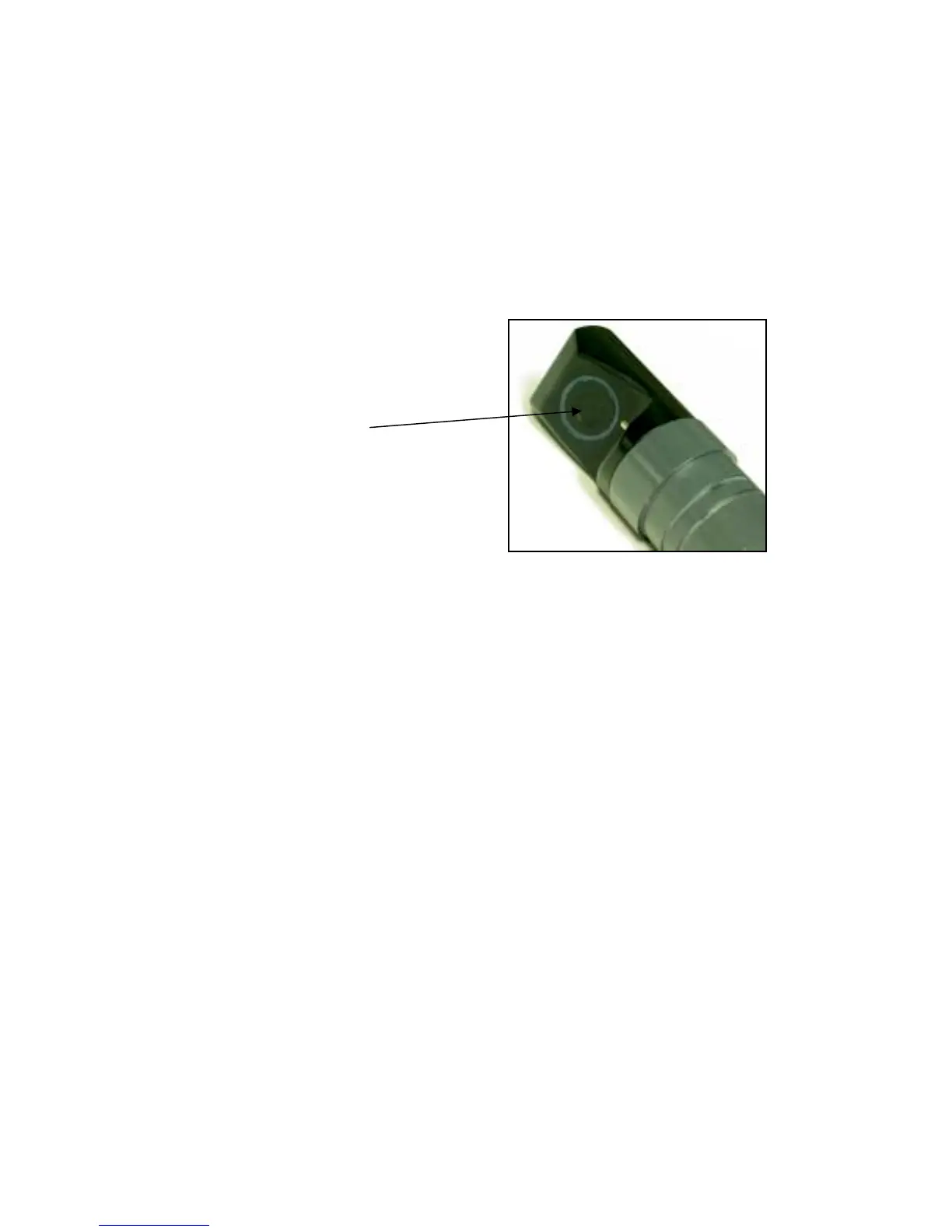
sensing surface (the red material; about a centimeter diameter) with a soft cloth and soapy water.
The optical dissolved-oxygen
sensor’s sensing surface
Where the Clark sensor requires only one calibration point, the optical dissolved oxygen sensor
requires two: one at zero dissolved oxygen, and one at the saturation point. To set the sensor’s
zero point:
1) Prepare a zero-oxygen solution by dissolving a few grams of sodium sulfite and a pinch
of cobalt chloride in a half-liter of tap water.
2) Fill your calibration cup until your aerated water covers the sensor by a centimeter or so.
3) Make sure your instrument’s Barometric Pressure setting is accurate.
4) Wait a few minutes for the temperature to equilibrate.
5) Follow the Manta 2 Control Software calibration instructions.
If you think the sodium-sulfite method is shaky and yesterday’s news, you can rig a plastic bag to
cover the empty calibration cup and run a little nitrogen (or helium or argon) gas into the bag so
as to immerse the sensor in pure nitrogen. Then follow the Manta 2 Control Software’s
calibration instructions. If you’re using a high-pressure gas bottle, please use a two-stage
regulator to prevent excitement.
To set the sensor’s saturation point:
1) Put a half-liter of tap water in a liter jar and shake the jar vigorously for one minute. Take
the lid off the jar (assuming you put one on in the first place) and let the water stand for
about five minutes to let the air bubbles float out.
2) Fill your calibration cup until your aerated water covers the DO sensor by a centimeter or
so.
3) Make sure your instrument’s Barometric Pressure setting is accurate.
4) Wait a few minutes for the temperature to equilibrate.
5) Follow the Manta 2 Control Software calibration instructions.
Optical dissolved-oxygen sensors usually have very low drift rates compared to Clark sensors, so
practice will show you how often to calibrate your optical sensor. You might also find that one or
27


 To Next Page