Most Eureka multiprobes have small lights (LED’s) to tell you things about your multiprobe. If so equipped, the Manta 2
has three LED’s mounted on the circuit board visible through the instrument housing:
Current functionality:
1) Green – Flashes once upon power-up.
2) Red – The red LED blinks briefly whenever RS-232 communication is received by the Manta 2.
3) Yellow - The yellow LED blinks once every two seconds to indicate that the Manta 2 has adequate operating
voltage.
To be implemented after December 2008:
1) Green - The green LED blinks once every two seconds to indicate that the Manta 2 has adequate operating
voltage.
2) Yellow – The yellow LED blinks briefly whenever RS-232 communication is received by the Manta 2.
3) Red – The red LED blinks every 2 seconds for 10 seconds upon each power up if logging is enabled.
Have you ever turned on a multiprobe from one of those other manufacturers, only to find it didn’t
work? And that you had no clue why it didn’t work? You’ll never have that problem with the Eureka
Manta 2 because the LED’s tell you what you need to know.
F3 Applications: Profiling (Spot-Checking), Logging, and Telemetry
There are three basic applications for the Manta 2. Perhaps most common is profiling (spot checking), in which the
Manta 2 is used with an operator present to gather data over a short time period. Data display options include the
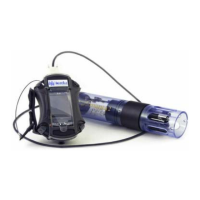
Amphibian and a PC or PDA.
Manta 2’s are often used for unattended logging, in which the Manta 2 uses a battery pack or other power source to
periodically record data over a long time period. No operator need be present.
Increasingly popular is telemetry, in which the Manta 2 uses a solar-charged battery to periodically transmit logged data
to a secure Internet site. The Manta 2’s internal logger can be used as a data back-up, and a Manta 2 battery pack can
be used as a power back-up. This method has the advantage of maximizing deployment times (i.e. minimizing labor
costs) because the user can watch his data over the Internet to determine when maintenance is required.
F4 Cables
Eureka cables have a special lower termination in which the cable wires can move around when the cabled is stressed
one way or another. This means that the chance of breaking a cable through normal use is very small. Generally, just
make sure the cable is kept clean and that you don’t run it over the side of the boat without a gentle radius for the cable.
And make sure to use the cable’s locking sleeve (or locking plate for the internal-battery-pack-equipped models).
Eureka cables are unique in the market because their lower termination does not fatigue solder joints
when you stress the cable. As of this manual’s date, Eureka has had no lower-termination wire
failures in the field. None.
F5 Operating the Manta 2 with Eureka’s Amphibian
34


 To Next Page