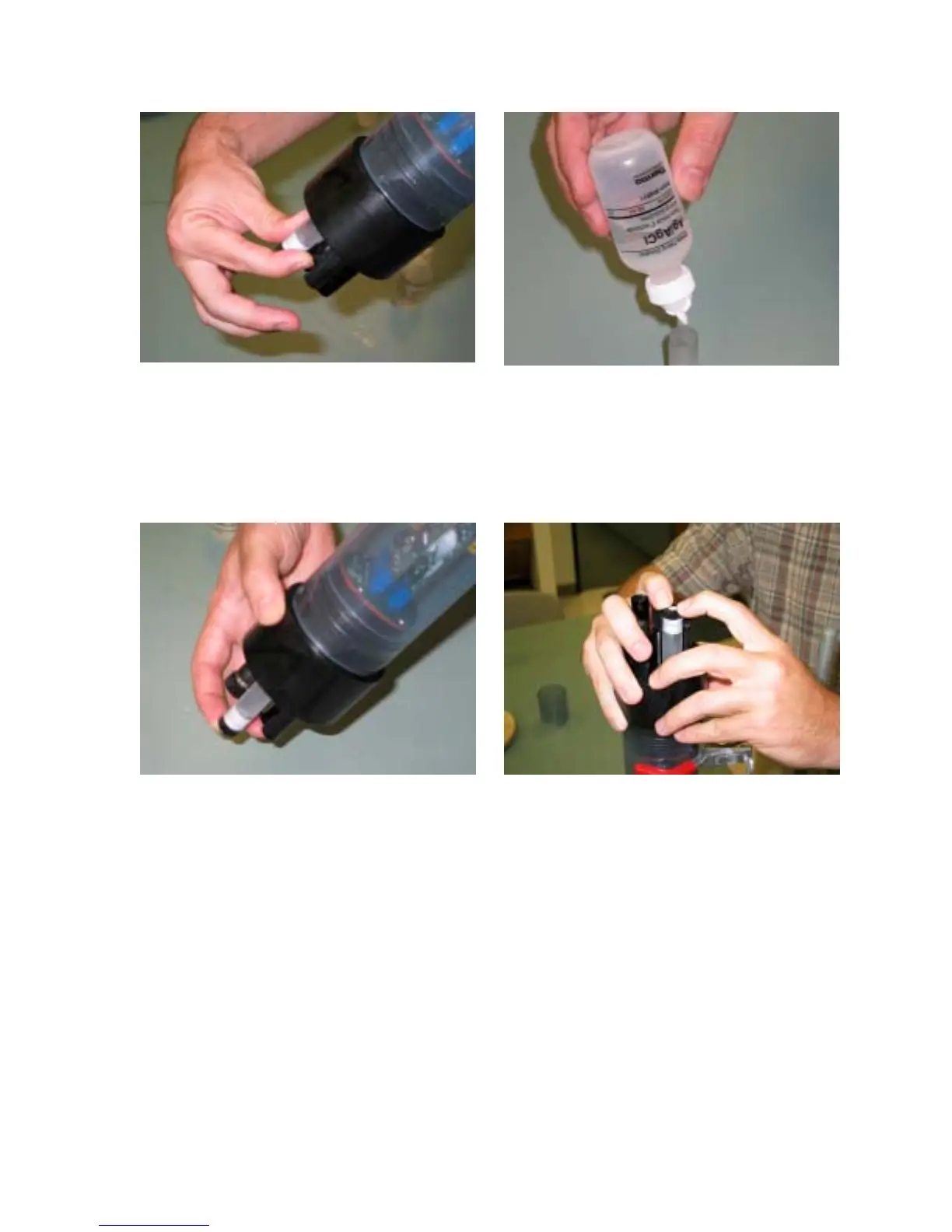
1) Remove the reference cap by unscrewing it from the reference sleeve and discard old
reference electrolyte.
2) Fill the sleeve completely with fresh pH reference electrolyte (KCl saturated with silver
chloride). Be careful not to introduce any air bubbles.
3) With the sensors facing up, screw the reference cap back on to the sleeve. Air should be
purged through the Teflon junction when replacement is done.
As you screw the sleeve into place, the excess electrolyte is forced out of the sleeve through the
reference electrode junction (the white, porous circle at the end of the sleeve). This not only
purges bubbles from the electrolyte, but also cleans nasty stuff out of the junction.
[Other manufacturers will tell you that their integral reference electrode is better. It’s not, because
every year you have to buy a new one for about $300 and install the whole thing yourself. Better
to spend a few pennies every month or two refilling the Eureka-style reference electrode. This is
not to mention the better stability you get out of the refillable reference electrode in low-
conductivity waters.]
E11 Oxidation-Reduction Potential (ORP)
ORP is measured as the voltage drop across the platinum membrane of an ORP electrode. A
reference electrode is used to complete the voltage-measuring circuit. Because platinum does
not react with ions in the water, it won’t give or take any electrons from those ions no matter how
much they beg. The potential (voltage) created by this refusal is what you’re actually measuring
as ORP.
29


 To Next Page