7.3 During operation
Locate and delimit the working area.
Make sure that no one is within the working area of the crane. Do not stop and
do not pass in the delimited area.
Choose the correct control position, making sure to have the complete visibility of
the
working area.
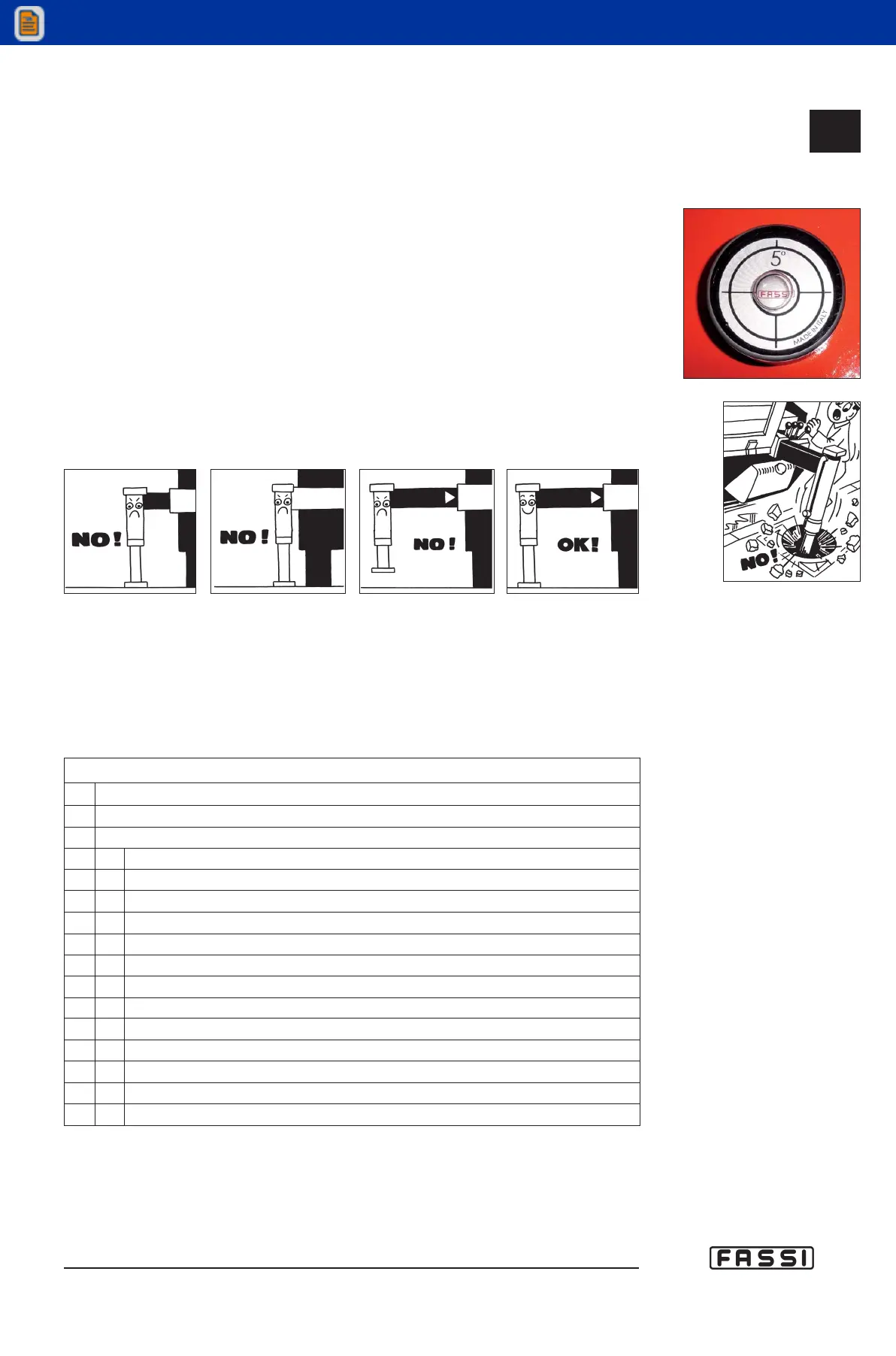
Stabilize the vehicle on a horizontal plane with a maximum tolerance of 1,5
degrees.
Check the vehicle inclination on the levelness indicator. The bubble must
be contained in the internal circle, and in any case it doesn't must to come out from
the external circle.
Make sure that the outrigger rams rest on a solid base. If necessary use larger
outrigger base plates (available on request) to avoid sinking. If you adopt other
means, make sure that they are suitably sized for the load they must bear.
(!) ATTENTION (!)
The stability of the unit (crane-vehicle) is only guaranteed by the complete
lateral extension of the outriggers and by the observance of the capacity
plates.
The values of the support force F are indicated in the table at paragraph "2.3 Technical
Data". Just as an indication it's enclosed the below table.
7.3
WARNING AND
INSTRUCTIONS
GRU FASSI
ADMITTED PRESSURE ON THE GROUND (Load capacity of the ground) - Rif. DIN 1054
A Made ground, not compacted artificially
B Asphalt
C Compact ground, not removed
1. Mud, peat, marshy ground
2. Not compacted ground, adequately solid
From fine to middle sand
From thick sand to gravel
Shattered and compacted stones
3. Compact ground
Wet
Soft
Compact
Half - solid
Hard (solid)
4. Rock
Eroded
0 - 10 daN/cm²
20 daN/cm²
0 daN/cm²
15 daN/cm²
20 daN/cm²
25 daN/cm²
0 daN/cm²
4 daN/cm²
10 daN/cm²
20 daN/cm²
30 daN/cm²
100 daN/cm²



 To Next Page