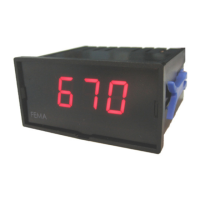
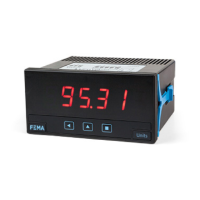
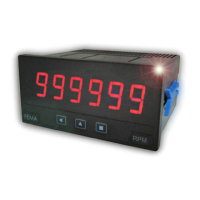
FEMA ELECTRÓNICA . Series M . M60-C1
3
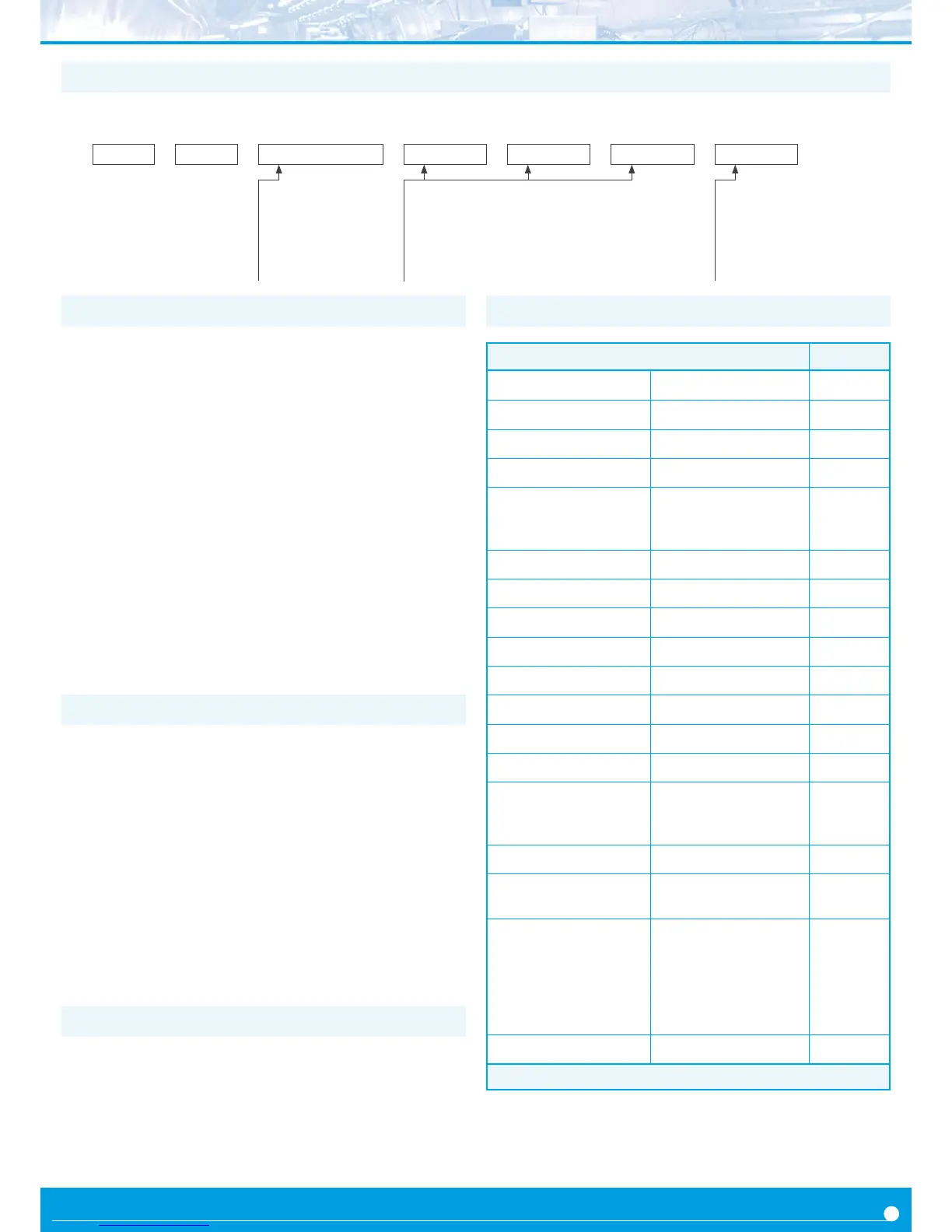
1.1 How to order
M60
C1
Model Power
-
Opon 1 Others
H- -
-
Opon 2
-
Opon 3
-
-R1
(1 relay)
-AO (analog output)
-RTU (Modbus RTU)
-S4 (RS-485)
-S2 (RS-232)
- (empty)
-H (85-265 Vac/dc)
-L (11/60 Vdc,
24 Vac, 48 Vac)
-NBT (no buons)
-65 (front IP65)
-G (green led)
1.2 Impulse counter modes
The instrument allows for 5 selectable impulse counter modes :
• Counter (‘cn.1’) (see secon 1.19.2)
• Counter quadrature (‘cnq.2’) (see secon 1.19.3)
• Counter with inhibion (‘cnI.3’) (see secon 1.19.4)
• Counter with control add / substract (‘cnc.4’) (see secon 1.19.5)
• Counter dierenal (‘cnd.5’) (see secon 1.19.6)
Congurable up or down counng, ‘reset’ at rear terminals, front key
and/or at alarm acvaon. Congurable ‘Preset’ value. Relay acva-
on and deacvaon delays.
Alarm funcons with ‘return to preset’ or ‘reset to 0’ generate cycles
of counng (instrument counts from ‘preset’ value to alarm value
in never ending cycle). The instrument provides memory of cycles
counter.
Scalable reading with congurable mulplier factor (1 to 999999)
and congurable divider factor (1 to 999999). Memory retenon in
case or power loss. Retains conguraon and last reading.
Counng frequency up to 250 KHz, in ‘FAST’ mode (see secon 1.16).
1.3 Ratemeter modes
In ratemeter mode the reading is proporonal to the measured fre-
quency. The instrument allows for 2 selectable ratemeter modes :
• Ratemeter (‘rt.6’) (see secon 1.19.7)
• Ratemeter quadrature (‘rtq.7’) (see secon 1.19.8)
The ratemeter mode has a single input channel, with scalable read-
ing. The quadrature ratemeter mode has 2 inpur channels available
for detecon of sense of turn when working with quadrature signals.
Scalable reading with congurable mulplier factor (1 to 999999)
and congurable divider factor (1 to 999999).
For low frequency applicaons, the ‘SLOW’ mode provides the best
response me for each applicaon (see secon 1.15).
Maximum frequency up to 900 KHz and minimum frequency down to
de 0.001 Hz (1 mHz) with ‘SLOW’ mode acve.
Reading is proporonal to the signal period. Scalable reading with
congurable mulplier factor (1 to 999999) and congurable divider
factor (1 to 999999).
For applicaons with long periods (slow frequencies), the ‘SLOW’
mode provides the best response me for each applicaon (see sec-
on 1.15).
1.4 Periodmeter mode
Funcons included Secon
‘Fast access’ yes 1.19.12
‘SLOW’ mode yes, for slow frequencies 1.15
‘FAST’ mode yes, for fast counng 1.16
Mulplier and divider from 1 to 999999 1.19.2
Reset congurable
yes (front, rear and linked
to alarm acvaon)
1.19.15 and
1.10 and
1.19.11
Preset yes 1.19.2
Trigger level congurable 1.19.10
‘Trigger Sense’ funcon helps to set the trigger 1.13
Sensor selecon by menu 1.19.10
Cycle counter 1.14
Retenon memory yes, recovers with power 1.11
‘On Power Up’ yes
1.19.14
Excitaon voltage congurable 1.19.10
Display lters recursive
1.19.7 and
1.19.8 and
1.19.9
Memory max., min., cycles 1.19.12
Password
blocks access to congu-
raon menu
1.19.18
Alarms
double setpoints
acvaon delays
deacvaon delays
hysteresis
inverted relays
locked alarms
1.19.11
Display brightness 5 levels
1.19.21
Table 1 - Funcons included
1.5 Funcons included


 To Next Page