168 169
Only use original replacement parts.
Otherwise it is possible that the func
-
tionality of your FLYER e-bike may be
impacted or damaged.
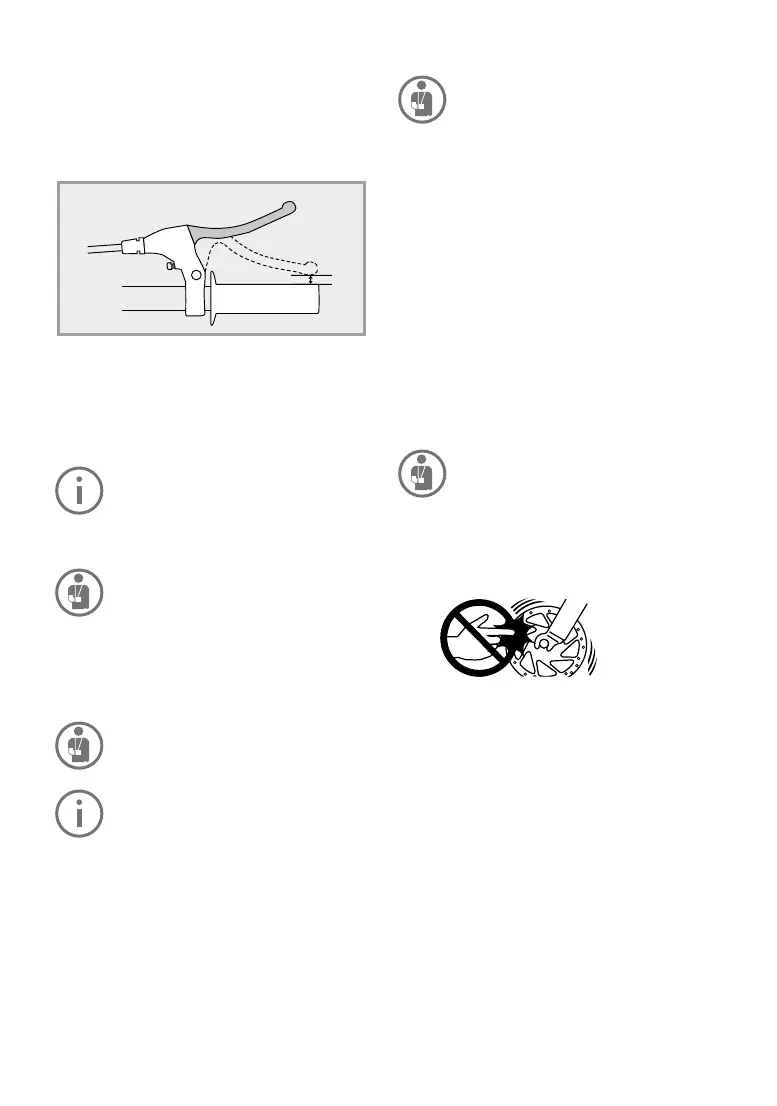
Adjust the brake lever to ensure that it
does not touch the handlebars when
pulled hard.
Back pedal brakes
If your FLYER is equipped with back pedal
brakes, brake by pushing the pedals backwards
instead of forwards. This means that your bicycle
will not freewheel and you are unable to rotate the
pedals backwards freely as you otherwise can.
Back pedal brakes work best when both
cranks are in a horizontal position. If one
crank is pointing up and the other one
down, less force can be applied and
braking is less effective.
The effectiveness of back pedal brakes
can deteriorate substantially on long in
-
clines. This type of braking system can
become very hot from continuous brak
-
ing. You should also use the rim brakes
to slow down on long inclines. Wait until
the back pedal brake has cooled down
and do not touch the brake drum.
Ensure that the brake anchor plate is
correctly attached with the appropriate
screw when removing or installing it.
Only original spare parts may be used
when changing the brakes.
Disc brake
Disc brakes must be installed and ser-
viced by a FLYER specialist retailer. In-
correctly set up brakes can cause acci-
dents and serious injuries.
A brake test is required before each drive and
particularly after each brake adjustment. Braking
behaviour may vary, in particular after exchanging
the brake pads. Disc brakes require a bedding-in
time to wear in the discs and pads. The braking
system only delivers its full performance after
around 10 braking cycles from 30 km/h. The brak
-
ing force increases during this time. Consider this
during the entire duration of the wearing-in period.
This wearing-in period is also required after re
-
placing the brake pads or discs.
Pay attention to any unusual noise when braking,
as this could be a sign that the brake pads have
worn down to the wear limit. Check the thickness
of the brake pads once the brakes have cooled
down. If necessary, have the brake pads replaced.
Please do not touch the brake disc while
it is rotating. You can suffer serious inju
-
ries if your nger is caught in the gaps of
a rotating disc brake.
The brake calliper and disc may get hot
during braking. You could suffer burns if
you touch this part during or directly after
braking.
Have the brake disc replaced if it is worn out or
bent. This replacement procedure must be car
-
ried out by a FLYER specialist retailer.
Source: Shimano
®
techdocs
* see “Technical Data”


 To Next Page