42
bent. This replacement procedure must be car-
ried out by a FLYER specialist retailer.
Hydraulic
brakes
It is possible that brake uid may escape from
the system due to leaky cables and connections.
This can negatively impact the eectiveness of
the brakes. Check the pipes and connections for
tightness before each ride.
DonotridewithyourFLYERifuidisleakingfrom
the braking system. Allow a FLYER specialist re
-
tailer to undertake repair work on this part imme-
diately. The danger of your brakes failing in this
condition is very high.
Formation of air bubbles: You can avoid
this problem by applying the brake lever
before transport and then xing it in this
position using a strap. This prevents any
air from entering the hydraulic system.
Please note that the brake lever may not
be pulled when the wheel has been re
-
moved. Place a spacer between the brake
pads if you need to remove the wheel.
Ask
for detailed instructions regarding the oper
-
ation and special features of the e-bike braking
system from your FL
YER specialist retailer, even
ifyouareanexperiencedcyclist.Practiseinaqui-
et,
safeareawithnotrac.
If you have any questions about assembling, set-
ting up, servicing or operating this part of your
bike, please contact a FL
YER specialist retailer.
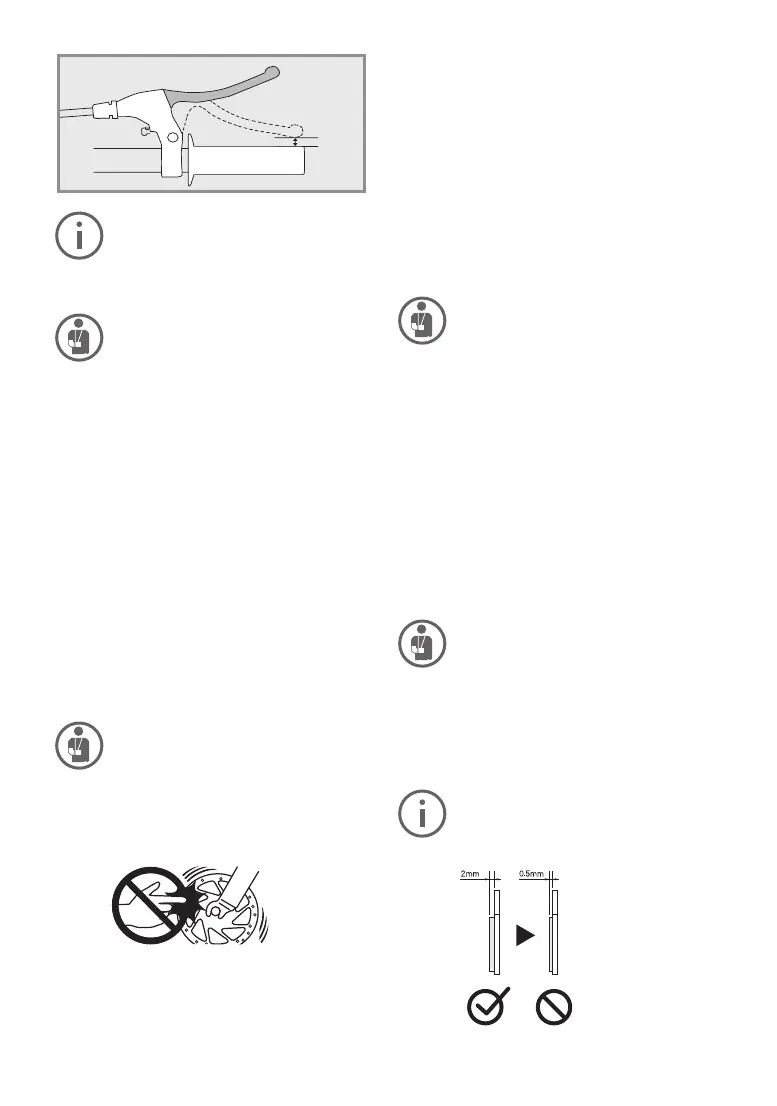
A trigger point should be clearly noticea-
ble
afterapproximatelyathirdoftheway
when pulling the brake lever. Do not start
to ride if the brake lever can be pulled up
to the handlebars. In this case, the
FLYER is not safe for operation. It is
then essential to visit your FLYER spe
-
cialist retailer and have the brake adjust-
ed or repaired.
Especially brake discs wear. Have these
safety-related components regularly
checked for wear and changed as re-
quired by your FLYER specialist retailer.
Source: Shimano®
techdocs
Only original spare parts may be used
when changing the brakes.
Disc brake
Disc brakes must be installed and ser-
viced by a FLYER specialist retailer. In-
correctly set up brakes can cause acci-
dents and serious injuries.
A
brake test is required before each drive and
particularly after each brake adjustment. Braking
behaviourmayvary,inparticularafterexchanging
the brake pads. Disc brakes require a bedding-in
time to wear in the discs and pads. The brake
does not deliver its full braking performance until
after around 10 heavy braking operations under
-
taken at 30 km/h. The braking force increases
during
this time. Consider this during the entire
duration of the wearing-in period.
This wearing-in period is also required after re
-
placing the brake pads or discs.
Pay attention to any unusual noise when braking,
as this could be a sign that the brake pads have
worn down to the wear limit. Check the thickness
of the brake pads once the brakes have cooled
down.
If necessary, have the brake pads re
-
placed.
Please do not touch the brake disc while
itisrotating.Youcansuerseriousinju-
ries
ifyourngeriscaughtinthegapsof
a rotating disc brake. The brake calliper
and disc may get hot during braking. You
couldsuerburnsifyoutouchthispart
during or directly after braking.
Have the brake disc replaced if it is worn out or
Source: Shimano
®
techdocs



 To Next Page