FMUSER INTERNATIONAL GROUP INC. 广州市汉婷生物技术开发有限公司
14
7 Enhanced Other Networks information (EON) control
The EON feature is used to update the information stored in a receiver about program services other than the one
received. Alternative frequencies, the PS name, Traffic Program and Traffic Announcement identification as well as
Program Type and Program Item Number information can be transmitted for each other service. The relation to the
corresponding program is established by means of the relevant Program Identification (PI).
The EON is especially useful for linking two or more stations of the same owner. Most of EON featured receivers
gives priority to stations linked by EON when seek function is activated. Since the RDS-C can store four EON links,
up to 5 stations can be linked together.
Station that doesn’t carry traffic announcements can refer to a station that does. This situation is described below.
For more information see appropriate section in the List of Commands or in the Magic RDS control software help.
7.1.1 Traffic Program and Traffic Announcement codes
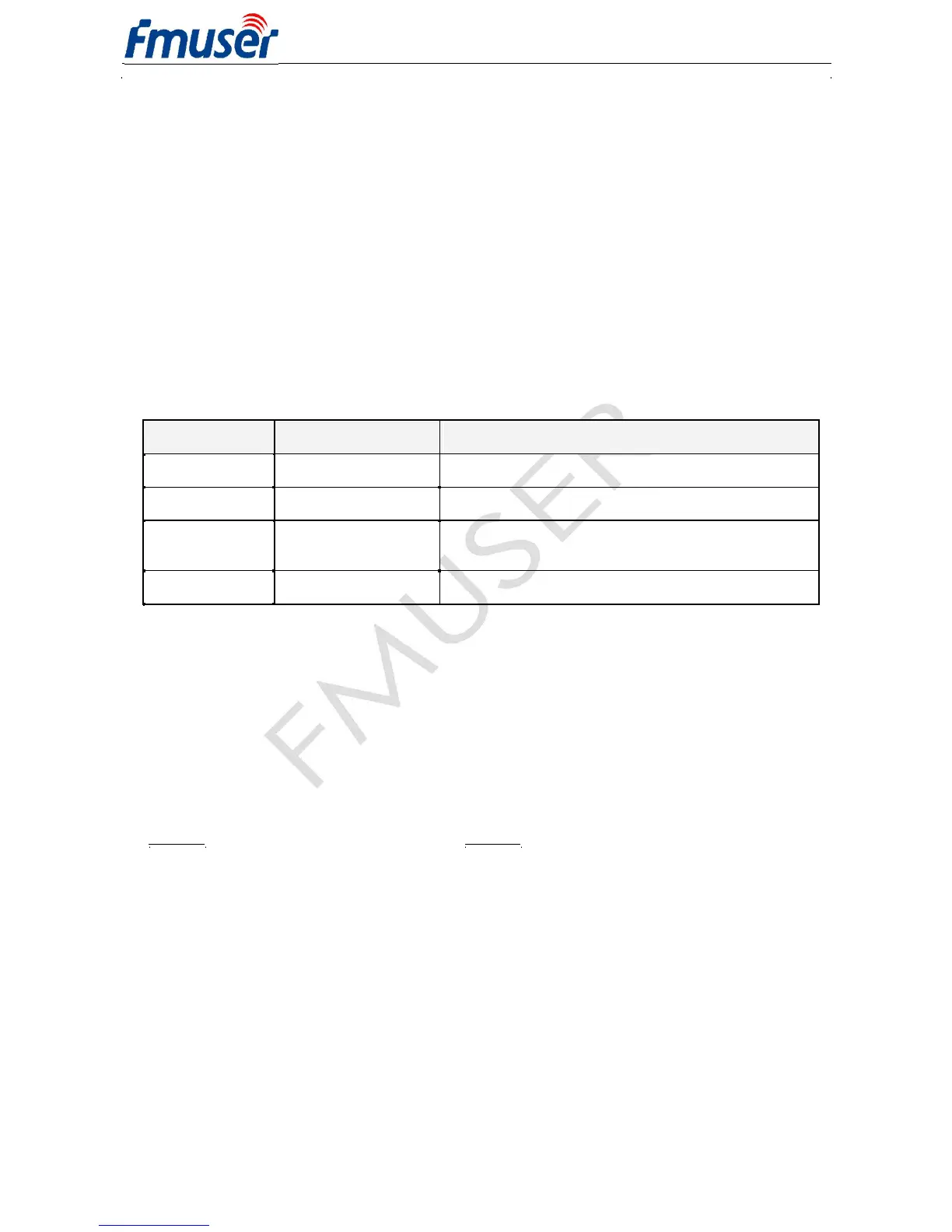
The coding to be used is as follows:
Traffic Program Traffic Announcement
This program does not carry traffic announcements nor does it
refer, via EON, to a program that does.
This program carries EON information about another program
that gives traffic information.
This program carries traffic announcements but none are being
broadcast at present and may also carry EON information
about other traffic announcements.
A traffic announcement is being broadcast on this program at
Station which uses the code TP=0, TA=1 must refer to at least one program service which carries traffic information,
and has the flag TP=1. When a particular program service begins a traffic announcement, the station that cross-
references this service via the EON feature will broadcast a switch signal by setting the appropriate EON TA flag to 1.
The EON TA flags can be controlled by software for all four EON links in the RDS-C. The first EON link TA flag can
be also controlled by external TA/EON1TA switch.
The situation described is illustrated on the example below:
7.1.2 Example
Kiss FM is a small station that doesn’t carry traffic announcements but refers via EON to City Radio, which is
regional station of the same owner that carries the traffic announcements. If the Kiss FM listener has activated the
EON feature on his receiver, he will be automatically tuned to City Radio for the duration of traffic announcements.
Station 1: Kiss FM
Station 2: City Radio
PI=20F1
PI=2501
PS=KISS FM
PS=CITY
TP=0, TA=1
TP=1, TA=(controlled by external switch)
Frequency: 90.2 MHz
Frequencies: 93.7 and 106.2 MHz
(only 93.7 can be received in the area covered by Kiss FM)
Station 1 EON Data:
EON1PI=2501
EON1PS=CITY
EON1TA=(controlled by external switch)
EON1AF=93.7
Both TA/EON1TA switch connectors can be wired together and controlled by only one switch or device if the
transmitters of 90.2 and 93.7 MHz are placed on the same site.



 To Next Page