FMUSER INTERNATIONAL GROUP INC. 广州市汉婷生物技术开发有限公司
20
10.4 Additional Information
This additional information provides all details required for implementation of the RDS-C protocol into your
application (broadcast automation system, messaging system, TMC data source etc.).
Please see also the Annex 1 - Communication Protocol Implementation Flowcharts. Some source code examples
are provided on the website.
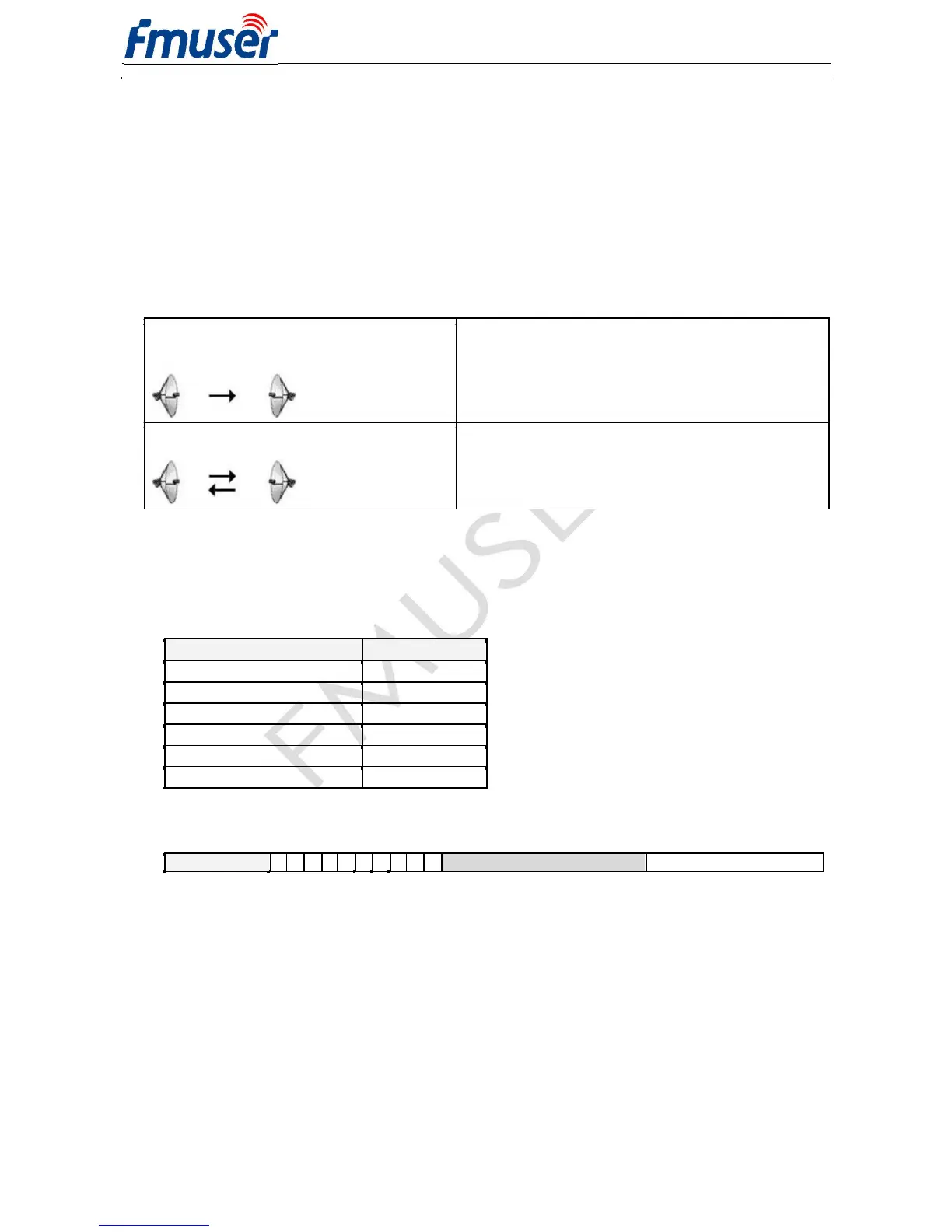
10.4.1 Unidirectional or bidirectional – What is the difference?
The RDS-C supports both unidirectional and bidirectional communication modes. Nothing is required to be set, the
mode of operation results only from the method of communication.
(backward channel from the RDS encoder is not Very simple to implement
present or the data from this channel are ignored)
No direct feedback from the unit
Unsuitable for higher user data rates
Bidirectional
Reliable remote control
(both channels are used, recommended mode)
High user data rates possible due to real command sync.
Backward channel may be hard to realize in some cases
10.4.2 Command synchronization
Unidirectional communication:
If sending more commands in sequence, the execution times must be taken into consideration. In other case
some commands may be discarded after internal buffer filling (the RX buffer length is 48 bytes).
Command
Execution time
PS=, TPS=, DPSx=
up to 400 ms
G=
up to 200 ms
*ALL
200 ms
*EON, *DPSx, *MSGxx=
50 ms
Other store commands, SEN=
10 ms
All other commands
0 ms (typ.)
The times result from the EEPROM write cycle duration or from the requirement of internal synchronization with
RDS data group order. Most of commands require no perceptible delay due to internal RX line buffering.
TX P
(execution time) (next command may follow)
Legend:
TX – data sent to the RDS encoder, ← - CR (char. 13, <Enter>)



 To Next Page