Cab Load Disconnect Switch
WARNING
Turning the cab load disconnect switch (CLDS) to
the OFF position does not disconnect power to
all electrical components (e.g. the starter and
sSAM). To work on the vehicle safely, the
negative leads must be disconnected from the
battery.
The cab load disconnect switch can be used to
disconnect the circuits between the battery and the
battery cable access box (BCA), minimizing the
power draw on the battery when the vehicle is
parked for an extended period of time.
The CLDS may be mounted in a variety of locations,
including:
•
inside the cab on the outboard side of the
driver’s sat;
•
behind the cab on the driver’s side;
•
at the battery box;
•
outside of the cab.
The ignition must be turned OFF before turning the
cab load disconnect switch ON or OFF.
The CLDS is set to ON for normal daily use. When
the CLDS is set to ON, a steady red LED indicator at
the base of the switch selector illuminates. See
Fig. 8.9.
A flashing red LED indicates an error with the CLDS.
Take the vehicle to an authorized Freightliner service
center for diagnostics.
The CLDS should be set to OFF if the vehicle will be
parked for more than two days. However, even with
the CLDS OFF, the vehicle still draws a small
amount of battery power. If parking the vehicle for
more than five days, disconnect the batteries.
IMPORTANT: If the vehicle is driven while the
CLDS is set to the OFF position, the vehicle will
run on the emergency power feed but the
f54804612/ 2219/20
1
2
3
4
5
6
7
8
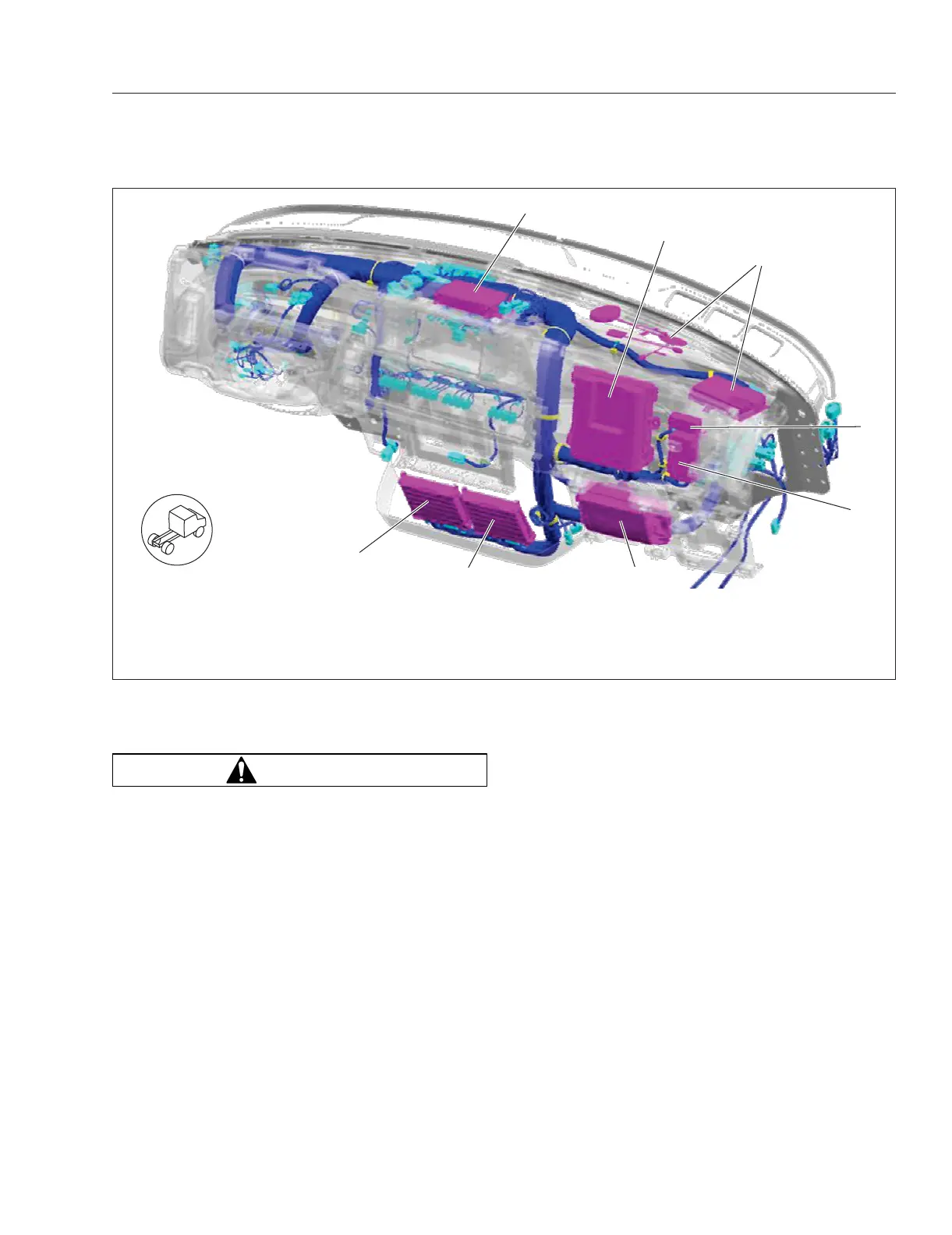
1. Common Powertrain Controller (CPC)
2. Advanced Signal Activation Module (ASAM)
3. Common Telematics Platform (CTP)
4. Central Gateway (CGW)
5. Video Radar Decision Unit (VRDU)
6. Power Distribution Module, Interior (PDMi)
7. Extension Module Controller 1 (XMC1)
8. Extension Module Controller 2 (XMC2)
Fig. 8.8, Component Locations Behind the Dash
Electrical System
8.4








 To Next Page