Engine Starting
This engine chapter is to serve as a guide for best
practices only. Each engine model may have
operating characteristics that are unique to that
particular engine, and is documented in the engine
manufacturer’s literature. Always refer to specific
instructions and recommendations from the engine
manufacturer.
NOTE: Before starting the engine, read
Chapter 3, Instruments, and Chapter 4, Driver
Controls. Read the engine manufacturer’s
operating instructions before starting the engine.
WARNING
Never pour fuel or other flammable liquid into the
air inlet opening in the air intake in an attempt to
start the vehicle. This could result in a flash fire
causing serious personal injury or property
damage.
IMPORTANT: Freightliner vehicles are equipped
with starter interlocks to enhance reliability and
safety. Anti-grinding, starter pinion, and thermal
protection logic limit the amount of time and
conditions for starter engagement. Cranking
may be limited from 5 to 15 seconds, with a 30-
second cool-down period, as determined by the
protection logic. If the engine is turning, the
starter will not engage. Depending on the
transmission option, the starter will not engage if
the clutch is not fully depressed, or if the
transmission is not in neutral.
IMPORTANT: The starter can not be used for
priming the fuel system. If the fuel/water
separator filter is replaced, and the fuel system
needs to be primed, see the engine
manufacturer’s operating instructions.
1.
Before engine start-up, complete the pre- and
post-trip inspections and maintenance
procedures in
Chapter 22.
2.
Set the parking brake.
3.
Place the transmission in neutral. On vehicles
with manual transmissions, fully depress the
clutch pedal.
NOTE: Depending on local jurisdictional
emissions regulations, vehicles and/or engines
that are domiciled outside of the U.S. and
Canada may not be equipped with the
STARTER BLOCKED function.
4.
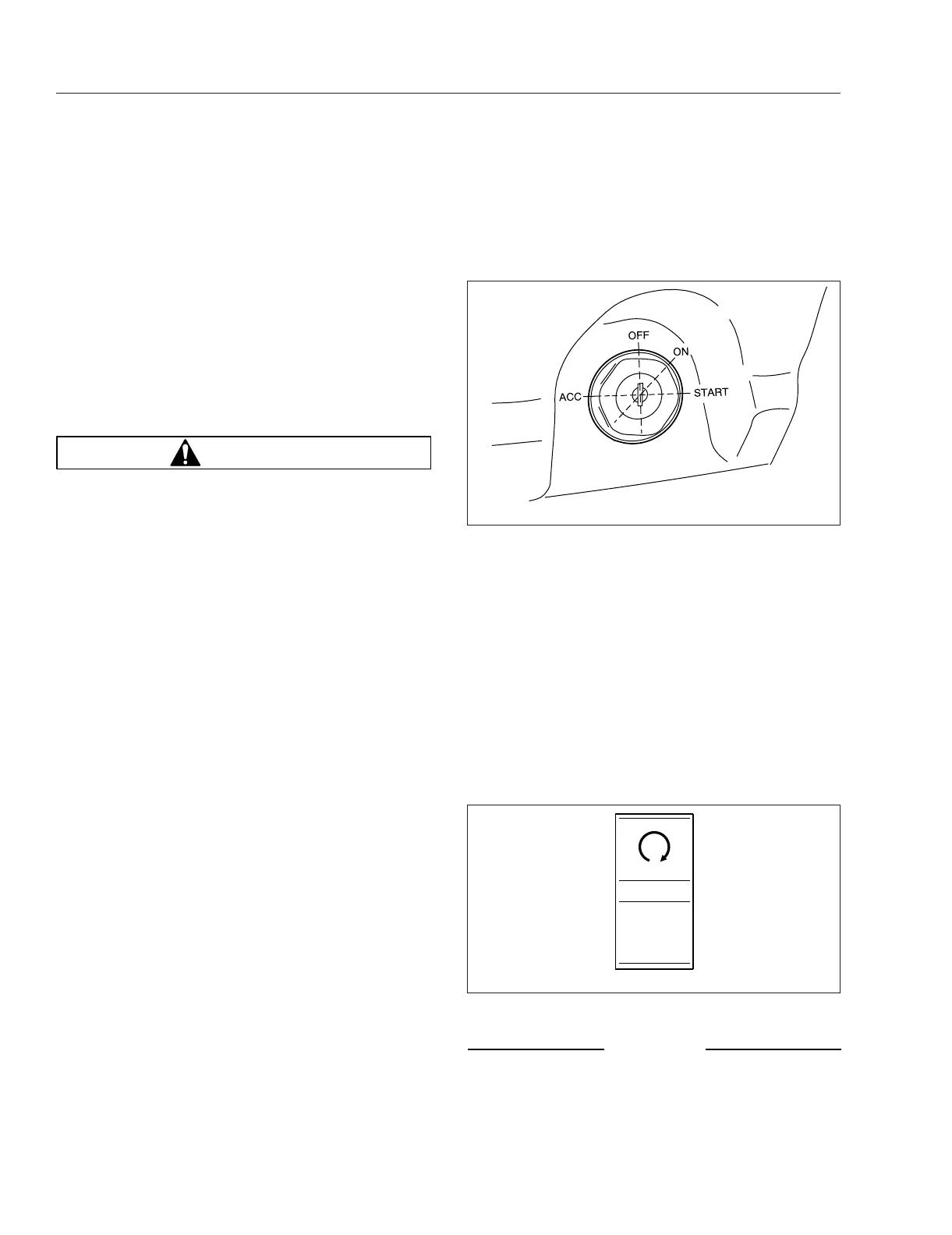
Turn the ignition switch to the ON position and
allow the self-check to complete. See
Fig. 9.1.
NOTE: The driver display screen may present a
STARTER BLOCKED message if the gauge
sweep is not completed, the transmission is in
gear, or the starter has overheated.
5.
Once the gauge sweep has completed, turn the
ignition key to the START position. Release the
key the moment the engine starts.
If the vehicle is equipped with an engine start
switch as shown in
Fig. 9.2, hold the switch
down while turning the ignition key to the START
position. Release the switch and the key the
moment the engine starts.
NOTICE
Do not rev the engine if the oil pressure gauge
indicates no oil pressure. Shut down the engine
f61080502/03/2017
Fig. 9.1, Ignition Switch
f61145609/15/2016
ENGINE
START
Fig. 9.2, Engine Start Switch
Engine Starting, Operation, and Shutdown
9.1



 To Next Page