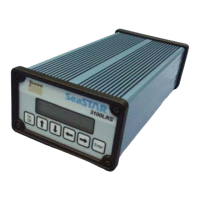
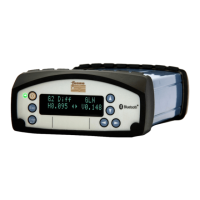
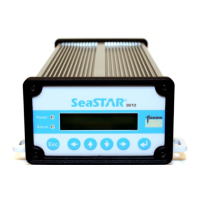
SeaSTAR 3610 USER MANUAL
INTRODUCTION
This manual has been produced to assist the typical user with the installation and
operation of the 3610 DGNSS receiver.
About this manual
This manual is organised into the following chapters:
Chapter 1 Introduction - A brief presentation of the manual and system features.
Chapter 2 Getting started – Describes how to get started with the 3610 DGNSS
receiver as quickly as possible.
Chapter 3 Modes of operation setup – Description of the different operation
modes.
Chapter 4 Receiver interfaces – Describes power, antenna and serial line
interfaces.
Chapter 5 Menus and displays – Describes how to set up and configure the
receiver.
Chapter 6 3610 DGNSS receiver and DPS setup example – Describes DGNSS
receiver setup with various DPS systems.
Chapter 7 Installation – A brief presentation of installation considerations and
description on how to install antennas and cables.
Chapter 8 Technical specifications – Describes the physical dimensions,
required power, environmental restrictions and cable specifications.
Appendix A Care of portable batteries
Appendix B Receiver service procedure
Appendix C SeaSTAR receiver problem report form
Appendix D Factory default settings
Appendix E Menu interface layout
System features
The 3610 DGNSS Receiver is a component of the Fugro worldwide DGNSS Service.
The Fugro service is a full-time differential GNSS (DGNSS) broadcast system
delivering corrections from an array of GPS and Glonass reference stations located
around the globe. Reference stations provide industry standard formatted corrections
to Network Control Centres (NCCs) at strategic geographic locations, where the
corrections are decoded, checked, and repackaged in a highly efficient broadcast
format. The data is modulated onto an RF carrier which is then up-converted for
transmission to an L-band communications satellite.
Issue 2.0 02/10
1


 To Next Page