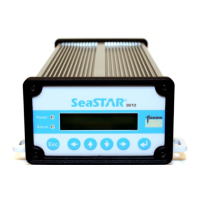
SeaSTAR 3610 USER MANUAL
The 3610 DGNSS receiver supports the following SeaSTAR services:
1. SeaSTAR HP
2. SeaSTAR G2
3. SeaSTAR XP
4. SeaSTAR DGNSS
5. SeaSTAR VBS
SeaSTAR HP is a decimetre level phase based service based on GPS L1 and L2
frequencies. The service uses GPS phase measurements to obtain an accuracy of 10
cm horizontal (95%) and 15 cm vertical (95%).
SeaSTAR G2 The L1 and L2 frequencies in both systems are used to compensate
for ionospheric delay. The orbit/clock concept utilizes reference stations with a
worldwide spread to calculate the orbit and the clock value of each GPS nd
GLONASS satellite more accurately than the broadcast ephemeris. Orbit and clock
corrections to the broadcast ephemeris are then transmitted to user. These
corrections are valid worldwide and the distance from the nearest reference stations
to the user does not affect performance.
SeaSTAR XP is a decimetre level phase based service using orbit/clock data valid
worldwide, based on GPS L1 and L2 frequencies. This concept uses reference
stations with a worldwide spread to calculate the orbit and the clock value of each
GPS satellite more accurately than the broadcast GPS ephemeris. Orbit and clock
corrections used to broadcast ephemeris, are then transmitted to the user. These
corrections are valid worldwide and the distance from the nearest reference stations
to the user does not affect performance.
SeaSTAR DGNSS is a metre level code based service based on GPS and
GLONASS L1 frequency. This is similar to DGPS. Since GLONASS is not fully
operational, DGLONASS has to be used together with DGPS to increase the number
of available satellites in the navigation solution.
SeaSTAR VBS (Virtual Base Station) is a metre level code based service based on
the GPS L1 frequency. VBS provides users with accurate positioning with a correction
message further enhanced from their location. This multiple reference station solution
can provide accuracy to within one metre. VBS provides consistent accuracy over
wide areas. VBS is highly reliable since it is not dependent on any single reference
station. There are no position jumps due to switching from one reference station to
another.
Issue 2.0 02/10
3


 To Next Page