Cell Connections
38
Normal Cell Connections
This section assumes that you are using standard, shielded cell cables. This information does not depend on the
length of such cables.
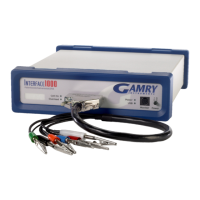
The cell end of the standard cell cables terminates in a number of banana plugs and pin jacks. Each termination
comes with a removable alligator clip. Table 5-1 identifies the terminals of the cables.
Table 5-1
Cell Cable Terminations: Potentiostat and Galvanostat Modes
Connect both the blue and green cell leads to the working electrode. The working electrode is the electrode
being tested. The blue pin jack connection senses the voltage of the working electrode. The green working
electrode connection carries the cell current. The working electrode may be as much as 520 mV above the
circuitry ground (floating ground).
Connect the white pin jack to the cell’s reference electrode, such as an SCE or Ag/AgCl reference electrode.
The measured cell potential is the potential difference between the blue and white cell connectors.
You may need to connect the Reference 5000 to a two-terminal device such as a packaged battery. In this case,
connect both the white cell and red cell leads to one side of the device, and the blue and green cell leads to the
other side. Try to connect the white and blue leads as close to the device as possible.
Connect the red banana plug to the counter or auxiliary electrode. In a three-terminal cell, the counter
electrode is usually a large inert metal or graphite electrode. The counter-electrode terminal is the output of the
Interface 5000’s power amplifier.
The orange cell lead is used to sense the counter-electrode potential (see following section). Automatic
switching to ZRA mode is possible if this lead is connected to the counter electrode. If you are not using ZRA or
Save Both ½ Cell modes, leave this lead open or connect it to the floating ground.
The black pin jack is connected to the Interface 5000 to Floating Ground. This is the circuitry ground for the
analog circuits in the Interface 5000. In most cases, leave this terminal disconnected at the cell end, but take
care that its metal contact does not touch any of the other cell connections.
If your cell is a typical glass laboratory cell, all of the electrodes are isolated from earth ground. In this case, you
may be able to reduce noise in your data by connecting the Interface 5000’s Floating Ground to an earth
ground.



 To Next Page