EasyManua.ls Logo

Go Partner 1680X - BASIC CHESS INSTRUCTIONS; The Game Board; The Game Pieces; Setting Up the Board

Default Icon
20 pages
Print Icon
To Next Page IconTo Next Page
To Previous Page IconTo Previous Page
Loading...
BASIC
CHESS
INSTRUCTIONS
THE
GAME
BOARD
THE
GAME
PIECES
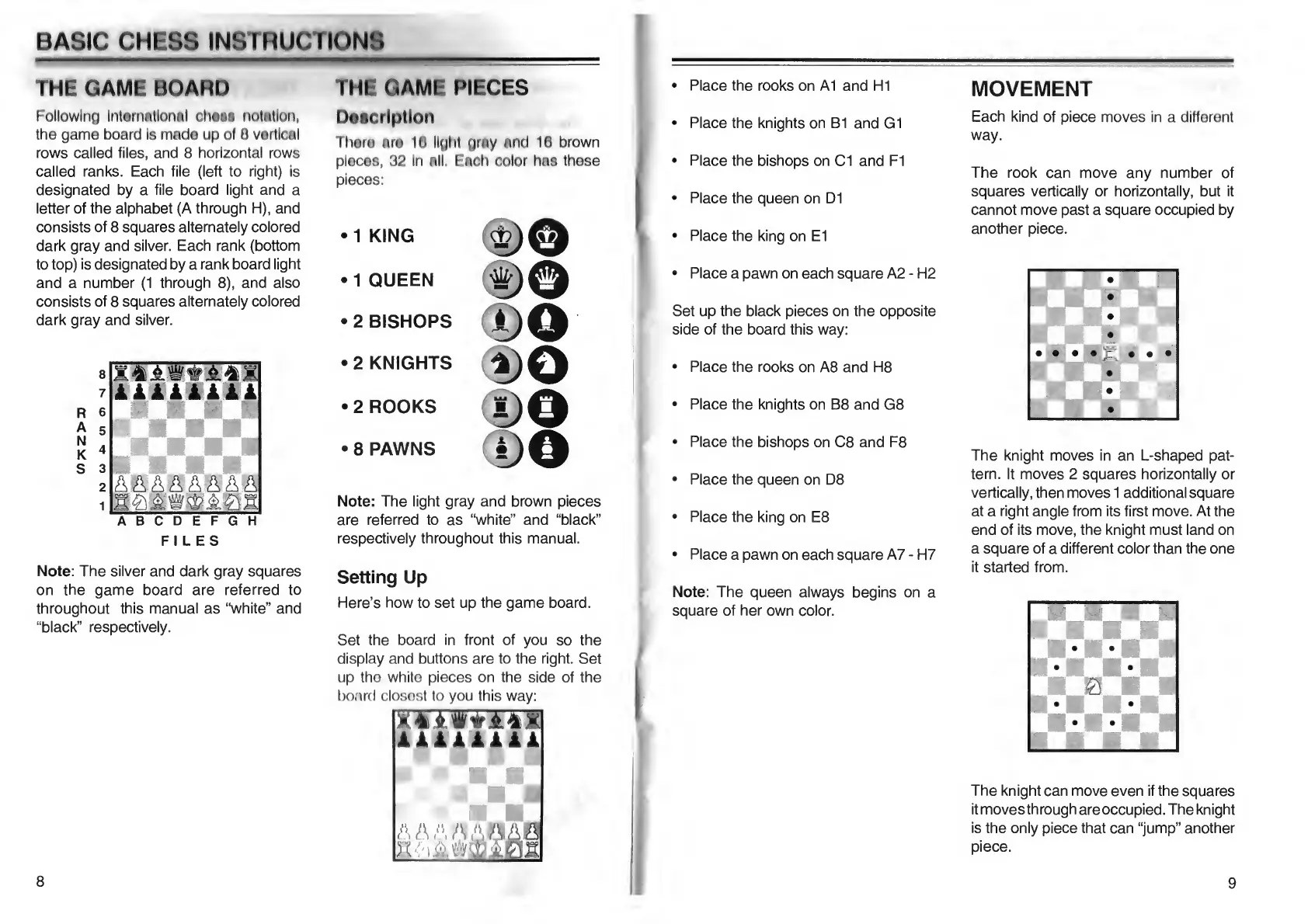
Following
International
cheaa
nolittion,
the
game
board
is
made
up
of
0
vertical
rows
called
files,
and
8
horizontal
rows
called
ranks.
Each
file
(left
to
right)
is
designated
by
a
file
board
light
and
a
letter
of
the
alphabet
(A
through
H),
and
consists
of
8
squares
alternately
colored
dark
gray
and
silver.
Each
rank
(bottom
to
top)
is
designated
by
a
rank
board
light
and
a
number
(1
through
8),
and
also
consists
of
8
squares
alternately
colored
dark
gray
and
silver.
8
7
R
6
S
3
2
1
ABCDEFGH
FILES
D«scrlptlon
there
are
10
light
gray
and
16
brown
pieces,
32
in
all.
E
ach
color
has
these
pieces:
1
KING
•1
QUEEN
•2
BISHOPS
1)0
2
KNIGHTS
®o
2
ROOKS
1)0
8
PAWNS
*)©
Note:
The
light
gray
and
brown
pieces
are
referred
to
as
“white”
and
“black”
respectively
throughout
this
manual.
Note:
The
silver
and
dark
gray
squares
on
the
game
board
are
referred
to
throughout
this
manual
as
“white”
and
“black”
respectively.
Setting
Up
Here’s
how
to
set
up
the
game
board.
Set
the
board
in
front
of
you
so
the
display
and
buttons
are
to
the
right.
Set
up
the
white
pieces
on
the
side
of
the
board
closost
to
you
this
way:
8
Place
the
rooks
on
A1
and
HI
Place
the
knights
on
B1
and
G1
Place
the
bishops
on
Cl
and
FI
Place
the
queen
on
D1
Place
the
king
on
El
Place
a
pawn
on
each
square
A2
-
H2
Set
up
the
black
pieces
on
the
opposite
side
of
the
board
this
way:
Place
the
rooks
on
A8
and
H8
Place
the
knights
on
B8
and
G8
Place
the
bishops
on
C8
and
F8
Place
the
queen
on
D8
Place
the
king
on
E8
Place
a
pawn
on
each
square
A7
-
H7
Note:
The
queen
always
begins
on
a
square
of
her
own
color.
MOVEMENT
Each
kind
of
piece
moves
in
a
different
way.
The
rook
can
move
any
number
of
squares
vertically
or
horizontally,
but
it
cannot
move
past
a
square
occupied
by
another
piece.
The
knight
moves
in
an
L-shaped
pat¬
tern.
It
moves
2
squares
horizontally
or
vertically,
then
moves
1
additional
square
at
a
right
angle
from
its
first
move.
At
the
end
of
its
move,
the
knight
must
land
on
a
square
of
a
different
color
than
the
one
it
started
from.
The
knight
can
move
even
if
the
squares
it
moves
through
areoccupied.
The
knight
is
the
only
piece
that
can
“jump”
another
piece.
9

Table of Contents