EasyManua.ls Logo

Go Partner 1680X - GAME RULES; Checkmate - The Object of the Game; Check; Capturing

Default Icon
20 pages
Print Icon
To Next Page IconTo Next Page
To Previous Page IconTo Previous Page
Loading...
Thti
blNhop
cun
movn
any
number
of
squares
diagonally,
but
It
cannot
mova
past
a
square
occupied
by
another
piece.
n
pV."
D
BUB
u
a
m%
a
m
m
_
a
IBID
D
The
queen
can
move
any
number
of
squares
vertically,
horizontally,
or
diago¬
nally.
(The
queen’s
moves
are
a
combi¬
nation
of
the
rook’s
and
bishop’s
moves.)
The
queen
cannot
move
past
a
square
occupied
by
another
piece.
Ilia
king
can
move
only
1
square
verti¬
cally.
horizontally,
or
diagonally.
The
pawn
can
move
only
1
square
di¬
rectly
forward,
except
when
capturing
another
piece.
It
captures
a
piece
by
moving
diagonally
forward
1
square,
except
when
capturing
en
passant
(see
“Capturing
En
Passant”).
When
it
moves
from
its
original
position,
it
can
move
1
or
2
squares
forward.
On
subsequent
moves,
it
can
only
move
1
square.
A
pawn
can
be
promoted
to
a
piece
of
higher
rank.
See
“Promoting
a
Pawn.”
GAME
RULES
Checkmate
The
Object
of
the
Game
The
object
of
the
game
is
to
position
your
pieces
so
your
next
move
would
capture
the
opponent’s
king,
and
your
opponent
cannot
move,
protect
the
king,
or
capture
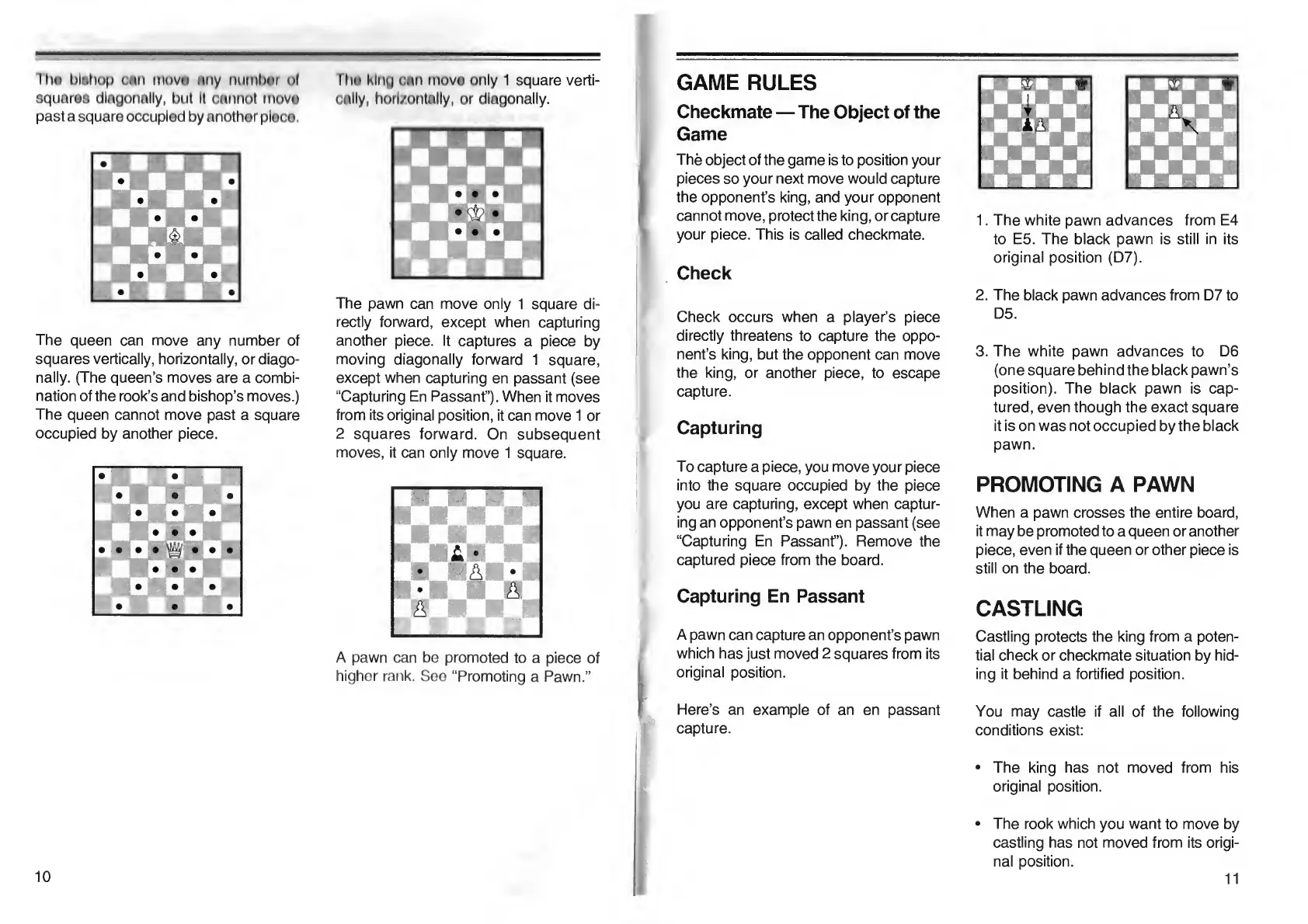
-|.
The
white
pawn
advances
from
E4
your
piece.
This
is
called
checkmate.
to
E5.
The
black
pawn
is
still
in
its
Check
original
position
(D7).
Check
occurs
when
a
player’s
piece
directly
threatens
to
capture
the
oppo¬
nent’s
king,
but
the
opponent
can
move
the
king,
or
another
piece,
to
escape
capture.
Capturing
To
capture
a
piece,
you
move
your
piece
into
the
square
occupied
by
the
piece
you
are
capturing,
except
when
captur¬
ing
an
opponent’s
pawn
en
passant
(see
“Capturing
En
Passant”).
Remove
the
captured
piece
from
the
board.
2.
The
black
pawn
advances
from
D7
to
D5.
3.
The
white
pawn
advances
to
D6
(one
square
behind
the
black
pawn’s
position).
The
black
pawn
is
cap¬
tured,
even
though
the
exact
square
it
is
on
was
not
occupied
by
the
black
pawn.
PROMOTING
A
PAWN
When
a
pawn
crosses
the
entire
board,
it
may
be
promoted
to
a
queen
or
another
piece,
even
if
the
queen
or
other
piece
is
still
on
the
board.
Capturing
En
Passant
A
pawn
can
capture
an
opponent’s
pawn
which
has
just
moved
2
squares
from
its
original
position.
CASTLING
Castling
protects
the
king
from
a
poten¬
tial
check
or
checkmate
situation
by
hid¬
ing
it
behind
a
fortified
position.
Here’s
an
example
of
an
en
passant
You
may
castle
if
all
of
the
following
capture.
conditions
exist:
The
king
has
not
moved
from
his
original
position.
The
rook
which
you
want
to
move
by
castling
has
not
moved
from
its
origi¬
nal
position.
11

Table of Contents