
 Need help?
Do you have a question about the Great Scott Gadgets HackRF and is the answer not in the manual?
Guide to setting up HackRF with the Pentoo Linux distribution for initial use.
Instructions for installing HackRF software on various operating systems.
Provides examples for testing HackRF functionality and basic usage.
Details the command-line arguments and usage of the hackrf_sweep tool.
Explains the meaning of the output columns generated by hackrf_sweep.
Guidance on installing HackRF software using package managers for different Linux distributions.
Instructions for compiling HackRF tools from source code.
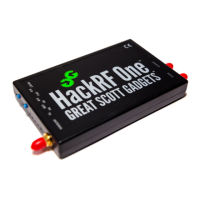
Lists the key features and specifications of the HackRF One hardware.
Compares the HackRF One hardware with its predecessor, Jawbreaker.
Discusses available enclosure options for the HackRF One.
Explains the function of the RESET and DFU buttons on the HackRF One.
Clarifies the antenna connector type and potential compatibility issues.
Details the transmit power capabilities of HackRF One across different frequencies.
Specifies the maximum receive power handling capacity and damage risks.
Explains the usage and specifications of the external clock interface.
Provides links to hardware schematics, assembly diagrams, and bill of materials.
Describes the various expansion headers available on the HackRF One board.
Instructions for configuring and using the Opera Cake antenna switching add-on.
Explains how to set and list the I2C address for Opera Cake boards.
Details the input and output ports available on the Opera Cake board.
Describes how to pre-configure HackRF for frequency bands with Opera Cake.
Step-by-step guide to updating the HackRF's SPI flash firmware.
Instructions for updating the CPLD bitstream on older HackRF firmware versions.
Explains how to boot HackRF into DFU mode for firmware recovery.
Details the process of recovering SPI flash firmware using DFU mode.
Instructions for installing the DFU-Util tool required for firmware updates.
Troubleshoots common Linux access issues, including permissions and udev rules.
Addresses issues caused by USB autosuspend and how to disable it.
Discusses conflicts with kernel modules and how to blacklist them.
Troubleshooting advice for the `hackrf_set_sample_rate` command failure.
Explains DC offset as a common phenomenon in SDR and HackRF.
Provides methods to handle or mitigate DC offset in received signals.
Lists the minimum hardware and software requirements for using HackRF.
Describes the function and colors of the LEDs on the HackRF One.
Explains the half-duplex nature of HackRF One and potential for full-duplex.
Discusses how to determine HackRF's receive sensitivity for specific applications.
Addresses issues with signal frequency changes and firmware/CPLD mismatches.
Example of using HackRF for spectrum analysis, with a link to a demo.
Example project involving wireless microphones and HackRF.
Project description about controlling a LEGO car using HackRF.
Example of using HackRF for automotive remote keyless entry systems.
Example of using HackRF for sniffing GSM signals.
Example of decoding Pocsag pagers using HackRF.
Project comparing HackRF capabilities with a Tesla Model S.
Information on seeking assistance and reporting issues via GitHub.
Guidance on accessing past discussions via the HackRF-dev mailing list.
Information on community support channels like Discord and IRC.
Discusses the importance of USB cable selection for HackRF performance.
Explains the impact of sampling rate and baseband filters on signal quality.
Directs users to the repository for instructions on building firmware.
Details how to use a Black Magic Probe for debugging the LPC43xx.
Information on using LPC-Link for debugging with LPCXpresso boards.
Setup and configuration for using an ST-LINK/V2 debugger.
Provides tips and commands for running ARM GDB for debugging.
Lists the MAX2837 transceiver and related documentation.
Details the MAX5864 ADC/DAC chip and its datasheet.
Information on the Si5351 clock generator and its documentation.
Lists the LPC43xx microcontroller and its user manual.
Details the RFFC5072 mixer/synthesizer and its documentation.
Mentions the W25Q80BV 8M-bit Flash memory component.
Presents block diagrams of the HackRF frontend/baseband architecture.
Shows the block diagram for the HackRF digital stage.
Explains how clock signals are generated by the Si5351 for HackRF.
Details the clock output mapping for Lemondrop/Jellybean boards.
Outlines the clock output mapping for the Jawbreaker board.
Explains the need for hardware-level synchronization for multiple HackRF devices.
Mentions related work on synchronizing HackRFs using the CPLD.
Lists the necessary hardware components for device synchronization.
Warns about opening the HackRF case and directs to a video guide.
Guides on connecting clock signals between HackRF devices for synchronization.
Explains how to identify specific pin headers on the HackRF board.
Step-by-step instructions for wiring pin headers for synchronization.
Instructions for upgrading HackRF firmware and libhackrf.
Describes how to test hardware synchronization using hackrf_transfer.
Discusses future possibilities and improvements for multi-device setups.
Overview of software compatible with HackRF.
Lists GNU Radio applications that support HackRF.
Lists software with direct HackRF support.
Lists tools that can process HackRF data files.
Introduces the command-line tools provided for HackRF interaction.
Provides an example of handling HackRF data using Matlab.
Describes functions for initializing and shutting down the libHackRF library.
Function to initialize libHackRF and the USB context.
Function to open a HackRF device.
Function to retrieve a list of attached HackRF devices.
Opens a specific HackRF device from a list.
Frees memory associated with the HackRF device list.
Opens a HackRF device using its serial number.
Closes a connection to a HackRF device.
Shuts down the libHackRF library and USB context.
Covers functions for starting and stopping radio operations (RX/TX).
Function to set the baseband filter bandwidth.
Covers functions for reading and writing device registers.
Covers functions for updating HackRF firmware components.
Function to write firmware to the CPLD.
Functions for reading board identification information.
Miscellaneous utility functions for libHackRF.
Describes data structures used by the libHackRF API.
Lists enumerations used within the libHackRF API.
Defines transceiver modes for HackRF operation.
Lists the key features of the HackRF Jawbreaker beta platform.
Guide to modifying Jawbreaker to use external antennas by disabling the PCB antenna.
Clarifies SMA vs. RP-SMA connectors for Jawbreaker.
Details the transmit power of Jawbreaker across different frequencies.
Provides links to hardware documentation for Jawbreaker.
Describes the expansion interface headers on the Jawbreaker.
Details boot configuration options for the LPC interface.
Lists pins and functions for the P19 SPIFI intercept header.
Lists pins and functions for the P20 GPIO header.
Lists pins and functions for the P21 Analog header.
Lists pins and functions for the P22 I2S header.
Lists pins and functions for the P25 LPC_ISP header.
Lists pins and functions for the P26 LPC_JTAG header.
Lists pins and functions for the P28 SD header.
Details the CPLD expansion interface headers.
Lists pins and functions for the P29 CPLD_JTAG header.
Lists pins and functions for the P30 BANK2_AUX header.
Lists pins and functions for the P31 BANK1_AUX header.
Discusses external clock connections and component requirements.
Details the P2 CLKOUT header pins and functions.
Details the P16 CLKIN header pins and functions.
Describes the P17 CLKIN jumper for enabling external clock input.
Lists the main design objectives for the HackRF project.
Outlines desired features and improvements for future HackRF designs.
Considers antenna design choices for future HackRF hardware.
Discusses potential modifications to the baseband interface.
Considers removing or replacing the CPLD in future hardware.
Discusses clock signal considerations and potential RTC integration.
Explores possibilities for enhanced USB support in future hardware.
Discusses power management options for future HackRF designs.
Mentions potential changes to regulator circuitry.
Suggests adding reset or DFU buttons to future hardware.
Considers adding RF shielding to future hardware designs.
Suggests improvements to component footprints for better soldering.
Discusses support for add-on shields and header configurations.
Details the process of bringing up the Si5351 I2C clock generator.
Lists the physical connections required for Si5351 I2C setup.
Provides commands for initializing the Bus Pirate for I2C communication.
Shows how to read registers from the Si5351 using I2C.
Demonstrates writing registers to the Si5351 via I2C.
Discusses phase relationships of Si5351 outputs with different configurations.
Introduces examples of using the LPC43xx SGPIO peripheral.
Example code for toggling SGPIO pins in GPIO mode for testing.
Example code for controlling SGPIO pins from within the SGPIO peripheral.
Example code for serializing data using SGPIO with a slice clock source.
 General
| Frequency Range | 1 MHz to 6 GHz |
|---|---|
| Bandwidth | 20 MHz |
| Half-Duplex Transceiver | Yes |
| Interface | USB 2.0 |
| ADC Resolution | 8-bit |
| DAC Resolution | 8-bit |
| Power Source | USB powered |
| Operating Systems | Linux, Windows, MacOS |

 To Next Page