GENERAL
16 © HAMM AG 2009
1.4 IDENTIFICATION OF THE
ROLLER
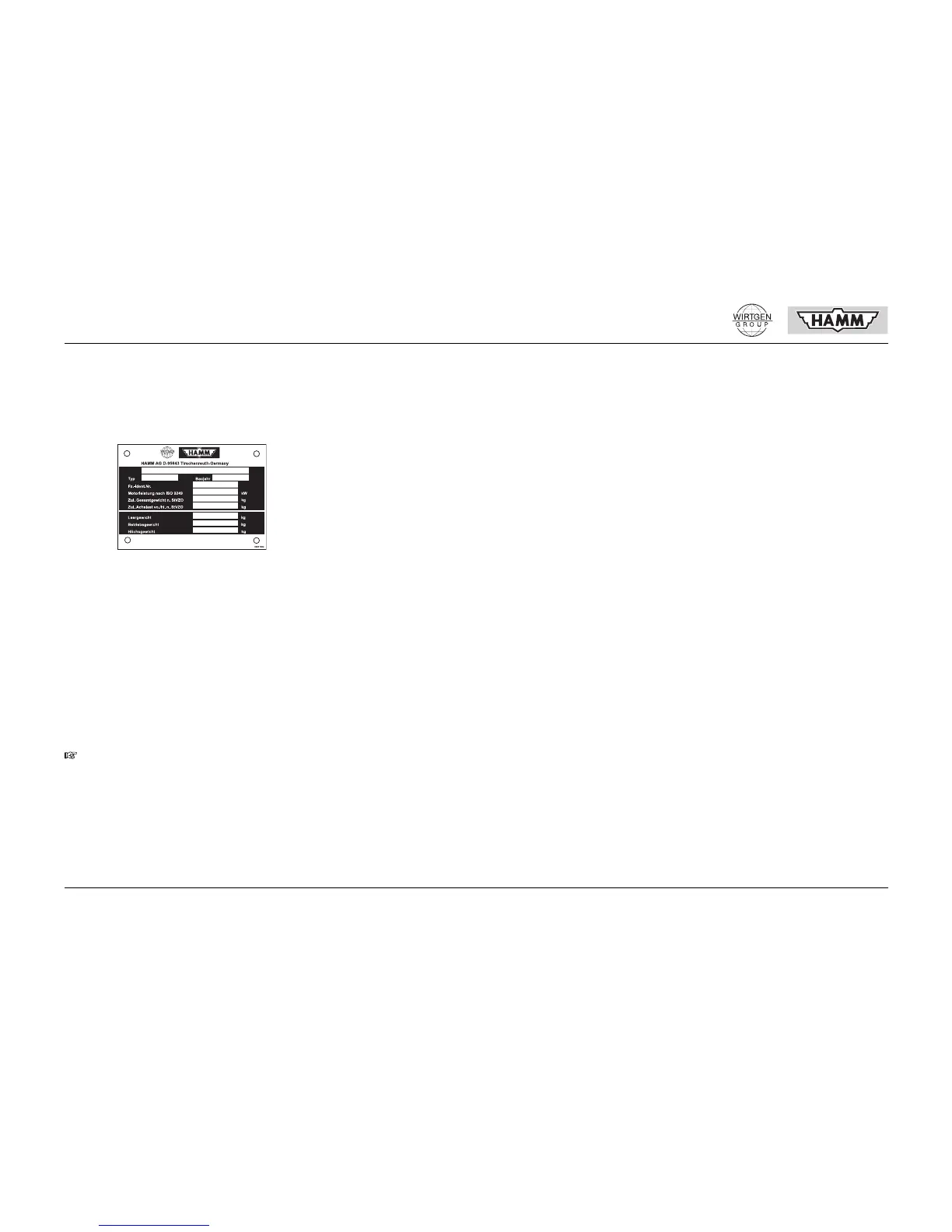
1.4.1 Type sign, VIN.
The unique identification of the roller is given
by the vehicle identification number (VIN). It
can be found on the type sign together with the
type designation and the weight indications.
The type sign is fixed to the machine frame. It
must neither be changed nor removed.
If the type sign is not legible any longer, or if it
has been lost, a replacement type sign must
be ordered immediately at the HAMM custom-
er service, stating the VIN embossed into the
right front part of the machine frame, and fixed
to the machine.
1.5 TECHNICAL DATA
1.5.1 Loading and transport
When loading rollers onto lorries, trailers or
semitrailers, it is very important to secure the
load properly. The duty for tie-down on street
vehicles arises from StVO § 22, StVO § 23,
HGB § 412 as well as from VDI guideline 2700.
Sufficient knowledge about the loading of vehi-
cles as well as about their behaviour under
load are required for loading and transporting
the machine. The machine may only be loaded
by trained loading staff. It must be fixed to the
vehicle in an form-locked or friction-locked and
transport-safe way. The machine must not
change its position of the vehicle during normal
traffic loads. Emergency braking, change ma-
noeuvres and uneven grounds count among
normal traffic loads. If it is impossible to secure
the machine properly onto the vehicle, of if the
loading vehicle shows visible defects which do
not ensure safe transport, loading must not be
performed.
The relevant accident prevention regulations
as well as further generally acknowledged
safety and traffic-related rules must be com-
plied with.
• Weight and dimensions (technical data).
• It is very important to use a loading ramp
when loading the machine onto a lorry.
• If necessary, support the loading area to
the floor in order to prevent the vehicle
(trailer) from tilting upwards when the roller
is driven onto the loading platform.
• Only use appropriate gantries or planks.
When driving the roller up the loading ar-
ea, take care that the drums or tires have
appropriate contact.
• Gantries and planks must be free from
grease, dirt, ice etc.
• Drive the machine slowly onto the loading
area with ¾ diesel engine speed.
• On rubber wheel rollers with tyre inflation
system, the tyre pressure must be set to
6 bar (87 psi). The actuation element for
tire filling must set the the centre position
after that.
• Shut down the machine and secure
against unauthorised start (see section
“Stopping, shutting down the engine, leav-
ing the machine”).
• In case of rollers with articulated steering,
the steering blocking must always be acti-
vated for transport.
• Secure the drums or tires with wedges
against shifting.
• Lash the machine with appropriate lashing
devices onto the loading area, using only
the marked lashing lugs (see figure).
• In case of crane loading, only fix ropes to
the marked lifting lugs.
Please state the VIN and the type designa-
tion of your machine for every spare part
order.


 To Next Page