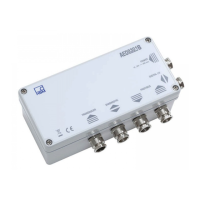
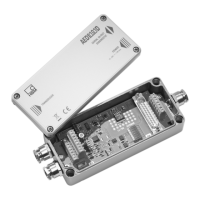
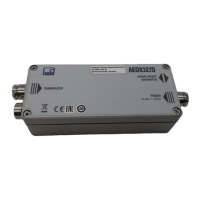
AED9101D
14 I3563-1.0 en
6 Electrical connection
Note
Electronic components are sensitive to electrostatic dis
charge (ESD). So you must discharge your own static
electricity before opening the device. We recommend
wearing an antistatic band (a conductive wristband) and
using a conductive base.
The required power supply is an extra-low voltage (10 ...
30 V
DC
) with safe disconnection from the mains.
Use shielded cables for the connecting cables to trans-
ducers and interfaces and connect the shield extensively
to the device housings on both sides, not to the measure-
ment ground or the supply voltage GND (use shielded
terminals if necessary). Also see Section 6.8 on page 29.
The cables for the supply voltage and the digital I/Os only
need to be shielded if the cables are longer than 30 m, or
are routed outside closed buildings (as per EN 61326-1).
Please ensure when making connections that the cable
wires do not project beyond the connection terminals
(risk of short circuit) and do not lie on the amplifier board
(risk of interference coupling). Please also make sure
that the cable shield is properly connected to the PG
gland, see Section 6.7 on page 28.
Tip
A connection diagram is attached inside the lid of the
each AED9101D basic device.


 To Next Page