Protocol description ASCII, SECS/HSMS
Customer manual
Version 1.2
LFM LP Reader 15.01.2019
Page 22 of 119
HERMOS AG
Gartenstrasse 19 Tel. +49(9279) 991-0
D-95490 Mistelgau Fax. +49(9279) 991-100
7. Installation
Follow the basic safety instructions in the chapter Safety instructions.
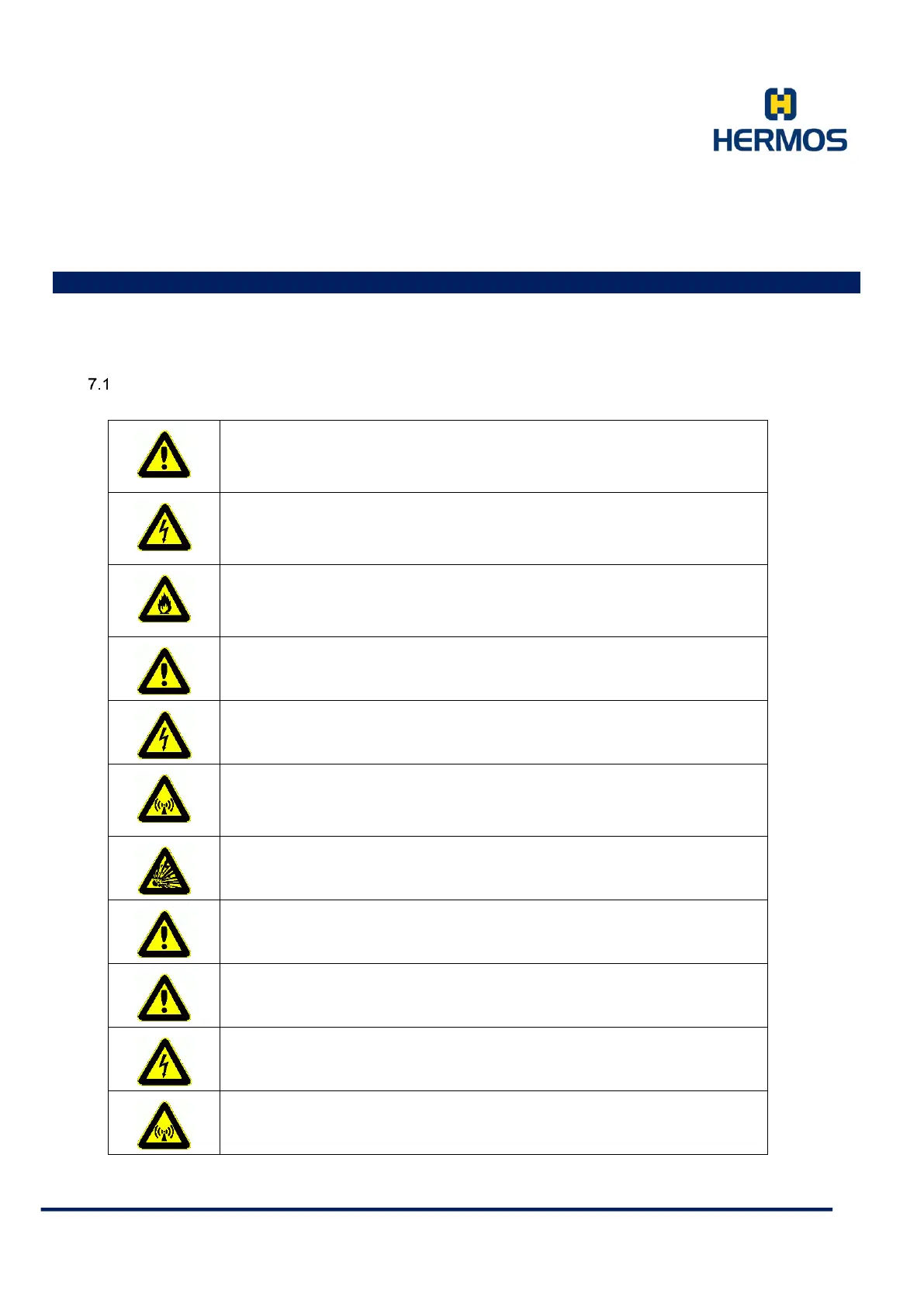
Safety instructions
The unit is exclusively designed for indoor use in an industrial
environment.
The unit may only be installed indoors with a temperature and humidity
level with in the range of the specified technical module parameters.
Never use the unit near or in water.
Never pour liquids of any type over the unit. However, if the unit should
still come in contact with liquid, disconnect it and have it checked by a
technician.
Do not install the device near heat sources such as radiators, heat
registers, stoves or other devices (including amplifiers) that generate
heat.
Do not install the unit in a flammable environment.
Never expose the device to extreme temperature fluctuations, since
condensation otherwise develops inside the unit and causes damages.
Do not install the device in the vicinity of voltage lines or other power
lines with which they could collide (for example, drilling), which could
result in serious injuries or even death.
The device (especially the antenna) should not be installed in the
immediate vicinity of electrical equipment such as medical devices,
monitors, telephones, TV sets and magnetic disks, and metal objects.
This could result in reduced read and write ranges.
Never use the unit in explosive areas (such as paint warehouses).
Do not use the device in areas where it is exposed to vibrations or
shocks.
The installation location must be adequately illuminated during the
installation.
Never install the unit during a lightning storm.
Make sure that the installation meets the requirements of the FCC
(country specific) for human exposure to radio frequencies.



 To Next Page