Need help?
Do you have a question about the HITEC RDX2 800 and is the answer not in the manual?
Allows simultaneous charging of two batteries with different configurations.
Monitors and balances each cell individually during discharge.
Supports charging LiPo, LiFe, Lilo, and LiHV batteries.
Equalizes cell voltages for optimum condition, recommended for Lithium.
Charges/discharges to 50% for safe storage, optimizing lifespan.
Sets a maximum time limit for charging to prevent overcharging.
Sets a limit for maximum mAh to prevent overcharging.
Switches between Port A and Port B, or exits system settings.
Enters menus, scrolls through options, and accesses system settings.
Describes AC and DC power input options for the charger.
Details LiPo and NiMH/NiCd/Pb battery connection methods.
Guides the user through initial setup after connecting the battery.
Lists available operations for different battery types.
Choose the correct battery type (LiPo, LiFe, Lilo, LiHV, NiMH, NiCd).
Select the number of cells for the connected battery.
Choose the charge mode (e.g., Balance CHG, Charge, Storage, Discharge).
Set the end voltage for charging or discharging.
Set the charge current, recommending 1C rate.
Start or stop the charging process with selected settings.
Choose the battery type (NiMH/NiCd).
Choose the operation mode (Charge, Re-Peak, Cycle).
Set the charge current, recommending 1C rate.
Choose the battery type (Pb).
Choose the operation mode (Normal, AGM, Cold Charge, Discharge).
Set the charge current.
Select battery type and cell count.
Choose task, condition, and current for the operation.
Start the program or return to the main interface.
Customize safety timer, max capacity, trickle charge.
Adjust language, screen brightness, volume, completion signal.
Set output voltage and current for DC power.
Measure battery voltage and internal resistance.
Errors related to DC input voltage being too low or too high.
Errors for reversed polarity, battery break, type mismatch, or balance connection break.
Errors like overcharge, overload, time out, or fully charged status.
Errors for high internal/battery temperature or cell voltage differences.
Errors for incorrect power settings or overloaded output.
Compliance with FCC rules for radio frequency energy.
Disclaimer for charger use and misuse liability.
Details the terms of the one-year repair or replacement warranty.
Instructions for obtaining service and repair for the charger.
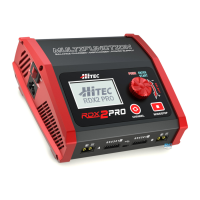
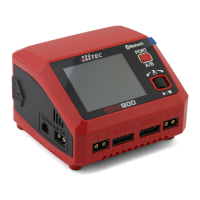
The Hitec RDX2 800 is a multi-function smart charger designed for RC hobby batteries, featuring independent circuits that allow for simultaneous charging of two batteries of different chemistries or capacities. It supports a wide range of battery types, including Lithium-Polymer (LiPo), Lithium-Ferrite (LiFe), Lithium-Ion (LiIo), high voltage Lithium-Polymer (LiHV), Nickel-Metal Hydride (NiMH), Nickel-Cadmium (NiCd), and Lead-Acid (Pb) batteries.
The RDX2 800 operates as a twin-channel charger, capable of charging two batteries concurrently with different configurations. It incorporates an internal independent Lithium battery balancer, monitoring and balancing each cell individually during charging and discharging processes. The charger offers multiple Lithium battery charge modes: Balance Charge (equalizes cell voltages for optimum condition), Charge (charges without balancing, though balance lead connection is recommended for monitoring), and Storage (charges or discharges to 50% capacity for safe storage). For NiMH/NiCd batteries, it provides Charge, Re-Peak (peaks the battery multiple times to ensure full charge), and Cyclic Charging/Discharging (1 to 5 cycles to refresh and restore performance). For Pb Lead-Acid batteries, it offers Normal, AGM Charge, Cold Charge (for low temperatures), and Discharge modes.
Beyond battery charging, the RDX2 800 also functions as a DC power supply, capable of powering external DC devices with up to 27V @ 15A. It includes a USB Type-C PD/QC3.0 output, allowing it to charge mobile devices with up to 20W of power.
The RDX2 800 features an LCD display screen, a metal scroll wheel for menu navigation and parameter selection, and a port select button to switch between Port A and Port B or exit system settings. It supports Terminal Voltage Control (TVC) for experienced users to reset the charger's end voltage. Safety features include Capacity Cut-Off Limit (prevents overcharging), Safety Timer (sets a maximum charging time), and Delta-Peak Sensitivity for NiMH/NiCd batteries (automatically terminates charge). The charger also includes a Battery Resistance Meter to check pack and individual cell voltages and resistance.
For enhanced control and monitoring, the RDX2 800 can be connected to a computer via a USB Type-C cable to use the Hitec Charge Manager software. This software allows for visual monitoring of charge time, capacity, current, and voltage in a curve, and enables battery performance analysis. Additionally, the charger has a built-in Bluetooth 5.0 module, enabling control and battery analysis through the Hitec LinkPower X mobile app (available on App Store and Google Play).
The RDX2 800 is compatible with the optional AD350 Analyzer & Discharger (sold separately), which expands its capabilities to include external discharging up to 40.0A and precise battery benchmarking with its Battery Analyze Software.
The manual provides a comprehensive list of warning and error messages with explanations to help users troubleshoot issues during operation. It also includes instructions for firmware updates, which can be performed via a computer using the Charge Manager software or through the LinkPower X mobile app. The device is designed for user-friendly operation, with clear instructions on connecting batteries and setting up charging programs. The manual emphasizes safety warnings, such as never leaving the charger unattended, avoiding charging on combustible materials, and only using reputable battery packs. It also recommends using safety devices like steel cases or LiPo sacks when charging Lithium batteries and keeping a fire extinguisher nearby.
The product comes with a one-year limited warranty covering defective equipment, with specific conditions and exclusions detailed in the manual. Service and repair information, including steps to obtain service and shipping instructions, are provided. The RDX2 800 also complies with FCC Part 15 Subpart B and CE directives, and includes a California Proposition 65 warning regarding chemicals known to cause cancer. The device is marked with a recycling symbol, indicating that it should not be disposed of with normal household waste at the end of its service life.
 General
| Brand | HITEC |
|---|---|
| Model | RDX2 800 |
| Category | Battery Charger |
| Language | English |

 To Next Page