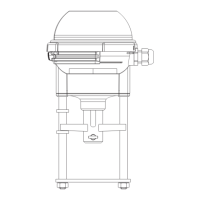
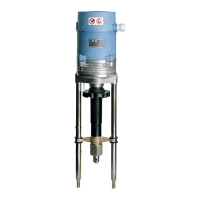
This document provides operating instructions for HORA M135, M140, M150, and M180 series rotary actuators. These devices are designed to adjust flaps and are controlled by three-position controllers.
Function Description
The rotary actuators transmit the geared-down rotary motion of a reversible motor to an actuator shaft, which then moves connected fittings. Integrated slow-down limit position switches automatically turn off the motor once the set point is reached.
The actuators can operate in either manual or automatic mode. In manual mode, the rotary motion is performed using a hand lever on an add-on kit. In automatic mode, the rotary motion is electrically controlled. The direction of motion in three-point mode is set via control voltage on terminals 2 and 3 of the terminal PCB: applying voltage to terminal 2 causes clockwise rotation, while voltage to terminal 3 causes anti-clockwise rotation.
Optional accessories enhance functionality:
- Potential-free path switches (106): Allow setting two actuating positions where a potential-free contact opens or closes.
- Potentiometer (180): Indicates the actual position of the rotary actuator, outputting angles of rotation up to 90° as resistance values (0-200 Ohm, 0-1 k Ohm, or 0-10 k Ohm).
- Actuator heater (190): Prevents condensation inside the actuator and ensures smooth gear movement down to -20°C.
Important Technical Specifications
The technical data varies by model (M135, M150 vs. M140, M180):
General:
- Supply voltage: 230 V AC +6%-10% or 24 V AC ±10% for all models.
- Frequency: 50/60 Hz ±5% for all models.
- Ambient temperature: 0 to +50°C for all models.
- Protection type: IP 54 for all models.
- Input signal Y: Three-point for all models.
- Limit stop cut-off: Slow-down, infinitely variable max. 320° for all models.
Model-Specific:
- Power consumption:
- M135 = 9 VA
- M150 = 12 VA
- M140 = 55 VA
- M180 = 26 VA
- Weight:
- M135, M150 = 2.5 kg
- M140, M180 = 3 kg
- Operation mode:
- M135, M150 = S1-100% ED
- M140 = S3-50% ED
- M180 = S3-60% ED
- Torque / Set time at 50 Hz:
- M135 = 35 Nm / 130 s/90° or 15 Nm / 70 s/90°
- M150 = 50 Nm / 130 s/90° or 40 Nm / 70 s/90°
- M140 = 50 Nm / 10 s/90°
- M180 = 80 Nm / 130 s/90° or 80 Nm / 70 s/90°
- Actuator heater heating capacity: 25 VA.
The type plate, located on the housing, provides the type designation, serial number, and date of manufacture.
Usage Features
- Installation: The actuator should not be arranged in a suspending position. Approximately 160 mm of space above the hood is required for installation.
- Mounting: If the actuator and flap are supplied separately, the actuator must be mounted onto the flap using a knee-bracket, coupling, and hexagon screws.
- Electrical Connection: Terminals for electrical connection are located under the hood. The wiring diagram (481) is positioned inside the hood (200). It is crucial to match the supply voltage to the type plate specifications and ensure proper line diameter. Parallel connection of multiple actuators via a single output contact is prohibited; a coupling relay must be provided for each actuator in a parallel circuit.
- Commissioning: Before operation, ensure the hood is mounted, the rotary knob is in the AUTO position, and the motor turns off in end positions (limit position switch).
- Setting Limit Position Switches: The limit position switches (WE 1 and WE 2) must be set before initial operation. WE 1 controls clockwise rotation, and WE 2 controls anti-clockwise rotation. The cam disks (45.1 to 45.4) within the cam block (40) can be adjusted separately.
- Setting Potential-free Path Switches: These switches (WE 3 and WE 4) are set similarly to limit position switches, allowing two actuating positions to be defined.
- Setting a Potentiometer: The potentiometer (180) is set by moving the actuator electrically to an end position (closed flap) and then carefully rotating the potentiometer axle with a screwdriver to its fixed stop.
- Manual Operation: To operate manually, disconnect the actuator from the power supply, turn the rotary knob (34) to the MAN position, and adjust the flap using the hand lever. Avoid excessive force to prevent damage.
- Automatic Operation: To switch back to automatic mode, turn the rotary knob (34) to AUTO, operate the hand lever until the gear engages, and then turn on the power supply.
Maintenance Features
The rotary actuator is designed for low maintenance, requiring no continuous or periodical maintenance.
Troubleshooting: A checklist is provided for common faults, including:
- Rotary actuator not working: Possible causes include the rotary knob being in MAN position, power cut, defective fuse, incorrect connection, short circuit, or motor winding damage. Rectifications involve turning the knob to AUTO, checking power supply, replacing fuses, correcting wiring, and checking motor data.
- Rotary actuator running unsteadily: May be due to voltage drop from long/insufficient cables or public power supply fluctuations. Rectifications include recalculating/replacing cables and improving power supply conditions.
- Rotary actuator temporarily interrupted: Often caused by a slack contact in the feeder line, requiring checking and tightening connections.
- Rotary actuator not moving to end positions: Possible causes are incorrectly set end limit position switches, a defective motor run capacitor, excessive system pressure, or a foreign object in the flap. Rectifications include readjusting switches, replacing the capacitor, adjusting system pressure, or removing foreign objects.
Spare Parts: When ordering accessories or spare parts, it is essential to quote the specifications from the rotary actuator's type plate (serial number, type denomination, supply voltage, frequency, and accessory equipment). Only genuine spare parts should be used.
Decommissioning and Disposal: The rotary actuator must be disposed of according to national regulations and laws.

 Need help?
 General

 To Next Page