Sk? am-ton Pag4?28.
Broilingis cookingfood by intense
radiant heat from the upper unit in
t!;eoven. Most fish and tender cuts
of meat can be broiled. Follow
thesesteps to keep spattering and
smokingto a minimum.
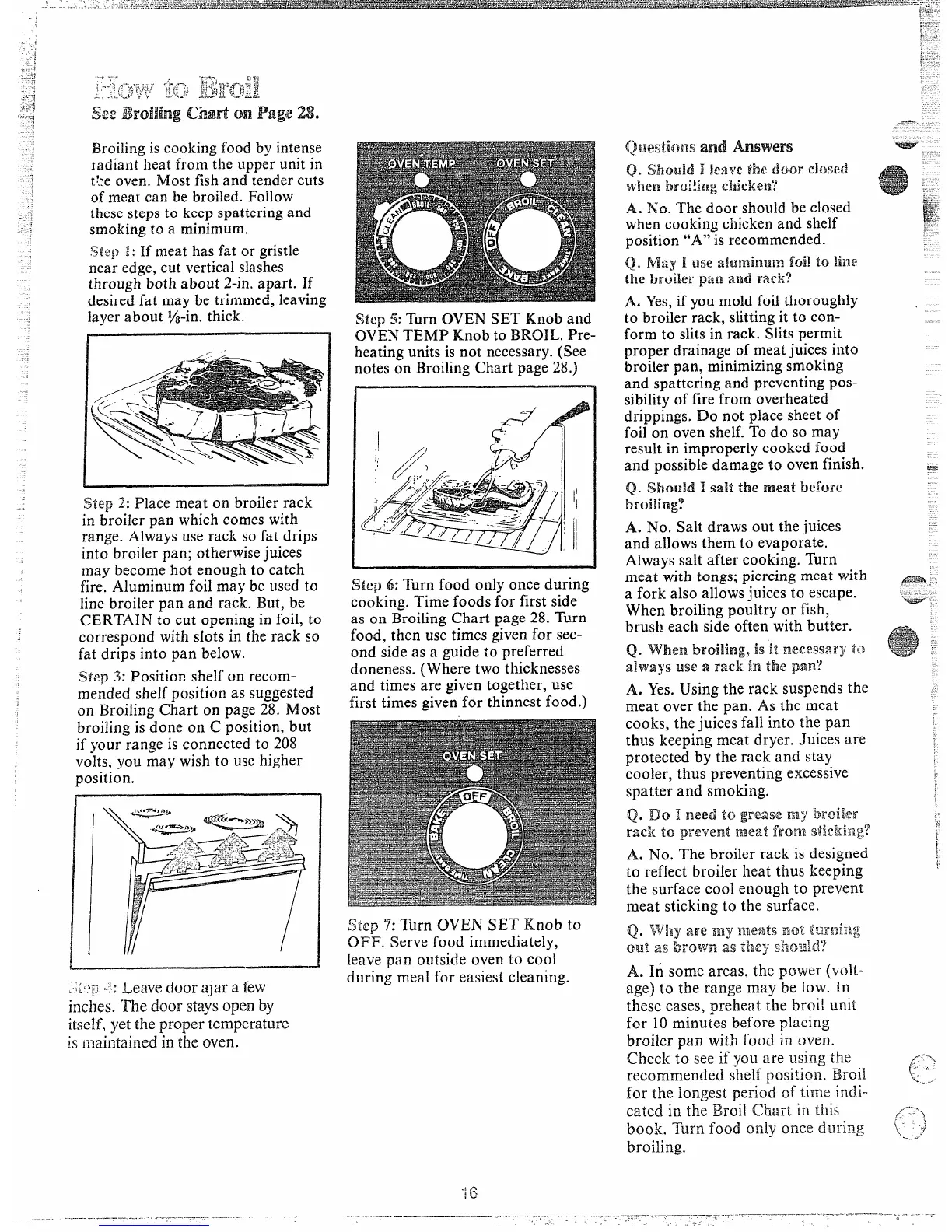
St~o j: If meat has fat or gristle
nea~edge, cut vertical slashes
through both about 2-in.apart. 1f
desired fat may be trimmed, leaving
layerabout %~in.thick.
Sfep 2: Place meat cmbroiler rack
in broiier pan which comes with
range. Alwaysuse rack so fat drips
into broiler pan; otherwisejuices
may become hot enough to catch
fire. A]uminum foil maybe used to
line broiler pan and rack. But, be
CERTAIN to cut opening in foil, to
correspond with slots in the rack so
fat drips into pan below.
Step 3: Position shelf on recom-
mended shelfposition as suggested
on Broiling Chart on page 28. Most
broiling is done on C position, but
if your range is connected to 208
volts, you may wish to use higher
position.
.,,
, .>;:-
,
r. ~
~: Leave dooi.ajar a few
inches. The door staysopen by
it@f,
yet the proper temperature
is maintained in the oven.
Step 5:Turn OVEN SET Knob and
OVENTEMP’Knob to BROIL. Pre-
heating units is not necessary.(See
notes on BroilingChart page 28.)
Step 6:Turn food only once during
cooking. Time foods for first side
as on Broiling Chart page 28. T~mn
food, then use times givenfor sec-
ond side as a guide to preferred
doneness. (Where two thicknesses
and times are given together, use
first times givenfor thinnest food.)
Step 7: Turn OVEN SET Knob to
OFF, Serve food immediately,
leave pan outside oven to cool
during meal for easiest cleaning.
Qlies’ti(]nsand hswers
:.
Q. should I !Mv(?ih door Ck)sed
when kmih.g Chicken?
A. No. The door should be closed
when cookingchickenand shelf
position “A” is recommended.
Q. May I use ahmlinum foilto line
the broiler pm and rack?
A. Yes,if youmold foil thoroughly
to broiler rack, slittingit to con-
form to slitsin rack. Slits permit
proper drainage of meatjuices into
broiler pan, minimizingsmoking
and spattering and preventingpos-
sibilityof fire from overheated
drippings. Do not place sheet of
foil on oven shelf.To do so may
result in improperly cooked food
and possibledamage to oven finish.
Q. Shouid I salt the meat before
broiling?
A. No. Salt draws out the juices
and allows them to evaporate.
Always salt after cooking. Turn
meat with tongs; piercing meat with
a fork also allowsjuices to escape.
When broiling poultry or fish,
brush each side often with butter.
Q. when broiling, is‘itmxxzwmyto
always use a rack in the pan?
A. Yes.Using the rack suspends the
meat over the pan. As the meat
cooks, the juices fall into the pan
thus keeping meat dryer. .Juicesare
protected by the rack and stay
cooler, thus preventing excessive
spatter and smoking.
Q. Do 1need to grease lmlyblmil~r
rack to prevent meat flwm Sticki!’ng’?
A. No. The broiler rack is designed
to reflect broiler heat thus keeping
the surface cool enough to prevent
meat sticking to the surface.
Q. ‘w/hyare my meats not tnrning
~~~~$~~Q~y~~~ihej’ Skiould?
A. In some areas, the power (volt-
age) to the range may be low. In
these cases, preheat the broil unit
for 10minutes before placing
broiler pan with food in oven.
Check to see if you are using the
recommended shelf position. Broil
for the longest period of time indi-
cated in the Broil Chart in this
book, Turn food only once during
broiling.
-—.



 To Next Page