Setup mode
OPERATION MANUAL Chapter 4
Unistat® V2.0.0en/09.06.16//15.09
4.3.1.3 Draining externally closed applications
Hot or very cold thermal fluid
SERIOUS BURNS/FREEZING OF LIMBS
Before draining, ensure that the thermal fluid has room temperature (20 °C).
If, at this temperature, the thermal fluid is too viscous to be drained: Control the temperature
of the thermal fluid for a few minutes until the viscosity will allow drainage. Never control the
temperature of the thermal fluid when the drain is open.
Danger of burns when draining thermal fluids at temperatures above 20 °C.
Wear your personal protective equipment when carrying out the drainage operation.
Only drain with a suitable draining hose and container (these must be resistant to the thermal
PROCEDURE
Connect a suitable drain hose to the >Drain< [8].
Place the other end of the hose in a suitable container.
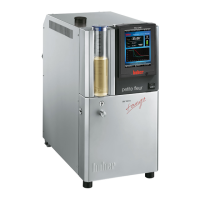
Table-top models
Open the >Drain valve thermofluid[3] by turning it counterclockwise (turn 90° left as far as it will
go). The thermofluid will flow from the external application via the pump chamber and the drain-
ing hose into the container. Check if the thermofluid can be reused. On page 16 observe section
»Proper disposal of resources and consumables«.
Drain your externally closed application. The description for the drainage procedure can be
found in the documents you received with the application. Check if the thermofluid can be re-
used. On page 16 observe section »Proper disposal of resources and consumables«.
Open the connection >Circulation flow< [1].
Open the connection >Circulation return< [2]. Leave the temperature control unit open for a
while to dry out (without screw caps) and with the >Drain valve thermofluid< [3]) open.
Free-standing models
Open all >Drain valves< [3] and [5] by turning them counterclockwise (turn 90° left as far as they
will go). The thermofluid will flow from the external application via the pump chamber and the
draining hose into the container. Check if the thermofluid can be reused. On page 16 observe
section »Proper disposal of resources and consumables«.
Drain your externally closed application. The description for the drainage procedure can be
found in the documents you received with the application. Check if the thermofluid can be re-
used. On page 16 observe section »Proper disposal of resources and consumables«.
Open the connection >Circulation flow< [1].
Open the connection >Circulation return< [2]. Leave the temperature control unit open for a
while to dry out (without screw caps) and with the >Drain valve thermofluid< [3]) open.
4.3.2 Externally open application
Operating an externally open system without >Isolating sleeve< [27] installed
BURNS/FREEZING DUE TO OVERFLOWING EXPANSION VESSEL
Shut down the temperature control unit immediately.
Allow the thermal fluid to cool down/heat up to room temperature.
If the temperature control unit is installed below the open system, the thermal fluid will escape
from the >Expansion vessel< [18] and from the >Sight glass< [23].
If the open system is located below the temperature control unit, overflow can occur in the
open system.
Prior to starting up the temperature control unit with an externally open system, install the
>Isolating sleeve< [27] (see page 33 in section »Mounting/removing the isolating sleeve (op-
tional)«).
Close the >Venting valve expansion vessel< [21] for all stand-alone units by turning them
clockwise (turn 90° right as far as it will go).



 To Next Page