C6 BLUE CAP OPTICAL DISSOLVED OXYGEN
Oxygen optical sensors work according to the principle of dynamic fluorescence quenching. The
sensor contains fluorescent dye that is excited by light of a certain wavelength. Depending on the
amount of oxygen molecules present, the luminescence response of the optical sensor varies. A
polymer fiber transmits the excitation light of the sensor and at the same time also transmits the
fluorescence response of the sensor to the measurement device. The oxygen sensitive dye is
immobilized in a polymer matrix. This polymer can be applied to carrier material and used as sensor
spots or sensor foil. It can also be coated directly onto the optical fiber. Oxygen quenching
luminophores have been studied from at least 1939 when Kautsky described quenching of
luminescence by oxygen. More recently, as optical sources, detectors, and data processing have
become more advanced, the application of luminophores to the measurement of oxygen
concentrations in liquids has resulted in bench-top instruments and optodes., with significant
advances since 1990,s. Recent advances in blue light –emitting diodes and low-powers high-speed
electronics have enabled the miniaturization of oxygen sensitive optodes to the point of field-
deployable units. The sensors do not consume oxygen and are stable over long deployment period.
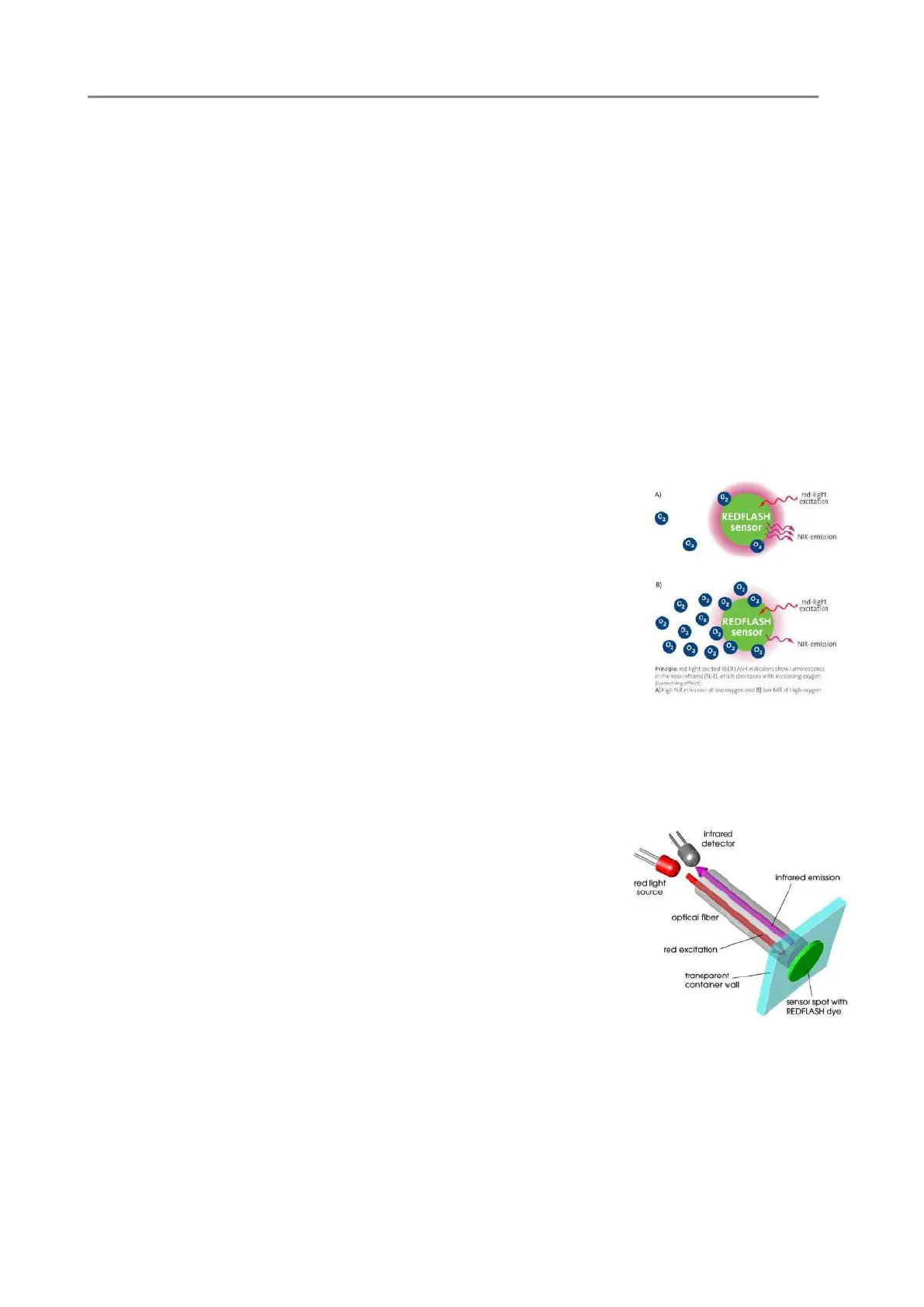
The new REDFLASH technology is based on the unique oxygen-sensitive REDFLASH dyes. In
contrast to common techniques using blue-light excitation, the
REDFLASH dyes are excitable with orange-red light and show and
oxygen-dependent luminescence in the near infrared (NIR). The
REDFLASH technology impresses by its high precision, high
reliability, low power consumption, low cross-sensitivity, and fast
response time. The orange-red light excitation significantly reduces
interferences caused by auto-fluorescence samples. Further, the NIR
detection technology significantly reduces interference with ambient
light, known from the old-blue-light techniques. The new
REDFLASH technology is based on the unique oxygen-sensitive
REDFLASH indicator showing excellent brightness. The measuring
principle is based on the quenching of the REDFLASH indicator
luminescence caused by collision between oxygen molecules and the REDFLASH indicator
immobilized on the sensor tip or surface. The REDFLASH indicators are excitable with the red light
(More precisely orange-red at a wavelength of 610-630nm) and show an oxygen-dependent
luminescence in the near infrared (NIR 760-790 nm).
Principle: Red light exited the REDFLASH indicators show
luminescence in the near infrared, which decreases with the
increasing of oxygen (quenching effect). A) High NIR emission at
low oxygen and B) low NIR at high oxygen. The measuring
principle is based on a sinusoidal modulated red excitation light.
This results in a phase-shifted sinusoidal modulated emission in the
NIR. The measurement device measures this phase shift (termed
dphi in the software) The phase shift is then converted into oxygen
units based on the Stem-Vollmer-Theory. The red-light excitation
significantly reduces interferences caused by auto-fluorescence and
reduces stress in the biological systems. The REDFLASH indicators show much higher luminescence
brightness than other optical sensor working with blue light excitation. Further due to the excellent
luminescence brightness of the REDFLASH indicator, the actual sensor matrix can be now prepared
much thinner, leading to fast response times of the oxygen sensors.


 To Next Page