EasyManua.ls Logo

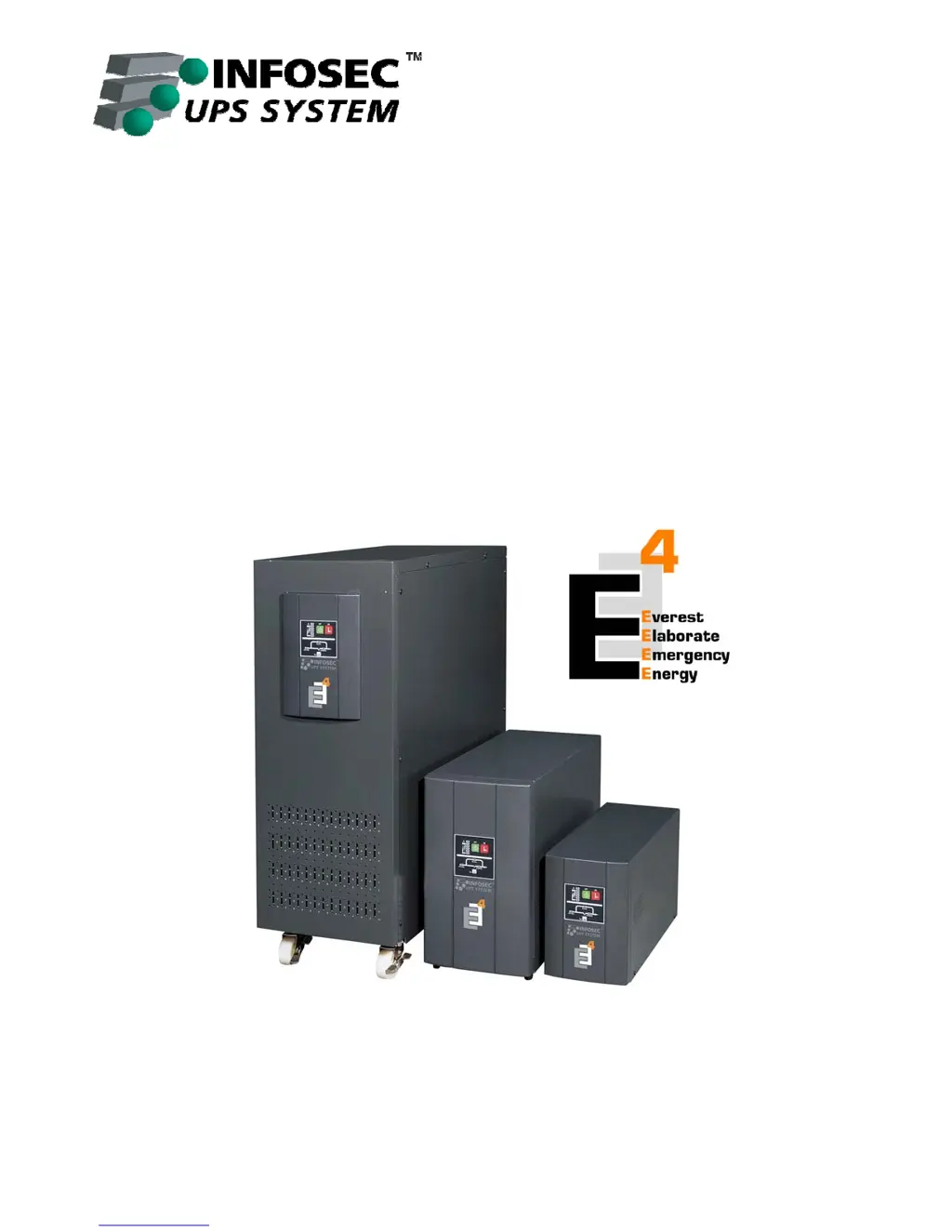
INFOSEC E 4 - User Manual

INFOSEC E 4
82 pages
Go to English
Print Icon
To Next Page IconTo Next Page
Loading...
6.
USER GUIDE
E
4
700 / 1000(S) / 2000(S) / 3000(S) /5000(S) / 6000(S) / 10000(S)

Table of Contents

Questions and Answers

  • V
    Valerie SmithAug 14, 2025
    What to do if the FAULT led lights and audible alarm beeps every second on my INFOSEC UPS?
    • C
      Claire BeltranAug 14, 2025
      If the “FAULT” LED is illuminated and the alarm beeps every second, it indicates an overload. To resolve this, remove some of the devices connected to the INFOSEC UPS.
  • J
    James CastroAug 17, 2025
    Why is the emergency supply period shorter than nominal value on my INFOSEC E 4?
    • L
      Louis BrooksAug 17, 2025
      If the emergency supply period of your INFOSEC UPS is shorter than expected, it could be due to batteries not being fully charged or defective batteries. Charge the batteries for at least 8 hours and then check their capacity. If the problem persists, you should consult your dealer.
  • D
    Dr. Henry FosterAug 20, 2025
    What does it mean when the INVERTER led lights up and an audible alarm beeps every 4 seconds on INFOSEC E 4 UPS?
    • M
      Matthew BurnsAug 20, 2025
      When the “INVERTER” LED lights up and the alarm beeps every 4 seconds on your INFOSEC UPS, it means the main power supply has failed. The UPS has automatically switched to battery mode. Note that the audible alarm will beep every second when the battery is almost empty.
  • T
    Tyler DouglasAug 25, 2025
    What to do if the FAULT led lights up and the alarm is continuously beeping on my INFOSEC E 4 UPS?
    • A
      albert44Aug 25, 2025
      If the “FAULT” LED is lit and the alarm is continuously beeping on your INFOSEC UPS, it indicates a UPS fault. You should notify your dealer.
  • A
    Alison RiversAug 27, 2025
    How to troubleshoot no indication on INFOSEC E 4 UPS even when connected to mains?
    • E
      Erika GarciaAug 27, 2025
      If your INFOSEC UPS shows no indication and there is no audible alarm even when connected to the mains power supply, the cause might be no input voltage. Check the building wiring outlet and the input cable.
  • M
    Matthew GarciaAug 31, 2025
    What to do if ON LINE and BY-PASS led light up even though the power supply is available in INFOSEC E 4?
    • C
      Christine HudsonAug 31, 2025
      If the “ON LINE” and “BY-PASS” LEDs are illuminated on your INFOSEC UPS, even when the power supply is available, the inverter may not be switched on. Press the On-Switch “I.”
  • M
    Melissa WuSep 2, 2025
    What does it mean when FAULT led lights, BAT led blinks and an audible alarm beeps every second on INFOSEC E 4 UPS?
    • L
      Laura LewisSep 3, 2025
      If the “FAULT” LED is lit, the “BAT.” LED is blinking, and the alarm is beeping every second on your INFOSEC UPS, it suggests that the charger or batteries are damaged. You should notify your dealer.
  • A
    Anna StewartSep 6, 2025
    Why is the ON LINE led blinking and BAT led lights up on my INFOSEC E 4?
    • S
      Sheena BarnesSep 6, 2025
      If the “ON LINE” LED blinks and the “BAT.” LED lights up on your INFOSEC UPS, it indicates that the input power and/or frequency are out of tolerance. Check the input power source and inform your dealer if necessary.
  • C
    Carol KiddSep 10, 2025
    Why is the ON LINE led blinking on my INFOSEC E 4 UPS?
    • T
      Tammy JonesSep 10, 2025
      If the “ON LINE” LED is blinking on your INFOSEC UPS, it means the line and neutral conductors have been reversed at the input of the UPS system. Rotate the mains power outlet by 180° or connect the UPS system.

Summary

1 Safety Instructions

1.1 Transport

Instructions for safely transporting the UPS unit using original packaging.

1.2 Set-up

Guidelines for proper UPS system setup, including acclimatization and environmental conditions.

1.3 Installation Guidelines

Advice on connecting equipment, cable placement, and earthing for safe UPS installation.

1.4 Operation

Procedures for operating the UPS, including connection, disconnection, and safety warnings.

1.5 Maintenance, Servicing, and Faults

Guidance on maintenance, servicing, and handling faults, emphasizing qualified personnel and electrical hazards.

2 Description of Commonly Used Notations

Notation Explanations

Explanation of various symbols and notations used throughout the user manual for clarity.

3 Introduction - E⁴ 700;1000;2000;3000(S) Models

Double-Converter Technology

Overview of the double-converter technology used in the E4 On-Line-Series UPS.

4 System Description

Switch and Button Functions

Description of the functions of the UPS system's switches and buttons for operation.

LED Indicator Guide

Explanation of the different LED indicators on the UPS panel and their meanings.

5 Connection and Operation for E⁴ 700;1000;2000;3000(S)

5.1 Control

Instructions for inspecting and controlling the UPS unit upon receipt.

5.2 Wiring and Connections

Details on UPS input and output wiring, including specific outlet and terminal block information.

5.3 Computer Connection

Steps for connecting a computer to the UPS system for monitoring and control.

5.4 Battery Charge

Information regarding the procedure and duration for fully charging the UPS batteries.

5.5 Turn On the UPS

Procedures for turning on the UPS system, with or without utility power.

5.6 Test Function

Method for testing the correct operation of the UPS system.

5.7 Turn Off the UPS

Instructions for safely turning off the UPS system in different operating modes.

5.8 External Battery Operation

Procedure for connecting and operating external battery packs for extended backup.

6 Trouble Shooting

Problem Diagnosis and Solutions

A guide to identifying and resolving common problems with the UPS system.

7 Maintenance

7.1 Operation & Battery Replacement

Information on UPS operation and battery replacement, noting no user-serviceable parts.

7.2 Storage Conditions

Guidelines for storing the UPS system, including battery charging intervals.

8 Technical Data

8.1 Electrical Specifications

Detailed electrical input, output, and battery specifications for various UPS models.

8.2 Operating Environment

Environmental parameters for optimal UPS operation, including temperature and humidity.

8.3 Typical Stored Energy Time

Typical battery backup times at different load levels and temperatures.

8.4 Dimensions and Weights

Physical dimensions and net weight for different UPS models, and compliance standards.

9 Introduction - E⁴ 5000;6000;10000(S) Models

9.1 General Specifications

Overview of general specifications for the E4 5000, 6000, and 10000(S) UPS series.

9.2 Electrical Performance

Detailed electrical performance characteristics, including input, output, and overload capabilities.

9.3 Operating Environment

Recommended operating environment conditions for the higher capacity UPS models.

10 Installation

10.1 Unpacking and Control

Procedures for unpacking the UPS, checking contents, and initial inspection.

10.2 Wiring Notes and Installation

Important notes for UPS wiring, ventilation, and installation procedures.

10.3 External Battery Connection Procedure

Step-by-step guide for connecting external battery packs to the UPS for extended backup.

10.4 Parallel Operation

Information on connecting multiple UPS units in parallel for redundancy and power sharing.

11 Operating Mode

11.1 Operation and Maintenance

General operational guidance and maintenance overview for the UPS system.

11.2 Operation Procedures

Detailed procedures for turning UPS on/off, including utility and battery power modes.

11.3 Removing Single UPS

Operational steps for safely disconnecting and removing a single UPS from a parallel system.

11.4 Combine Machine Warning

Important warnings and precautions when operating UPS systems in parallel or inverter mode.

12 Battery Maintenance

Battery Care and Charging

Guidance on maintaining UPS batteries, including charging requirements and lifespan.

13 Battery Disposal and Replacement Notes

Safety Precautions for Batteries

Critical safety precautions and warnings when handling batteries for disposal or replacement.

14 Trouble Shooting

Problem Diagnosis and Solutions

A guide to identifying and resolving common problems with the UPS system.

15 Operating Modes for All Models

15.1 ON LINE MODE

Description of the ON LINE operating mode, including LED indicators and load handling.

15.2 Battery Mode

Explanation of the Battery operating mode, detailing LED indicators and battery capacity.

15.3 Bypass Mode

Details on the Bypass operating mode, its indicators, and lack of backup time.

15.4 Fault Mode

Information on the Fault mode, directing users to the Trouble Shooting chapter.

16 Communication Port

16.1 RS232 Interface

Description of the DB-9 connector pin assignment for RS232 communication.

16.2 AS400 Interface (Option)

Details on the optional AS400 interface card and its DB-9 connector pinout.

17 Software for All Models

17.1 UPSurf-Control Software Download

Information on downloading and features of the UPSurf-Control monitoring software.

17.2 Installation Procedure

Instructions for installing the UPSurf-Control software, including serial number.

18 Appendix 1: Parallel Connection System

Parallel System Wiring Diagram

Diagram illustrating the wiring configuration for connecting UPS units in parallel.

19 Appendix 2: Display Panel (E⁴ 5000;6000;10000)

Display Panel Indicator Layout

Diagram showing the layout and labels of the display panel indicators on E4 5000/6000/10000 models.

20 Appendix 2: LED Display for E⁴ 5000;6000;10000

LED Display and Alarm Table

Table detailing LED displays and alarm warnings for various operating states of E4 5000/6000/10000.

21 Appendix 3: Back Panel Views

Back View E⁴ 700;1000;1000(S)

Diagram of the back panel for E4 700, 1000, and 1000(S) UPS models.

Back View PEX 2000

Diagram of the back panel for the PEX 2000 UPS model.

Back View PEX 2000 S

Diagram of the back panel for the PEX 2000 S UPS model.

Back View PEX 3000

Diagram of the back panel for the PEX 3000 UPS model.

Back View PEX 3000 S

Diagram of the back panel for the PEX 3000 S UPS model.

Back View E⁴ 5000;E⁴ 6000

Diagram of the back panel for E4 5000 and E4 6000 UPS models.

Back View E⁴ 5000 S;E⁴ 6000 S

Diagram of the back panel for E4 5000 S and E4 6000 S UPS models.

Back View E⁴ 10000

Diagram of the back panel for the E4 10000 UPS model.

Back View E⁴ 10000 S

Diagram of the back panel for the E4 10000 S UPS model.

INFOSEC E 4 Specifications

General IconGeneral
BrandINFOSEC
ModelE 4
CategoryUPS
LanguageEnglish

Related product manuals