32
4.4. TROUBLESHOOTING
Electronically-managed diagnostics:
• This symbol turns on
• The alarm Code appears on the DS1 display
DescriptionCode
AL0
Downloading
default data
AL1
Serial line error
for printing
Incorrect cable connection
Faulty electronics Replace the circuit board
Connect the serial cable of the
printer correctly
AL2
Depleted clock module
or battery:
registration block
Depleted clock module or battery:
registration block
Replace circuit board
AL3
ALP
Cell temperature
at 40°C during
defrost cycle
High pressure alarm
Cell door micro
switch faulty
High work room temperature
Check that the "open door" indicator
signals opening and closing correctly.
If not: intervention of a technician
to replace micro switch.
Air condition the work room
High room temperature
(above 32°C)
Dirty condenser filter Clean the condenser
Condenser fan faulty Intervention of a technician
The starting condenser of the
condenser fan is faulty
Intervention of a technician
Intervention of a technician
Condensation control pressure
switch faulty (only for versions with
remote unit or remote condenser)
High pressure pressure switch faulty
Intervention of a technician
Excessive gas load in system
Open compressor discharge tap
Compressor discharge tap closed
Intervention of a technician
Possible cause Possible solution
The electronic control of the machinery is equipped with a
visual system which signals the presence of alarms.
The alarms are registered on an alarm list.
In case of alarms:
Press P1
Eliminate the cause of the alarm
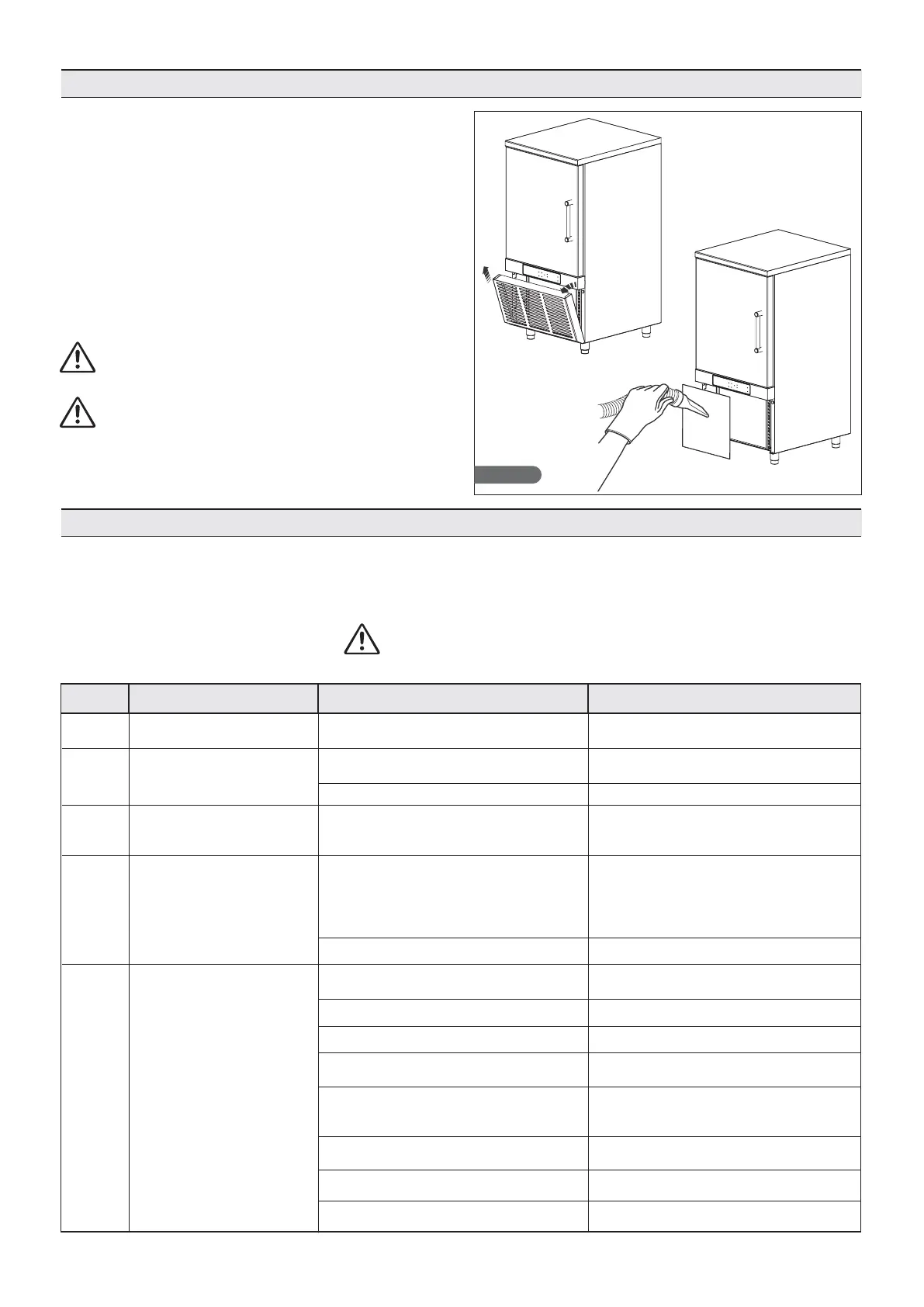
4.3. CLEANING THE CONDENSER
For Blast chillers with built-in condensing units, access
the condenser pulling the front flapped grid with force.
For remote condensing units, the air condenser must
be kept clean to allow free air flow.
This operation, which must be carried out at least every 30
days, can be done with non-metallic brushes in order to
remove all dust and down from the condenser flaps. It is
recommended to use a vacuum cleaner to avoid disper-
sing the dust in the area. Use a brush soaked in alcohol if
there are oily deposits.
Do not scrape the surfaces with sharp or abrasive
elements.
Always wear protective gloves, goggles and masks
protecting the respiratory tract for these operations.
Fig. 18


 To Next Page