User Manual
SUPM1
page 36 of 94© KEYMILE December 2015 EN/LZTBU 372 129/1 RC
94
Functional Description
5.2 Mercury CAS Modes of Operation
This mode of operation is used in the United Kingdom market with Mercury
CAS (MCAS) protocol compliant switches. The signalling bit settings are pre-
defined.
The MCAS modes require a 2 Mbit/s (P12) transport connection to the
switch supporting the Mercury CAS protocol. The P12 transport connection
is implemented with the SELI8, STM14, NUSA1, NUSA2 or SDSL8 unit of
the XMC20.
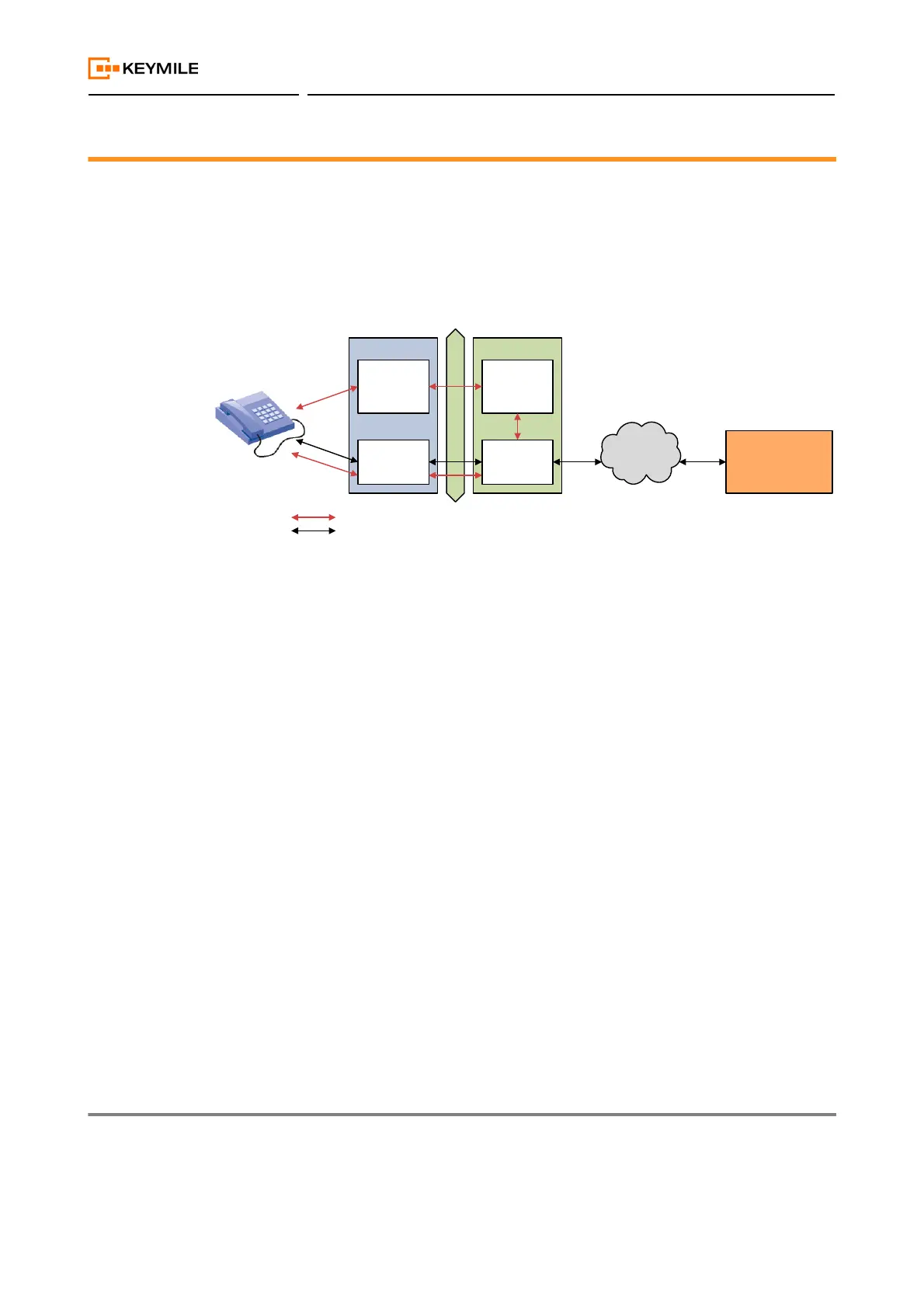
Figure 9: MCAS routing in XMC20
The SUPM1 supports four different sub modes for the Mercury CAS proto-
col:
• MCAS direct line
• MCAS loop calling PBX
• MCAS earth calling PBX
• MCAS PBX extension
The differences to the V5CAS mode of operation are as follows:
• Internal signalling pattern is according to MCAS.
• Pulse dialling, ground key and flash impulse timing parameters are fixed
and can not be changed by the custom parameter set (CPS).
• Pulsed no battery signalling is not supported.
• The X.731 administrative state handling (lock, shutdown, unlock) is not
supported.
In the MCAS mode of operation the
• Blocked port line feed function is fix enabled,
• Metering pulse function towards the subscriber can be enabled or disa-
bled,
• Pulse on answer function can be enabled or disabled. The function is
only effective if the metering pulse function is enabled.
Pulse on answer means that a metering pulse is sent to the subscriber
when the called subscriber goes off-hook,
• Polarity reversal function towards the subscriber is enabled.
5.2.1 MCAS direct Line
A standard telephone set is connected to the SUPM1 unit.
PSTN signalli ng
to/from time slot
16
Signalling
TDM
64 kbit /s cross
connect
PSTN signalli ng
(out of band ) to
MCAS
PCM64 codec
(G.711 A- law)
Voice channel
(with inband
PSTN signalling )
PSTN signalling
(out of band )
E1 link
MCAS
exchange
signalling data
voice traffic
E1 link
Access
Network


 To Next Page