User Manual
SUPM1
page 41 of 94© KEYMILE December 2015 EN/LZTBU 372 129/1 RC
94
Functional Description
5.4 Phone-Phone Mode of Operation
This mode of operation is used in private networks. A PSTN user port is
directly cross connected with another PSTN user port without any exchange
in between. A subscriber (called A-subscriber) is able to speak with another
subscriber (called B-subscriber) without dialling a number. This function
works in both directions.
Such applications are generally called “Engineering Order Wire” (EOW).
The SUPM1 unit offers the following Phone-Phone mode:
• Phone-Phone auto ring down
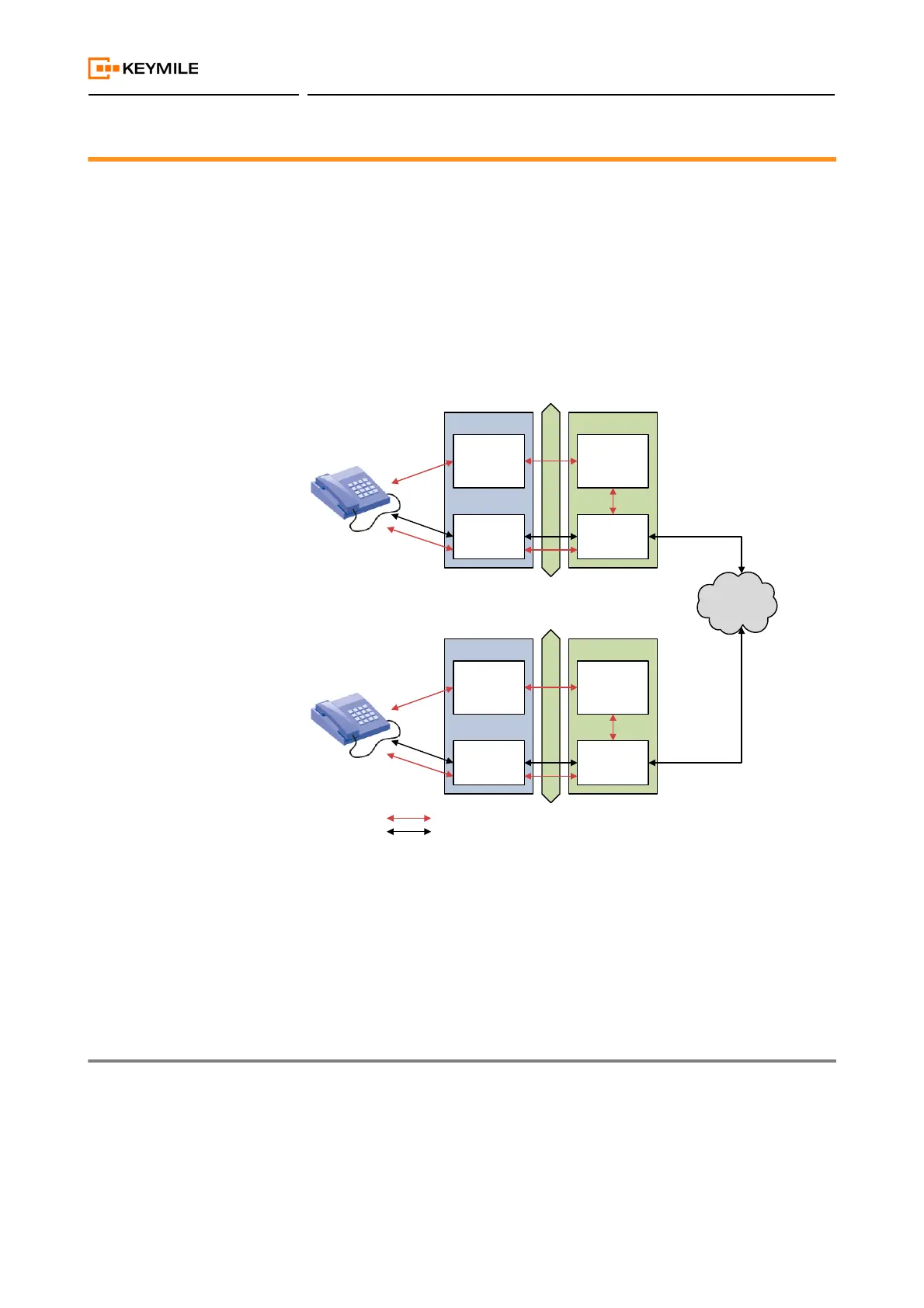
In the Phone-Phone mode the A-subscriber receives a ring control tone from
the B-subscriber. This ring control tone has a frequency of 444 Hz.
Figure 11: Phone-Phone mode
In the Phone-Phone mode of operation the
• Blocked port line feed function is fix disabled,
• Metering pulse function towards the subscriber is disabled,
• Pulse on answer function is disabled,
• Polarity reversal function towards the subscriber is disabled.
5.4.1 Phone-Phone Auto Ring Down
As soon as the calling subscriber (A-subscriber) goes off-hook, the SUPM1
sends the CAS pattern “Off-hook” in upstream direction. The SUPM1 on the
receiving side creates the ring back control tone towards the A-subscriber
and applies the ringing signal cadence with 2 seconds ringing, followed
PSTN signalling
to/from time slot
16
Signalling
TDM
64 kbit /s cross
connect
PSTN signalling
(out of band ) to
Phone -Phone
CAS
PCM64 codec
(G.711 A-law)
Voice channel
(with inband
PSTN signalling )
PSTN signalling
(out of band )
E1 link
PSTN signalling
to/from time slot
16
Signalling
TDM
64 kbit /s cross
connect
PSTN signalling
(out of band ) to
Phone -Phone
CAS
PCM64 codec
(G.711 A-law)
Voice channel
(with inband
PSTN signalling )
PSTN signalling
(out of band )
E1 link
signalling data
voice traffic
Access
Network
SUPM1
SELI8
SUPM1
SELI8
PBUSPBUS


 To Next Page