Unity Motorhome
107
Liquid Propane Gas System
Selecting Fuel Types
Butane burns at a much higher temperature
than propane, but will not change from a
liquid to a gas at temperatures below 32 °F
(0 °C). Propane, however, burns at a lower
temperature and will convert from liquid to gas
at temperatures as low as -40 °F (-40 °C).
LP gas dealers typically provide only the type of
gas commonly used and suited for the climate
in their area. If you travel from a warmer to
a colder region, verify that you have the
appropriate type of LP gas for the climate.
How LP Gas Works
There are two types of LP (liquid petroleum)
gas: propane and butane. Both are compressed
into a liquid state for easier transportation and
storage. Common names used for LP gas are
tank gas, bottle gas, or simply LP.
In the tank, LP gas is in liquid form and under
very high pressure. As it is released, it changes
to a vapor or gas and expands to a much
greater volume.
Exercise caution when temperatures fall below
-40 °F (-40 °C). Propane will not convert from a
liquid to a gas in extremely cold temperatures,
and LP gas appliances will not function properly.
LP Gas Tank System
The LP gas storage tank is mounted underneath
the motorhome and is attached to the vehicle
oor. It is accessible only from outside the
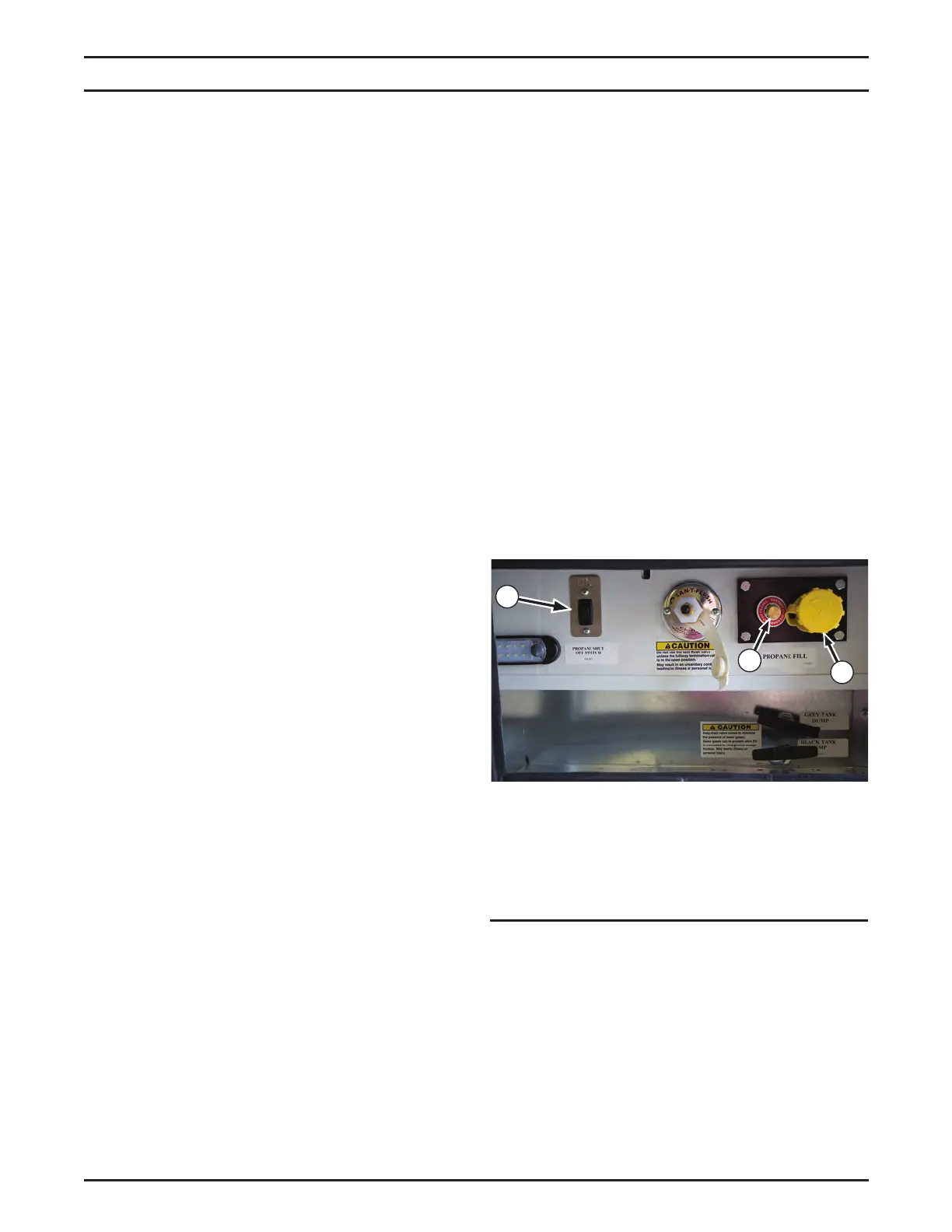
vehicle. Before turning on the LP gas control
valve (1) located in the exterior utility center,
make sure all controls for the various LP gas
appliances are in the “OFF” position to prevent
any LP gas from leaking into the motorhome.
The LP gas supply valve is operated by the
LP gas switch in the exterior utility center. The
valve is held open using 12 volt DC power. If
the battery is dead or the battery disconnect is
in the “OFF” position, the LP gas supply valve
will automatically close.
NOTE: The LP gas storage tank is also
equipped with a manually operated shut-off
valve. See the maintenance section of this
manual for details.
1
2
3
Relling the LP Gas Tank
1. Shut off the LP gas control valve (1) in the
exterior utility center before lling the tank or
travelling. Always rell an empty LP gas tank
as soon as possible.
2. Connect the LP gas supply to the ll
connector (2).
3. Do NOT overll your LP gas tank. Stop
lling when liquid appears at the overow
valve (3) (often called a 10% valve) which
contacts the liquid level at 80% of container
capacity, allowing 20% for expansion.
4. Check the LP gas level after relling by
opening the overow valve and bleeding
gas in a well-ventilated area until the white
liquid stops emerging from the overow
valve. Overlling may cause damage to the
regulator and cause malfunction of LP gas
appliances.
NOTICE
The LP gas tank has an automatic 80% stop-
ll device to prevent overlling of the tank.
To prevent against overlling, have the tank
lled only by an authorized lling station.
The tank is permanently mounted to the
motorhome, therefore, the motorhome must
be taken to a fueling station for relling. When
liquid LP gas appears at the overow valve (3),
the tank is full.
LP gas stations are found in all parts of the
country. Check the yellow pages in your
telephone book if you have trouble nding a
station. Look under “Gas - Liquid Petroleum -
Bottled and Bulk” or “Propane.”


 To Next Page