EasyManua.ls Logo

Light Conversion ORPHEUS - User Manual

Light Conversion ORPHEUS
39 pages
Print Icon
To Next Page IconTo Next Page
Loading...
Last Rev. AV20180329
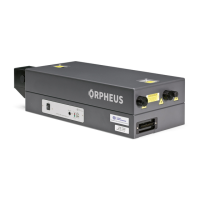
ORPHEUS
Collinear optical parametric amplifier of white light continuum
User’s Manual
UAB MGF Šviesos Konversija
Address: Keramikų 2B, LT-10233 Vilnius, Lithuania
Tel: +370 5 2491830
E-mail: company@lightcon.com
www.lightcon.com

Table of Contents

Questions and Answers

  • M
    Marco AllenAug 3, 2025
    Why is the Second Harmonic Generation Efficiency low in my Light Conversion Amplifier?
    • W
      william83Aug 3, 2025
      If the Light Conversion Amplifier experiences low second harmonic generation efficiency, it could be due to several factors. First, optimize the angle of the SHG crystal through the “Motors” section in the WinTOPAS software. Second, optimize the pulse compression of the pump laser while monitoring the output power of the second harmonic or Signal. Finally, adjust the timing of Pockels Cells while monitoring the second harmonic of pump or Signal power, in case of low pump pulse contrast.
  • D
    Donna ThomasAug 18, 2025
    What to do if there's low parametric output or no output at all from Light Conversion ORPHEUS Amplifier?
    • J
      john17Aug 18, 2025
      If you observe low or no parametric output from your Light Conversion Amplifier, it could stem from several causes. Check if white light generation is unstable or not occurring. Also, verify the efficiency of the second harmonic generation. Ensure that all OPA motors are correctly positioned by resetting them through the “Motors” section. If the issue persists, it might be due to beam misalignment inside ORPHEUS.

Summary

PREFACE

SAFETY SIGNAL WORDS AND SIGNS

1. SAFETY PRECAUTIONS

1.1 Optical Safety

Detailed safety measures for laser operation, including protective eyewear and beam handling.

1.2 Electrical Safety

Guidelines for safe handling of electrical connections and preventing shocks.

1.3 Warning and Information Labels

Identifies and describes safety labels and logos found on the ORPHEUS unit.

2. ELECTRICAL AND PHYSICAL SPECIFICATIONS

2.1 Dimensions

Provides physical dimensions of the ORPHEUS unit with diagrams.

2.2 Description of Input and Output Ports

Details the location and function of all input and output ports on the device.

3. PUMP REQUIREMENTS

4. POSITIONING AND CONNECTING ORPHEUS

4.1 System Layout on Optical Table

Recommends optimal placement of ORPHEUS and related equipment on an optical table.

4.2 Fixing ORPHEUS on the Optical Table

Explains the procedure for securely mounting the ORPHEUS unit onto an optical table.

4.3 Beam Routing Units

Describes the use and adjustment of periscopes, beam splitters, and mirrors for beam delivery.

4.4 Connecting ORPHEUS

Details the necessary connections for power, computer control, and external devices.

4.5 Input Beam Shutter

Explains the function and operation of the external shutter for user safety and heat dissipation.

4.6 Interlock

Describes the safety interlock mechanism that prevents operation with the cover open.

5. DESCRIPTION OF OPERATION

5.1 Overview

Introduces the two-stage OPA system and its basic configuration of subunits.

5.2 Pump Beam Delivery and Splitting

Details how the pump beam is delivered, split, and prepared for amplification stages.

5.3 White Light Continuum Generator

Explains the process of generating the white light continuum seed pulse.

5.4 Generation of the Second Harmonic of Pump

Describes the process of generating the second harmonic of the pump beam.

5.5 First Amplification Stage

Details the first stage of amplification, including its two-pass configuration.

5.5.1 The First Pass

Explains the beam path and optical interactions during the first pass of the amplification stage.

5.5.2 The Second Pass

Describes the beam path and optical interactions during the second pass of the amplification stage.

5.6 Second Amplification Stage

Details the second stage of amplification, responsible for power amplification.

5.7 Output polarization

Specifies the output polarization states for the Signal and Idler beams.

5.8 Wavelength Separators

Explains the use and mounting of optional wavelength separators for beam separation.

5.9 Computer Controllable Motorized Stages

Lists and describes the automated stages controlling optical components for wavelength tuning.

5.10 Computer Control of ORPHEUS

Explains how to control the ORPHEUS system using WinTopas software via USB.

6. DAILY OPERATION

6.1 Setting the Wavelength

Guides on how to select and set the desired output wavelength using the software.

6.2 Optimizing the Output

Details procedures for fine-tuning the system to achieve optimal output power and performance.

7. OPTIMIZATION OF ORPHEUS PERFORMANCE

7.1 Checking Pump Laser Parameters

Lists critical pump laser parameters to check for ensuring optimal ORPHEUS output.

7.2 Resetting Motor Positions

Explains how to reset the position of motorized stages in case of software or power issues.

7.3 Input Beam Alignment

Guides on aligning the input pump beam into the ORPHEUS system for optimal performance.

7.4 Damage of Sapphire Substrate in White Light Generation Path

Addresses potential damage to the WLG substrate and methods to avoid it.

7.5 Adjusting the Pump Intensity for White Light Generation

Details how to adjust pump intensity for stable and high-quality white light generation.

7.6 Adjusting the Pump Intensity for the First Amplification Stage

Explains how to adjust pump intensity for the pre-amplifier stage for optimal amplification.

7.7 Applying Offsets for the Calibration Curve

Describes how to apply calibration offsets to motors for fine-tuning wavelength tuning curves.

8. MAINTENANCE

8.1 General Maintenance

Covers cleaning procedures and environmental factors affecting ORPHEUS longevity.

8.2 Handling of Nonlinear Crystals

Details proper handling, cleaning, and storage of hygroscopic nonlinear crystals.

9. TROUBLESHOOTING GUIDE

9.1 White Light Generation Does Not Occur;Is Instable

Addresses issues with white light generation, including causes and solutions.

9.2 Low Parametric Output or No Output at All

Covers troubleshooting for insufficient or absent parametric output.

9.3 Low Second Harmonic Generation Efficiency

Provides solutions for poor efficiency in second harmonic generation.

10. DISPOSAL

10.1 Dismantling the System

Step-by-step guide for safely dismantling the ORPHEUS device into modules.

10.2 Disposal

Guidelines for proper disposal of system components according to regulations.

Light Conversion ORPHEUS Specifications

General IconGeneral
BrandLight Conversion
ModelORPHEUS
CategoryAmplifier
LanguageEnglish