ORPHEUS User’s Manual
Light Conversion support@lightcon.com 27
increasing the pump energy by more than ~10 % of the nominal value (pump energy at the time of
installation).
After amplification, the residual pump is separated from the amplified pulse at the dichroic mirror
DM3 and is directed towards output port B by mirror M25.
The beam path of the pump beam (515 nm) in the power amplifier:
• P2 – M18 – M19 – M20 – M21 – RP4 – M22 – M23 – L12 – L13 – M24 – DM2 – Crystal 2 – DM3 –
M25 – Output B
The beam path of the seed:
• M7 – M8 – DP2 – DP3 – L6 – L7 – DM2 – Crystal 2 – DM3 (transmitted) – Output A
5.7 Output polarization
Below is a table with ORPHEUS tuning range and output polarizations.
Table 6. ORPHEUS output polarizations
5.8 Wavelength Separators
Duo to the collinear nature of amplification used in the power amplifier of ORPHEUS, Signal and Idler
waves both exit the housing at the same position and direction. If only one of those is required for your
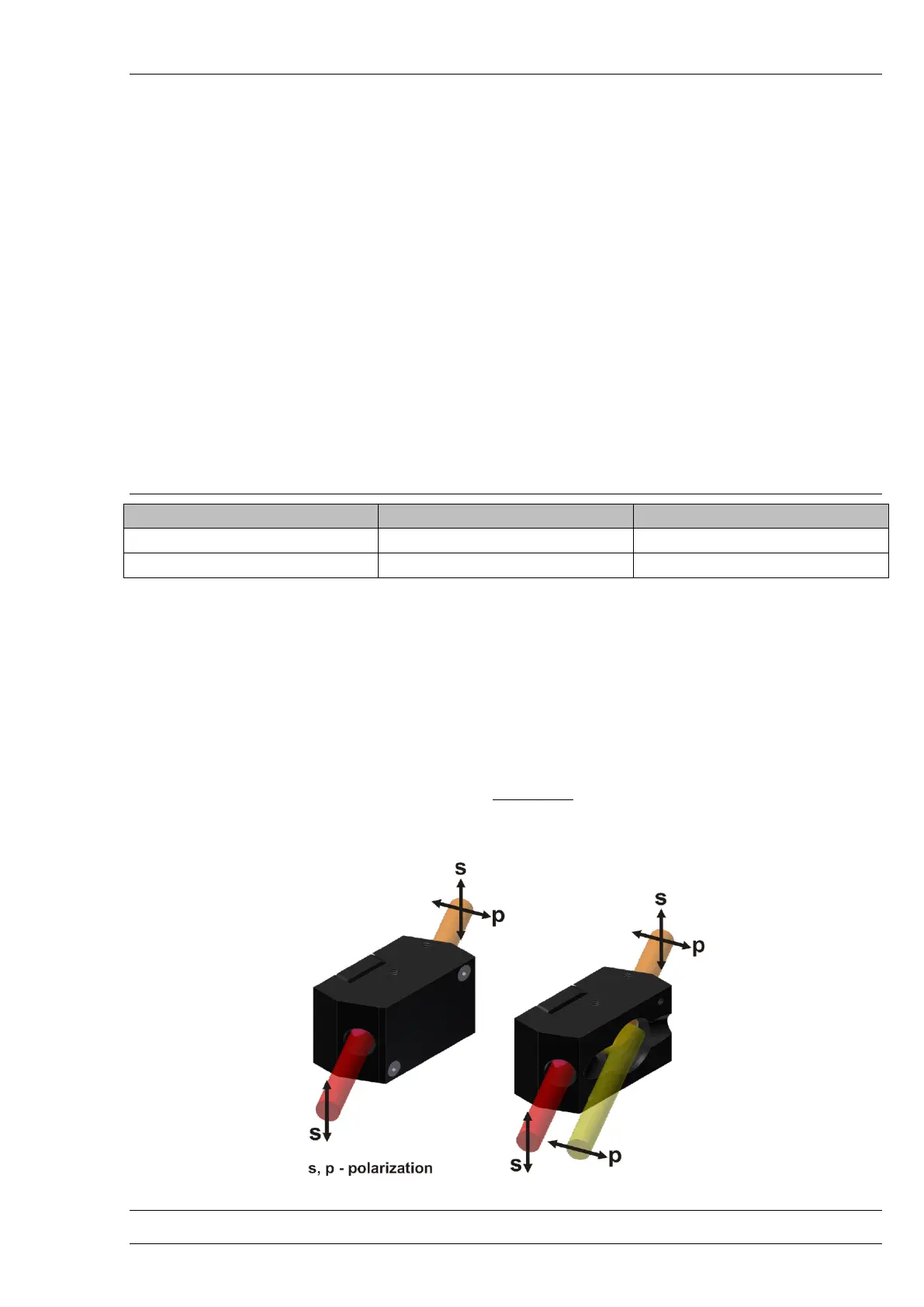
application, the beams can be separated by using optional wavelength separators (WS). Each WS consists of
two dielectric mirrors with high reflectivity (HR) coatings for a specific wavelength region. Depending on
whether the Signal or Idler wave is reflected, the WS can be mounted in two orthogonal positions – the
beam is either translated sideways (horizontally) or downwards (vertically). The two mounting positions are
necessary because Signal and Idler waves are of orthogonal polarizations and the mirrors efficiently reflect
s polarization only. A list of available wavelength separators is presented in Table 7.
Figure 20. Wavelength separator (WS) with and without metal cover


 To Next Page