ORPHEUS User’s Manual
Light Conversion support@lightcon.com 25
Mirrors M14 and M15 then direct the pump beam into the retro reflector M16/M17, which
translates the beam downwards by 5 mm. The amplified WLC beam travels beside the M14 mirror through
the delay plate DP1 and into the M5/M6 retro reflecting periscope.
5.5.2 The Second Pass
Periscope M5/M6 is fixed on a manual translation stage which is used to coarsely overlap the second
pass pump and WLC beams in time at the Crystal 1. Fine tuning of the temporal overlap is done by rotating
the delay plate DP1 (“Delay 2” in the software).
After the M5/M6 periscope, the amplified white light travels through the DP1 for the second time
and arrives at the L5 lens 5 mm below the first pass WLC beam. The second pass pump beam arrives at L5
5 mm directly below the first pass pump.
Once again, the WLC and pump beams are focused into the Crystal 1 at the height of 22.5 mm – the
same spot as the first pass. After Crystal 1 both pulses travel above the first pass beams and this time they
travel through the C1 compensator crystal. This crystal is used to compensate the spatial drift of the
amplified WLC due to the rotation of nonlinear crystal Crystal 1. After C1 the beams arrive at L4, where
they are 5 mm above their first pass counterparts.
The residual pump beam then hits the mirror M13 and is blocked by the reflection shield. The
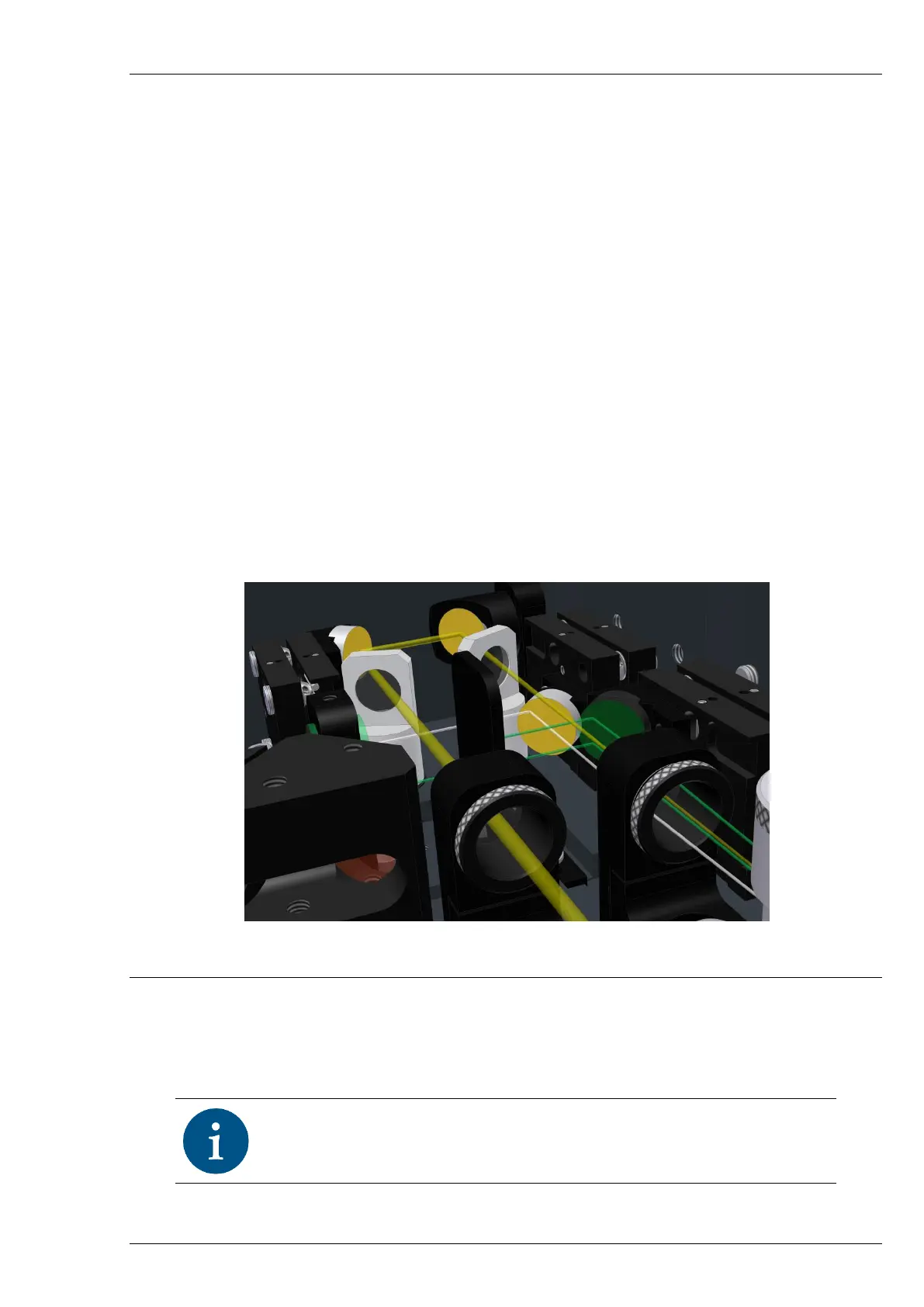
amplified WLC beam travels above the M4 mirror and onward to the power amplification stage. Figure 18
illustrates the beams exiting the pre-amplifier.
Figure 18. A closer look at the amplified seed beam exiting the first amplification stage
after the second pass. Yellow is the amplified beam, White – WLC, Green – pump
The pump intensity in Crystal 1 should be high enough for efficient amplification of white light
however it should be below the threshold of white light generation in the nonlinear crystal. This is because
the threshold for white light generation in BBO crystal is very close to the damage threshold. White light
generation in Crystal 1 could also be an indication of dust or damage on the surface of the crystal.



 To Next Page