46
Causes of incorrect measurements
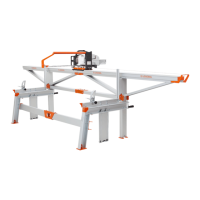
when sawing with the Logosol F2+
A. The sawmill is incorrectly adjusted or set-up.
B. The cutting equipment does not work as it
should.
C. Tensions in the wood.
A. Checking the sawmill
1. Check that each of the four legs of the sawmill
stands rmly and that the feet do not sink into the
ground when the sawmill is loaded with a heavy log.
2. Check the levelness of the log beds to make sure
that the sawmill is not skewed. Check both when
the sawmills is loaded and unloaded.
3. Using a set square, check very carefully that the
guide rail is at an exact 90° angle to the long legs.
even a small deviation can lead to incorrect timber
measurements.
4. Set the distance between the guide bar and the
log beds so that it is exactly the same at both log
beds. Make sure that the guide bar and the log beds
are completely parallel.
5. Check that the guide rail is absolutely straight by
sighting along it, or by running a line over the guide
rail and using nails or the like as spacers between
the line and the guide rail.
If support legs are used for the guide rail, it is
essential that they stand on a rigid surface such as a
pole driven into the ground.
Even factory-new guide bars can be out of true.
This is detected if the parallel relation to the log
bed changes when the guide bar is turned over. A
bent guide bar is most easily straightened by being
pressed up or down while the saw is mounted on
the sawmill (page 40).
6. Check that the guide bar is straight in relation to
the sawing direction by placing a straight 1.5 m long
strip of wood on the guide bar (without the chain).
Then sight across the wood strip. It must be parallel
with the guide rail. If the wood strip is angled more
than 5 mm forwards or backwards, it can have a
negative effect on sawing. An out of true guide bar
is corrected by placing washers between the carriage
plate and the slide rail. Non-parallel guide bars most
often occur when chainsaws other than Stihl are
used.
7. The sawmill settings can be checked by placing
a broad board of maximum length on the log beds
and then edge it. First saw away a 1⁄4” wood strip
from one side of the board. Then turn the board, set
both log beds to the same height and saw off a 1⁄4”
strip. Now measure the width of the board carefully.
If the board is not the same width along its entire
length, it means that the log beds are incorrectly set
or that the guide rail is crooked.
B. Checking the cutting equipment
The guide bar must not cut upwards or downwards
during sawing. If the cutting equipment is faulty, it is
most noticeable when the guide bar leaves the log.
If the guide bar does not ’oat’ out of the log but
springs up or down, problems can arise. This can be
an indication that there is something wrong with the
guide bar or the chain.
Reasons for malfunction in the cutting
equipment:
1. A common cause of sawing problems is that blunt
chains are used.
2. The chain may be damaged on one side, for
instance by metal objects in the log. The chain may
still cut, but pulls up or down.
3. The chain may have been led incorrectly. The
teeth on one side may have been led less than the
ones on the other side. To get a more even result, try
to maintain the same working position when ling
the left and the right sides of the chain. A few teeth
that are damaged or that are missing, e.g. by sawing
through nails, usually have very small effect on the
function of the chain.
4. When precision diminishes after a period of
problem-free sawing, it is almost always due to wear
on the guide bar.
5. If you get a ridged surface, consult The Handbook
for Your Cutting Tools. It can be downloaded free of
charge from our web site.
TROUBLESHOOTING


 To Next Page