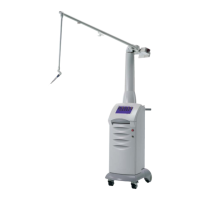
UltraPulse
0637-129-01, Revision G
80 UltraPulse
Energy Level and Fluence
In UltraPulse mode, fluence, or energy density, determines the nature of the
laser-tissue interaction. Fluence is defined as energy per unit area and is
measured in joules per square centimeter (J/cm
2
).
Ablation of tissue with minimal thermal artifact requires pulse fluence above
the ablation threshold of approximately 5 J/cm
2
.
1
In the following table,
which shows fluence values at various spot sizes and energy settings, the
shaded area highlights this critical range. Note, however, that for some
applications, the required fluence may be considerably higher.
WARNING - The table values are approximations and will vary with slight
changes in spot size. The table should not be used to set treatment parameters,
but simply as a guide to fluence and its relationship with laser energy and spot
size. Serious tissue damage can occur as a result of incorrect energy settings;
use the lowest acceptable energy settings until you understand the biological
interaction between the laser energy and tissue.
CAUTION - As indicated in the following table, fluence is inversely related to
spot size; for any constant energy setting, fluence will decrease as spot size is
increased. For this reason, any increase in spot size must be accompanied by a
corresponding increase in energy if an equivalent fluence is desired.
1. Fitzpatrick, R.E., J. Ruiz-Esparza, M.P. Goldman, “The Depth of Thermal Necrosis Using the
CO
2
Laser: A Comparison of the Superpulsed mode and the Conventional Mode.” Journal of
Dermatology and Surgical Oncology, 1991, Vol 17, pages 340-344.


 To Next Page