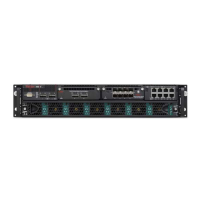
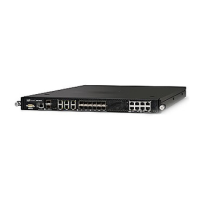
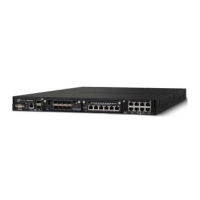
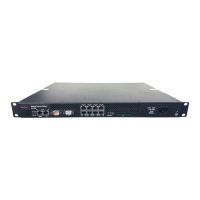
If you need to congure failover pair between sensors kept at distance greater than 1m, consider the following
options:
• For distances up to 3m, purchase QSFP28 DAC from external source
• For distances greater than 3m, purchase 40G SR4 transceivers from McAfee and ber cables from external
source
Task
1
Plug the cable(s) appropriate for use with your QSFP+ or QSFP28 module into port G0/1 (NS9500) of the
active NS-series Sensor.
2
Connect the other end of the cable(s) into port G0/1 (NS9500) of the standby NS-series Sensor.
Connect the cables for Sensor Fail-Open
The Fail-Open Kits minimize the potential risks of in-line Sensor failure on critical network links. You need to
purchase these kits separately. Both copper and optical versions of the kit are available for the one-gigabit
ports. The standard Gigabit Fail-Open Kits, 10 Gigabit Fail-Open Kits and 40 Gigabit Fail-open Kits are available
for the 1, 10, and 40 gigabit ports respectively.
The Monitoring ports of the Sensors can be fail-close; thus, if the Sensor is deployed in-line fail-close, a
hardware failure results in network downtime. Except the built-in RJ-45 ports which have the fail-open function
built-in as well, for the Monitoring ports to fail-open, you use the optional external bypass switch provided in an
Active Fail-Open Kit.
While the Sensor is operating, the Active Fail-Open kit is in-line and routes all trac directly through the Sensor.
When the Sensor fails, the switch automatically shifts to a bypass state; in-line trac continues to ow through
the network link but is no longer routed through the Sensor. After the Sensor resumes normal operation, the
switch returns to the "on" state, once again enabling in-line monitoring.
Sensor outage breaks the link connecting the devices on either side of the Sensor for a brief moment and
requires the renegotiation of the network link between the two peer devices connected to the Sensor. Depending
on the network equipment, this disruption introduced by the renegotiation of the link layer between the two peer
devices might range from a couple of seconds to more than a minute with certain vendors' devices.
A very brief link disruption might also occur while the links between the Sensor and each of the peer devices are
renegotiated to place the Sensor back in in-line mode. This outage, again, varies depending on the device, and
can range from a few seconds to more than a minute.
The performance of the switchover from in-line to bypass and vice versa varies depending on the
vendor.
You can nd the installation and troubleshooting instructions for the kit in the guide that accompanies the kit.
For example, for more information on the Optical kits, see the following guides:
• 1 Gigabit Optical Active Fail-Open Bypass Kit Guide
• 10 Gigabit Optical Active Fail-Open Bypass Kit Guide
• 40 Gigabit Optical Active Fail-Open Bypass Kit Guide
• Active Fail-Open Kit Quick Start Guide
• Passive Fail-Open Kit Quick Start Guide
Attaching cables to the Sensor
About connecting cables to the Monitoring ports
7
McAfee Network Security Platform
33



 To Next Page