

 Need help?
Do you have a question about the McQuay AGR 080AS and is the answer not in the manual?
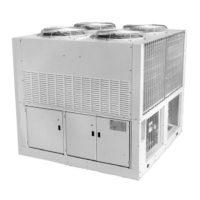
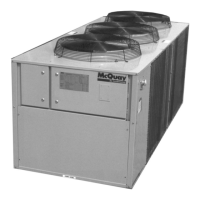
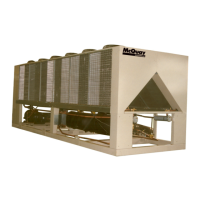
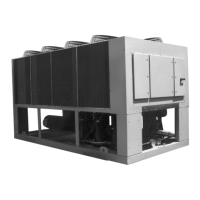
Overview of the McQuay Air-Cooled Global water chillers.
Procedure for checking units upon arrival for damage.
Safety warning regarding sharp edges and coil surfaces.
Guidelines for careful handling and lifting of the unit.
Recommendations for unit placement and foundation requirements.
Required air flow clearances for proper unit operation and servicing.
Methods to reduce noise transmission for sensitive applications.
Ensuring accessibility for periodic maintenance and servicing.
Caution regarding evaporator heating cable disconnect.
Caution regarding the type of glycol to be used.
Information on internal and external wiring.
Caution regarding internal power wiring and disconnects.
Initial checks before starting the unit.
Procedure for checking the water system.
Procedure for checking refrigerant lines and joints.
Procedure for verifying electrical connections and voltages.
Step-by-step procedure for starting the chiller.
Procedures for temporary and extended shutdowns.
Detailed description of the unit's operating logic.
Default setpoints for the Global UNT controller.
Information on controller software and interface kit.
Description of the optional hot gas bypass feature.
Description and service recommendations for filter driers.
Procedures for adjusting system superheat and subcooling.
Checking the sightglass for refrigerant charge and moisture.
Recommendations for field charging refrigerant.
Description of the expansion valve function.
Setting optimal superheat and subcooling values.
Caution regarding superheat adjustment.
Description of compressor crankcase heaters.
Description of the direct expansion water cooler.
Overview of the Global UNT microprocessor based controller.
Description of available optional sensors.
Details on sensor mounting and connection.
Information on low voltage control wiring.
Details on external voltage inputs for control.
Wiring requirements for field devices.
Checking and adjusting controller set points.
Overview of control panel interconnecting wiring.
Contractor responsibilities for unit power wiring.
Internal power supplies for controller circuitry.
Details on analog input signals and wiring.
Details on digital input signals and dry contacts.
Control logic for remote stop/start functionality.
Connection and function of the chilled water flow switch.
Description of controller digital outputs.
Connecting an audible alarm to the controller.
Connecting the controller to a computer for monitoring.
Identifying the controller software version.
Summary of controller inputs and outputs.
Detailed list of analog inputs and their ranges.
Detailed list of digital inputs and their states.
Description of relay board outputs and their functions.
Available controller reset options.
Description of the outside air reset function.
Description of the return water reset function.
Description of the zone temperature reset function.
Details on the remote reset input signal.
Details on the demand limit input signal.
Operation when remote stop/start is active.
Controller behavior in unoccupied mode.
Feature to limit stages during start-up.
Description of compressor staging logic.
Operation and conditions for chiller pumpdown.
Operation and alarms related to freeze protection.
Timers that affect compressor start sequences.
Control logic for condenser fans based on head pressure.
Using SpeedTrol for low ambient head pressure control.
Overview of circuit and system alarm conditions.
Alarms affecting individual refrigerant circuits.
Alarms affecting both refrigeration circuits.
Description of the optional Zone Terminal device.
Explanation of Monitor and Adjust operating modes.
How to view chiller settings and values.
How to change adjustable setpoints via the Zone Terminal.
Explanation of Zone Terminal interface elements.
Procedure for installing the plastic label insert.
Instructions for connecting the Zone Terminal.
How to connect the ZT to the controller.
How the ZT indicates alarm conditions.
General procedure for adjusting control settings.
Step-by-step guide to adjusting settings.
List of adjustable chiller parameters via Zone Terminal.
Definitions of Zone Terminal display terms.
Chart listing problems, causes, and corrective actions.
Overview of the MicroTech controller and its features.
Description of optional sensor packages available.
Information on MicroTech controller installation.
Details on MicroTech sensors and their connections.
Information on low voltage control wiring.
Signals for leaving water reset or demand limit.
Wiring for field devices like flow switches.
Checking and adjusting unit set points.
Optional kit for remote monitoring.
Description of optional thermistor sensor kits.
Types of interconnecting wiring for the control panel.
Contractor responsibilities for unit power wiring.
Internal power supplies for controller circuitry.
Details on analog input signals and wiring.
Details on digital input signals and dry contacts.
Control logic for remote stop/start functionality.
Connection and function of the chilled water flow switch.
Description of digital output board functions.
Optional relay for chilled water pump control.
Connecting an audible alarm to the controller.
Connecting the controller to a computer for monitoring.
Requirement for remote access phone line.
Identifying the controller software version.
Details on analog inputs and their ranges.
Detailed list of digital inputs and their states.
Description of relay board outputs.
Available controller reset options.
Default reset option for leaving water temperature.
Description of the return water reset function.
Details on the 4-20mA remote reset input signal.
Description of the outside air reset function.
Description of the ice mode reset function.
Limits stages during start-up to prevent overshoot.
Manual mode for turning the unit off.
Automatic operation for circuit 1, circuit 2 off.
Automatic operation for circuit 2, circuit 1 off.
Manual control of staging for circuits 1 and 2.
Description of compressor staging logic.
Control logic for condenser fans based on head pressure.
Alarms affecting individual refrigerant circuits.
Alarms affecting both refrigeration circuits.
Detailed description of the unit's operating logic.
Describes the various states when the unit is off.
Controller logic for initiating unit start-up.
Special start logic for low ambient conditions.
Controller logic for the pumpdown sequence.
Checks to be performed before unit start-up.
Procedure for setting HEX address switches.
Verification of control switch positions.
Checking ribbon cable connections.
Procedure for powering up the controller.
Procedure for temporary unit shutdown.
Procedure for extended unit shutdown.
Caution regarding protection against water circuit freezing.
Description of the keypad and display interface.
Explanation of the controller's menu tree structure.
How information is displayed on the LCD screen.
Breakdown of Status, Control, and Alarm menus.
Security procedure for changing menu entries.
Description of keypad key groups and functions.
Keys for quick access to strategic menus.
Keys for navigating between menus.
Keys for navigating between menu items.
Keys for making changes and clearing alarms.
Step-by-step example of keypad operation.
Explanation of various menus in the controller.
Menus providing chiller operating information.
Displays the unit's current operating status.
Displays the operating condition of refrigerant circuit #1.
Displays the operating condition of refrigerant circuit #2.
Displays evaporator and condenser water temperatures.
Displays circuit #1 refrigerant pressure readings.
Caution regarding parameter changes.
Selection of automatic or manual operating modes.
Adjusting leaving water set points and control band.
Continued adjustment of leaving water set points.
Setting soft loading parameters.
Setting lead-lag order and interstage timers.
Adjusting head pressure control set points.
Setting demand limit for cooling stages.
Setting the controller's internal time and date.
Setting daily start/stop times for automatic operation.
Entering holiday dates for schedule overrides.
Adjusting alarm set points and time delays.
General operating characteristic settings.
Menus for displaying alarm conditions.
Displays current alarm message for circuit #1.
Displays current alarm message for circuit #2.
Displays the last recorded alarm for circuit #1.
Displays the last recorded alarm for circuit #2.
Description of the Microprocessor Control Board (MCB).
Connection of digital inputs to the MCB.
Connection of analog inputs to the MCB.
Connection of digital outputs from the MCB.
Description of the MCB power input connector.
Description of MCB power supply fuses.
Information provided by MCB status LEDs.
Connection of the keypad/display interface to the MCB.
Procedure for setting HEX address switches.
Description of MCB communication ports A and B.
Description of the Output Board and its functions.
Details on power terminals for peripheral devices.
Using MCB status LEDs for diagnostics.
Troubleshooting when the red LED stays on.
Troubleshooting when red and green LEDs are off.
Procedures for diagnosing power supply issues.
Troubleshooting keypad and display issues.
Troubleshooting steps for LCD display clarity.
Troubleshooting steps for a non-functional backlight.
Troubleshooting steps for a blank or garbled display.
Troubleshooting analog input signal issues.
Troubleshooting steps when MCB doesn't read analog input.
Troubleshooting digital input signal issues.
Troubleshooting when MCB doesn't read digital input.
Troubleshooting issues with output boards.
Troubleshooting steps when one output LED fails.
Troubleshooting steps when all output LEDs are out.
Troubleshooting when LED is lit but output is not energized.
Troubleshooting when output is energized but LED is not lit.
Troubleshooting issues related to contact chatter.
Procedures for testing solid-state relays.
Overview of routine maintenance checks.
Information on compressor maintenance requirements.
Details on lubrication for unit components.
Procedure for tightening electrical terminals.
Maintenance of air-cooled condensers.
Procedure for observing refrigerant sightglasses.
Schedule outlining weekly, monthly, and annual tasks.
Safety caution for service personnel.
Recommendations for filter-drier replacement.
Service and replacement of liquid line solenoid valves.
Description of the evaporator component.
Recommendations for field refrigerant charging.
Steps for charging a moderately undercharged unit.
Chart listing common problems and corrective actions.


 To Next Page


 General